



News:
Brokerage
Posted: January 23, 2018
Watkins Glen to be part of Waterfront Revitalization Program–Part of Southern Tier plan to spur economic development
Albany, NY According to governor Andrew Cuomo, the village of Watkins Glen will be part of the Local Waterfront Revitalization Program to develop projects that will spur economic development in the community. The Local Waterfront Revitalization Program serves as a management program for the village’s treasured waterfront resources along the Seneca Canal system outlined in the Southern Tier Soaring Upstate Revitalization Initiative plan. The Local Waterfront Program is aimed to invigorate targeted New York areas with potential to grow into communities where the next generation of workers want to live, work, and play.
“Through our Local Waterfront Revitalization Program, we are laying the groundwork for the growth of the tourism industry in the Seneca Canal system,” governor Cuomo said. “The transformed Watkins Glen will be ready to offer a world class destination for thousands of tourists to visit year-round and will serve as an economic engine to keep the Southern Tier rising for decades to come.”
The Watkins Glen Local Waterfront Revitalization Program consists of an assessment of the village’s current and desired waterfront uses, identifying exceptional opportunities to grow the local economy, bolster waterfront access opportunities, and preserve the community vision of natural and cultural resources. The program also seeks to strengthen the relationship of Watkins Glen with Seneca Lake in light of the economic resurgence that is transforming the Southern Tier. While Watkins Glen is currently a summertime destination, the village intends to stretch the tourist season by increasing the attractiveness and accessibility of the village’s commercial areas and waterfront parkland well into the fall season.
The capital projects identified in this Local Waterfront Revitalization Program for Watkins Glen include:
• The rehabilitation of Clute Park bathhouse;
• Upgrades to the village’s public boat launch and marina; and
• Improvements to the Catherine Valley and the Queen Catherine Marsh Loop Trails that provide public access to the waterfront.
New York State has focused a variety of resources to help Watkins Glen advance the goals of the Local Waterfront Revitalization Program and re-imagine the community as part of the plan to create economic development in the southern region of the state. Schuyler County won a 2016 Environmental Protection Fund-Local Waterfront Revitalization Program grant for nearly $1.1 million for part of the first phase of Project Seneca. Schuyler County will use the funds to prepare a regional strategic plan that will generate job opportunities, development and tourism, benefiting local residents of Watkins Glen and Montour Falls.
As part of the overall economic development plan for the Southern Tier, the state also awarded over $1.3 million through the 2017 Environmental Protection Fund-Local Waterfront Revitalization Program to Schuyler County for the second phase of the proposed Project Seneca Redevelopment of the Village Seneca Lake Waterfront. Improvements will include design and construction of a four-season pavilion with restrooms and a commercial grade kitchen in Clute Park, as well as preparation of a Reuse Feasibility Study, exploring options for redevelopment of the soon to be decommissioned lakefront Waste Water Treatment Plant.
Watkins Glen was also selected as the second-round Downtown Revitalization Initiative winner for the Southern Tier region, which has directed $10 million to the Watkins Glen downtown.
The village is in the process of refining information from their Downtown Revitalization Initiative application to develop a list of projects suitable for funding. The program is designed to undertake redevelopment activities that will affirm the Watkins Glen downtown as an active, inspiring, and fun place to be.
The Department of State’s Office of Planning, Development & Community Infrastructure works in partnership with waterfront communities across the state through the Local Waterfront Revitalization Program. This partnership focuses on strengthening the local economy and expanding public access opportunities while protecting natural and cultural resources.
Tags:
Brokerage
MORE FROM Brokerage
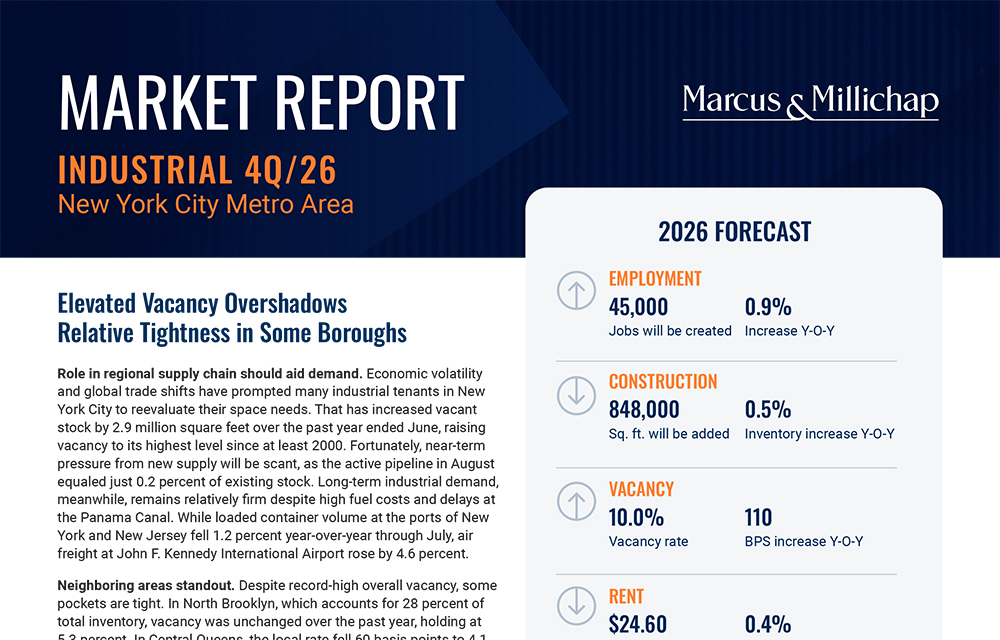
Marcus & Millichap releases fourth-quarter 2026 NYC industrial market report
Manhattan, NY Marcus & Millichap has published its fourth-quarter 2026 New York City Industrial Market Report. “New York City’s industrial market is showing a clear




Quick Hits
 (2).gif)

Columns and Thought Leadership

Hunt CRE question and answer: Choosing a real estate agent - by David Hunt
First, we will only work with one agent exclusively. The primary reason is that we want that agent to legally represent our client’s interests. In New York State, a real estate agent has a fiduciary

The art of investing in real estate - by Thomas Donovan
Real estate investing is as much an art as it is a skill. No one can time the market, or the factors that drive it, perfectly. Location, zoning, size, transportation, and neighborhood density give you a baseline for

Hunt commercial real estate question and answer: Fortune 500 wisdom - by David Hunt
Yes, there are lessons to be learned from the largest companies in America when comes to managing your real estate. But the decision to buy or lease real estate may not be one of

New York’s streets are full again, and the retail numbers prove it - by Noam Aziz
Walk down any New York block this year and you can feel it. The sidewalks are crowded, the storefronts are lit, and the energy that defines this city is back at full volume.
.gif)