



News:
Brokerage
Posted: January 28, 2025
Walls up, steel underway at Crow Holdings Golden Triangle Logistics Center
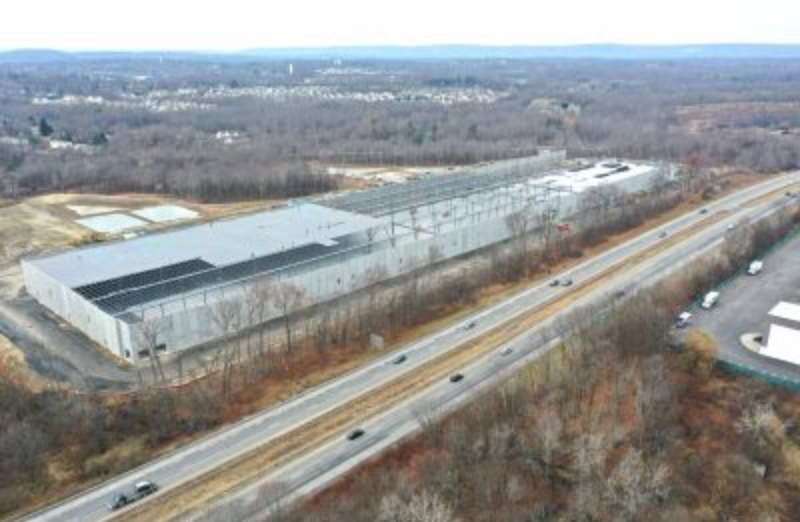
Wallkill, NY With walls up and steel installation underway, construction is progressing on track at Golden Triangle Logistics Center according to Crow Holdings Development. The class A, two-building warehouse/distribution property sits on 92 acres in Orange County and marks the company’s first New York State industrial venture.
Golden Triangle Logistics Center, located at 2 and 4 Katy Trail, is fully approved for 834,800 s/f. Situated at the intersection of I-84 and Rte. 17 (future I-86) 60 miles north of New York City, the campus offers reach to more than 50 million consumers in a day’s drive. This includes connectivity to service the Boston to Baltimore corridor.
“Orange County has come into its own,” said Crow Holdings Development’s Brad Vander Vliet, vice president. “The Hudson Valley is a natural extension of the Northern New Jersey market, while offering rents 30% lower, greater regional connectivity characteristics, and port proximity comparable to that of Exit 8A. A strong labor pool and reasonable taxes add to its appeal.”
Vander Vliet added that the market’s progress was instrumental in Crow Holdings Development purchasing in 2024. “In the past, this region posed barriers to entry from a cost standpoint,” he said. “However, market conditions have reached a point that justifies development. For us, Golden Triangle is a strong initial investment in Orange County and New York State as a whole.”
A summer 2025 delivery is anticipated for the property’s first, 535,600 s/f building, which is divisible. Checking every box for modern, world-class industrial product, it features 36-ft. ceiling heights, 88 dock doors, and parking for 83 trailers and 422 cars. Office space will be built to suit.
A JLL team headed by James Panczykowski and Rob Kossar is marketing the campus for lease to tenants or turnkey sale to users. Golden Triangle also includes plans for a second, 299,200 s/f building.
Crow Holdings’ Northeast regional presence is well established. Its projects also include 2900 Grant Ave. and Crow Holdings at I-95 in Philadelphia, as well as the recently completed Crow Holdings at Carteret in Carteret, N.J., 25 Market St. in Elmwood Park, N.J., and others comprising more than 3.5 million s/f of new development in New Jersey and Pennsylvania over the past two years.
Crow Holdings Development is the development platform of?Crow Holdings, a privately owned real estate investment and development firm with 75 years of history, $33 billion of assets under management, and an established platform with a vision for continued success. The company specializes in multifamily and industrial development across high-opportunity markets in the United States, with a newly launched office development platform as well. Led by a highly experienced leadership team, the firm has developed more than 72 million s/f of industrial space since 2013.??
Tags:
Brokerage
MORE FROM Brokerage

Law Firm Nutter expands space to 11,438 s/f at 5 Grand Central East
Manhattan, NY According to the Durst Organization, full-service law firm Nutter is expanding their office at 5 Grand Central East to 11,438 s/f. Nutter will take the entire 25th floor, in addition to renewing the firm’s existing office space on the 27th floor of the building.




 (2).gif)

Columns and Thought Leadership

A guide to finding the right NYC property management company - by Sanjay Gandhi
Being a small to midsize landlord in NYC is an increasingly demanding endeavor. From navigating complex regulations, increased compliance demands to dealing with tenant issues and remediating violations. It is wise to enlist the assistance of a partner, a professional

New York’s streets are full again, and the retail numbers prove it - by Noam Aziz
Walk down any New York block this year and you can feel it. The sidewalks are crowded, the storefronts are lit, and the energy that defines this city is back at full volume.

Hunt commercial real estate question and answer: Fortune 500 wisdom - by David Hunt
Yes, there are lessons to be learned from the largest companies in America when comes to managing your real estate. But the decision to buy or lease real estate may not be one of

Positive forecast for New York’s pro-housing push? - by Philip Butler
New York’s housing crisis remains a hot button topic despite growing consensus that varied and affordable housing is desperately needed statewide. Governor Hochul has recently introduced several initiatives to overcome N.Y.’s anti-housing
.gif)