



News:
Brokerage
Posted: April 5, 2016
Uniland Development completes 330,000 s/f mixed-use building – $113 million project
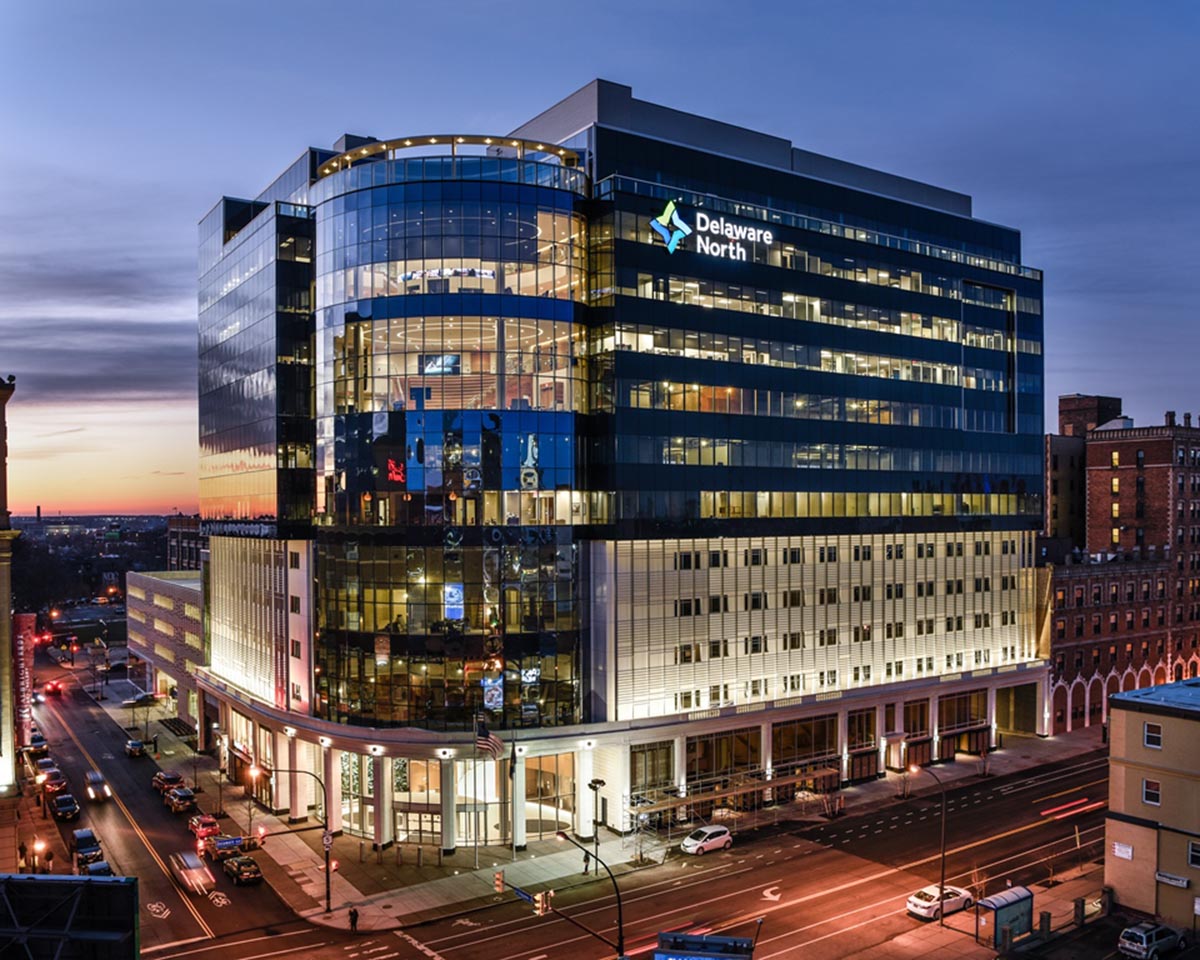 250 Delaware Avenue - Buffalo, NY
Buffalo, NY Uniland Development Co. has completed the 12-story, 330,000 s/f mixed-use building at 250 Delaware Ave. The project covers an entire city block to provide class A office, retail, hospitality, and secure parking in the downtown area. The complex, situated on a former Brownfield site, includes 193,000 s/f class A office and 18,000 s/f retail space, a 7,000 s/f outdoor courtyard, and a five-story parking ramp with 593 car parks and is fully-leased. The project cost was $113 million.
In January 2014, Uniland Construction Corp. removed asbestos and other contaminants from the two-story structure on the site to make way for the new complex.
The project was developed by the property owner, Uniland Development Co., and designed by Diamond Schmitt Architects.
Designed to achieve LEED Silver certification, the facility’s lobby features one of the areas’ largest living wall of hydroponic plants to purify and hydrate the air circulating in the building. The building was designed to strike a balance between modern and classic by enclosing it with a 12-story elliptical glass element and terracotta.
Additionally, Uniland replicated 3,200 pieces of the previous building’s two-story, detailed terracotta façade to pay homage to the previous building which dates back to 1913 and once housed offices of the city’s most notable architects, designers and engineers.
The office portion of 250 Delaware was 99% leased when its first floors opened on November 1, 2015, and Delaware North occupied the top five floors to create its new global headquarters. Other tenants include KeyBank retail and office, UBS Financial, The Cullen Foundation and the Government Services Administration. Delaware North will also operate The Westin Buffalo on the property and a full-service restaurant with catering. The hotel and restaurant are expected to open in the summer of 2016.
Tags:
Brokerage
MORE FROM Brokerage

Ones To Watch: Innovators In Commercial Real Estate: Lisa Nickerson, Infinityy
What I’m most proud of is the human impact of what we’re building. Technology should do more than improve efficiency — it should make


Quick Hits

Columns and Thought Leadership

Hunt commercial real estate question and answer: Fortune 500 wisdom - by David Hunt
Yes, there are lessons to be learned from the largest companies in America when comes to managing your real estate. But the decision to buy or lease real estate may not be one of

New York’s streets are full again, and the retail numbers prove it - by Noam Aziz
Walk down any New York block this year and you can feel it. The sidewalks are crowded, the storefronts are lit, and the energy that defines this city is back at full volume.

The art of investing in real estate - by Thomas Donovan
Real estate investing is as much an art as it is a skill. No one can time the market, or the factors that drive it, perfectly. Location, zoning, size, transportation, and neighborhood density give you a baseline for

Hunt CRE question and answer: Choosing a real estate agent - by David Hunt
First, we will only work with one agent exclusively. The primary reason is that we want that agent to legally represent our client’s interests. In New York State, a real estate agent has a fiduciary
.gif)