



News:
Brokerage
Posted: December 9, 2014
Tips for first time investors in New York real estate
The following are tips for first time investors in New York real estate:
1. Don't only buy on today
Buy on the future upside of a property. A potential buyer of an investment property needs to do their due diligence and look at the history of the area especially the past and current demographic trends.
2. Purchase a Property Needing Renovation
Buying property that needs renovation allows the buyer a tremendous opportunity and leverage to negotiate a better purchase price. There can be a circumstance where you purchase a property for $100,000 and you put in $300,000 for renovation and then sell it for $1 million.
Make your offer contingent upon having an engineer doing an inspection first (cannot emphasize how important this is). A home inspection is completely different. An engineer will test the structure. Also, ensure that you have an environmental expert to test the land and water. If a buyer doesn't do their due diligence on these fronts, they stand to lose a substantial amount of money.
3. Put as Little Money Down as Possible
Put as little money down that the purchase will allow because after the buyer fully occupies the property, the new rents rolling in will bring in revenue. The tenants and the owner should do a cash out refinance allowing the investor to use that money to purchase another property.
You want the banks to work for you and now money is so cheap to borrow.
If the property is a four family and under, you can get a residential loan. If it's a five family or over, it's considered a commercial property and you need to get a commercial loan and the minimum down payment is 30% (a lot of buyers don't even know this).
If you are buying a 6 family unit, you can get a 15-year fixed loan on a commercial mortgage (you cannot get at 30-year fixed-rate) at around 4.5 - 4.75%.
If you purchase a 1-4 family unit, you can put down 20% and get around 4% for a 30-year fixed-rate mortgage. If you can put more money down great but, why put all your eggs in one basket? If you have more money you can invest it in another property.
4. 6% Cap-rate of Return
Try to buy a property with a minimum of a 6% cap-rate of return meaning take your net potential income, divide that number into the purchase price and that gives the investors their rate of return
5. Location & Public Transportation
Find property in up and coming areas near public transportation that are on the outskirts of really hot real estate markets. Buying in best locations is very competitive and chances are the investors will not get the best deal in this market. There is always someone that has more money than you in hot real estate market areas.
When Not To Invest in
New York Real Estate
Crime - An area's crime rate is a huge indicator of whether or not you'll see a return on investment. The higher the crime rate, the less likely you'll be successful.
Proximity to Transportation - If your property is too far from the train or bus line, it's perceived as a high negative.
Environmental Concerns - If there is anything related to an environmental hazard, if the air is difficult to breathe, if the area is saturated in an unpleasant odor from anything industrial - this will hurt your chances of seeing a return on investment.
At Auctions - Avoid buying properties at "as is" auctions where you don even get an engineers inspection. If you can't get engineers inspection, walk away. Also keep in mind that there is always someone at the auction with more money than you.
Blocks & Hurdles - If you are trying to get a property and there are all these hurdles and roadblocks in the way (unexpected headaches), its likely not the deal for you. When things flow seamlessly, it's the right deal.
What Are The Three Hottest Locations For Real Estate Investing In New York?
Bushwick, Brooklyn - Because if borders Williamsburg (a very hot & trendy area), five years ago many investors became fixated on Bushwick. Their instincts were right as Bushwick is now thriving.
Ridgewood Queens - Really booming because of the type of architecture there. Its close proximity to Manhattan and the type of people (young adults) are also driving up the value. Prices in Ridgewood are about 30-40% less than you would have to spend on a property n most parts Brooklyn.
Bedford Stuyvesant, Brooklyn - Really starting to pick up. Property values are soaring. It's where many people are doing the buy and flip. They are buying the 2-3 family brownstone at low cost, renovating them and renting them. Great area to invest.
Chris Pepe is the president and lead broker of NC Pepe Corp., New York, N.Y.
Tags:
Brokerage
MORE FROM Brokerage
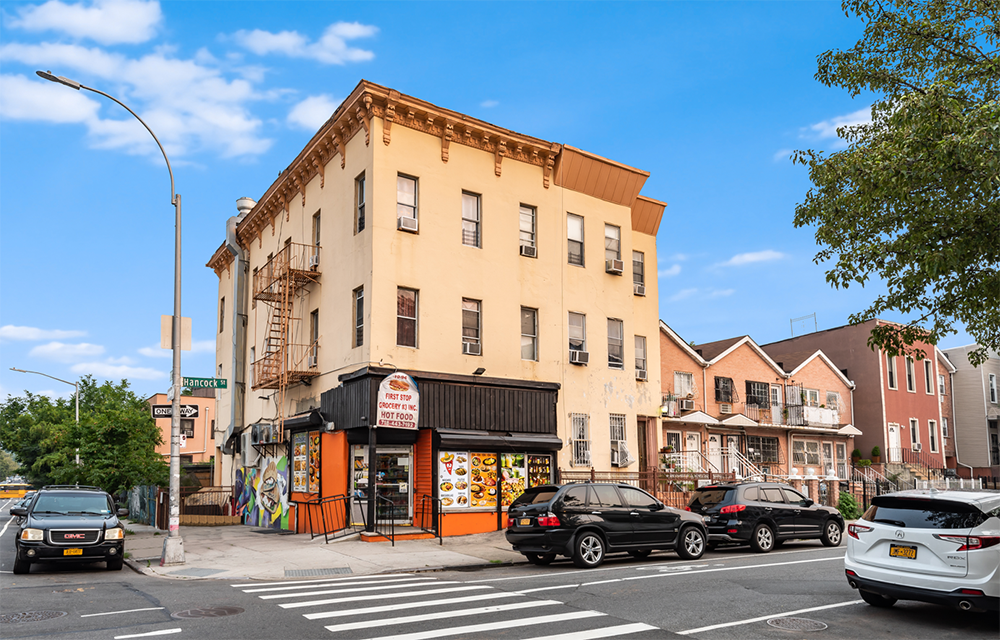
Investment Property Realty Group closes $1.75 million sale of 1094 Hancock Street in Brooklyn
Brooklyn, NY Investment Property Realty Group (IPRG), a New York-based commercial investment firm, has closed the sale of 1094 Hancock St., a mixed-use building in the Bushwick section, for $1.75 million.


Quick Hits
 (2).gif)

Columns and Thought Leadership

A guide to finding the right NYC property management company - by Sanjay Gandhi
Being a small to midsize landlord in NYC is an increasingly demanding endeavor. From navigating complex regulations, increased compliance demands to dealing with tenant issues and remediating violations. It is wise to enlist the assistance of a partner, a professional

New York’s streets are full again, and the retail numbers prove it - by Noam Aziz
Walk down any New York block this year and you can feel it. The sidewalks are crowded, the storefronts are lit, and the energy that defines this city is back at full volume.

Hunt commercial real estate question and answer: Fortune 500 wisdom - by David Hunt
Yes, there are lessons to be learned from the largest companies in America when comes to managing your real estate. But the decision to buy or lease real estate may not be one of

Hunt CRE question and answer: Choosing a real estate agent - by David Hunt
First, we will only work with one agent exclusively. The primary reason is that we want that agent to legally represent our client’s interests. In New York State, a real estate agent has a fiduciary
.gif)