



News:
Brokerage
Posted: December 20, 2016
There is always someone who knows more than you by Mark Schnurman
 Mark Schnurman, Eastern Consolidated
I do a lot of negotiating, and think I am pretty good at it. In sales, recruiting and real estate in general, we work in a world built on negotiations with some of the best negotiators in the world.
I believe that negotiation comes down to understanding leverage–who has more, what it is and how important it is to the other party. Generally, the party with more leverage has a unique advantage but one that can easily be squandered. Positional power is important in leverage, but so is knowledge. Understanding time and how it creates scarcity is also of critical import. Finally, knowledge of the product, the other parties needs and several other factors plays a part.
I recently decided I was going to buy a truck. Cars are not my thing and I buy them so rarely that I don’t know much about negotiating for them. In other words, my knowledge, actually the lack of any, put me at a disadvantage. I needed help and I knew it.
The confluence of a quick call to a friend for advice on car negotiation coupled with an Internet search saved me almost 10% on the purchase. I can only wonder how many 10%’s I paid by not seeking advice.
By learning the basics of car negotiation I saved myself thousands of dollars. It also helped to highlight the reality of our business–that many of buyers, sellers and brokers don’t prepare well enough for due diligence, negotiations or financing requirements to properly secure the best deal for themselves.
It’s an interesting realization, because I pride myself on not extrapolating any narrow skills that I have into other areas. Yet, I realize that I do this with regularity when I think I can negotiate without facts.
So what can you do to avoid this?
First, know your limits. If you think you can do anything and everything, you are wrong. Hubris leads to avoidable epic failures.
Second, when you don’t know something do not fake it. Learn by engaging others more knowledgeable. Asking questions is virtuous. Get help and advice from experts–other brokers, owners, analysts, attorneys, etc. There is always someone who knows more than you.
Third, do your own independent research. There are a myriad of resources that can help explain the nuances on New York City real estate. So whether you tap into the general Internet, information sources, such as CoStar, Property Shark or Reonomy or government websites, there is a ton of research you can do on your own.
Finally, no matter how good a negotiator you are you can always be better. I find that simply bouncing ideas off of others helps me get good advice, and also serves to clarify my thoughts and strategies.
Mark Schnurman is chief sales officer and principal at Eastern Consolidated, New York, N.Y.
Tags:
Brokerage
MORE FROM Brokerage
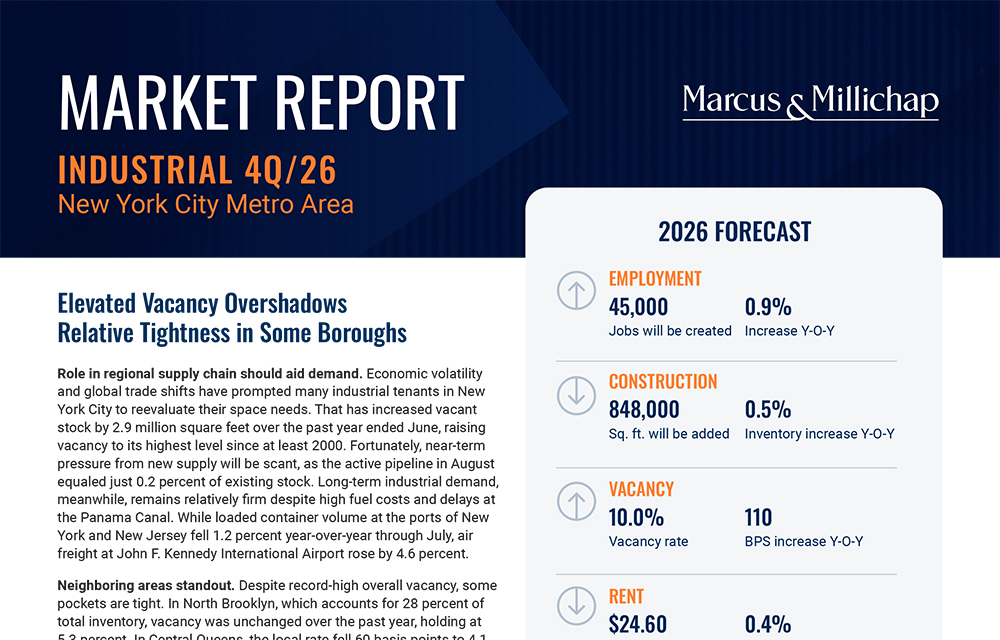
Marcus & Millichap releases fourth-quarter 2026 NYC industrial market report
Manhattan, NY Marcus & Millichap has published its fourth-quarter 2026 New York City Industrial Market Report. “New York City’s industrial market is showing a clear






Columns and Thought Leadership

The art of investing in real estate - by Thomas Donovan
Real estate investing is as much an art as it is a skill. No one can time the market, or the factors that drive it, perfectly. Location, zoning, size, transportation, and neighborhood density give you a baseline for

Hunt CRE question and answer: Choosing a real estate agent - by David Hunt
First, we will only work with one agent exclusively. The primary reason is that we want that agent to legally represent our client’s interests. In New York State, a real estate agent has a fiduciary

New York’s streets are full again, and the retail numbers prove it - by Noam Aziz
Walk down any New York block this year and you can feel it. The sidewalks are crowded, the storefronts are lit, and the energy that defines this city is back at full volume.

Hunt commercial real estate question and answer: Fortune 500 wisdom - by David Hunt
Yes, there are lessons to be learned from the largest companies in America when comes to managing your real estate. But the decision to buy or lease real estate may not be one of
.gif)