



News:
Brokerage
Posted: October 27, 2008
There are plenty of houses for sale: Just show me the money
More front lawns in my New Rochelle neighborhood have sprouted "For Sale" signs than I have ever seen, collectively, in the ten years that I have lived in this cradle to grave neighborhood.
Normally, this would be a textbook definition of a "buyers' market." Now, if only the buyers could find and get the mortgage money that they need! The government's $700 billion financial market bailout is expected to alleviate some of the banks' borrowing jitters but that's not happening, yet. Until then, there are steps that Realtors can take to educate both their buyers about how to get their financial house in order before they go shopping for a mortgage.
Edward Gajdosik, senior lending consultant, consumer lending mortgage, Citibank N.A., said, "In general, more fear has taken over than need be. Certain types of mortgages are very difficult, if not impossible, to get. No income verification, no documentation loans, sub-prime, 100% financing - almost all are non-existent. For the average homeowner putting 20% down, they're still getting the mortgages. The way pricing is, the most competitive mortgage is the 30-year or 15-year fixed. Banks are most comfortable with selling those. "But," Gajdosik adds, "the big uncertainty is pinpointing the rate. We could have four changes a day, just like in the stock market."
"For people with credit scores in the low to mid-600's, or looking for financing over 90%, FHA loans have become much more popular with the larger banks," said Gajdosik. "It's more challenging now, but it can still be done if the credit is good."
But putting 20% down on a house in Westchester is pretty tough to do - even in this market. There aren't too many $400,000 or even $500,000 properties available in the county and for most people who are looking in this price range, what's the likelihood that they have been able to save $80,000 to $100,000?
"I tell my clients that if their credit report shows an outstanding $80 cell phone bill, for example, pay it. "Even if it's on a phone that they no longer have and dispute the charges," said Robert Castro, a mortgage consultant, with Lending Resources, Inc., New Rochelle.
Castro is a very affable and conscientious young man, the kind of person who someone who is either looking to secure or underwrite a mortgage is going to want to do business with. So I am fairly certain that he personally is not the reason why his pool of lenders "has shrunk from 75 or more banks, a year-and-a-half ago to less than ten lenders, today," he said.
"All of the sub-prime lenders are gone. That's a good thing. There should have been more rules and regulations," said Castro. He says he now spends more time going over people's credit reports to show them what they can do to clean up their credits, like that outstanding cell phone bill.
"You want to be 'clean' on your mortgage application. You want to be as debt-free as you possibly can. Don't max-out your credit cards. Don't have any outstanding judgments against you," he said. "It's easier to qualify if you have less debt (no more than 45% debt to income ratio), so you may want to take some of your liquid assets to pay down debt and then apply for a bigger mortgage."
Both lenders advise people to update their credit scores and not to rely on one credit bureau alerting the other two of the big three. Lenders can't do this for you for reasons of conflict of interest.
"99% of the time" and I wouldn't hold his feet to the fire about this projection - Castro says that borrowers can take care of credit report blemishes to raise their scores before applying for a mortgage. It may still take six months or more of responsible spending and bill-paying habits that error on the side of fiscal conservatism before an otherwise shaky buyer can approach a bank or third-party mortgage broker with confidence.
Rob Seitz is an agent at Goldschmidt & Associates, Scarsdale, N.Y.
Tags:
Brokerage
MORE FROM Brokerage
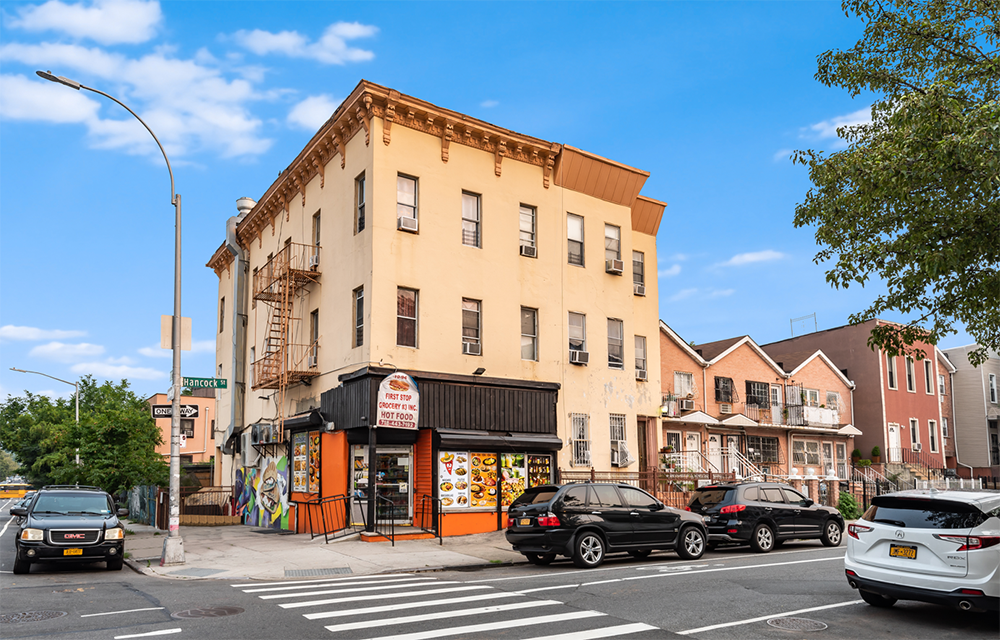
Investment Property Realty Group closes $1.75 million sale of 1094 Hancock Street in Brooklyn
Brooklyn, NY Investment Property Realty Group (IPRG), a New York-based commercial investment firm, has closed the sale of 1094 Hancock St., a mixed-use building in the Bushwick section, for $1.75 million.




Columns and Thought Leadership

Hunt commercial real estate question and answer: Fortune 500 wisdom - by David Hunt
Yes, there are lessons to be learned from the largest companies in America when comes to managing your real estate. But the decision to buy or lease real estate may not be one of

A guide to finding the right NYC property management company - by Sanjay Gandhi
Being a small to midsize landlord in NYC is an increasingly demanding endeavor. From navigating complex regulations, increased compliance demands to dealing with tenant issues and remediating violations. It is wise to enlist the assistance of a partner, a professional

Hunt CRE question and answer: Choosing a real estate agent - by David Hunt
First, we will only work with one agent exclusively. The primary reason is that we want that agent to legally represent our client’s interests. In New York State, a real estate agent has a fiduciary

New York’s streets are full again, and the retail numbers prove it - by Noam Aziz
Walk down any New York block this year and you can feel it. The sidewalks are crowded, the storefronts are lit, and the energy that defines this city is back at full volume.
.gif)