



News:
Brokerage
Posted: October 17, 2023
The stage is set for C-PACE in New York - by Michael Doty

The commercial real estate industry is catching on to the value of C-PACE - and an increasing number of owners and developers are turning to the mechanism to help finance their projects. But in New York City, commercial property owners and developers face a different set of hurdles, and the C-PACE industry eagerly awaits the ability to help the city meet its climate goals.
What is C-PACE?
Commercial Property Assessed Clean Energy (C-PACE) is a state policy-enabled financing mechanism that allows commercial building owners and developers to make energy-related equipment upgrades in their existing buildings, support construction costs for new, low-carbon buildings, and make onsite renewable energy accessible and cost-effective.
The program starts with a state-level government policy that classifies efficient, resilient, or clean energy upgrades as a public benefit – like a road, a water line, or streetlights. These upgrades can be financed with no money down from the building owner and then repaid as a benefit assessment charge on the property over a term that matches the useful life of improvements and/or new construction infrastructure (typically ~20-30 years). The assessment transfers upon sale of the property and can be passed through to tenants where appropriate.
C-PACE offers low-cost, fixed-rate, long-term financing, and it is growing in popularity across the country as it is one of the least expensive forms of financing, while also enabling property owners to comply with sustainability mandates by providing an efficient source of capital. C-PACE also enables CRE owners and developers to increase their property value, while helping to address growing tenant demand for modernized, sustainable buildings.
C-PACE can also act as an economic driver for communities, by supporting the creation of jobs through projects that may not otherwise have been able to move forward and facilitates the adaptive reuse of historic properties. In the face of recent economic uncertainty, C-PACE is also providing welcome relief to commercial real estate owners and developers seeking capital to complete their projects.
C-PACE in New York City
While C-PACE is currently available in 38 states, including New York state - and an increasing number of states and municipalities are making the program available - the program has hit some road bumps in New York City.
In 2019, New York enacted one of the most ambitious decarbonization plans in the country – to reduce greenhouse gas emissions by 40% by 2030, and by 80% by 2050 through Local Law 97, which was part of the Climate Mobilization Act. Property owners with buildings above 25,000 square feet would face steep fines if they did not comply with the mandates. To help finance and address the mandates, C-PACE was adopted by the city through Local Law 96 to act as a ‘carrot’ for property owners to have a source of funds available to make the necessary capital improvements to meet these strict new requirements.
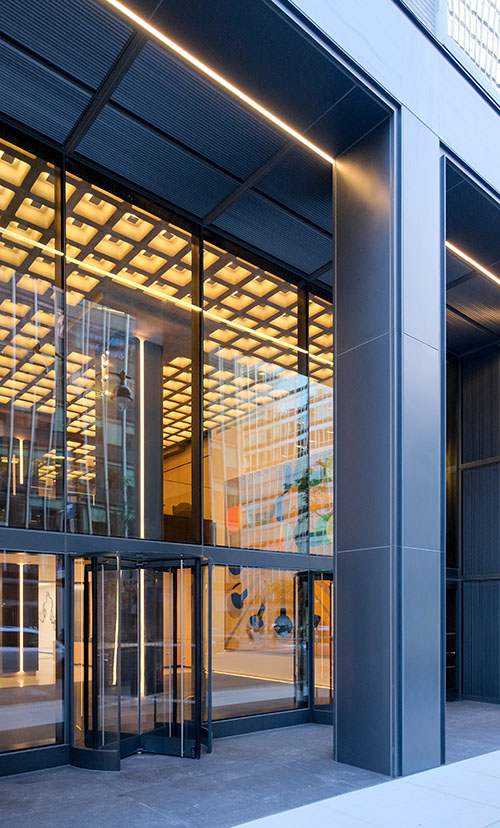
As an example, in 2021, Nuveen Green Capital provided $28M in C-PACE financing to fund extensive sustainability measures for parent company, TIAA / Nuveen’s financial services headquarters at 730 Third Avenue. The use of C-PACE enabled Nuveen to retrofit the building to become a LEED Gold-certified, state-of-the art, energy-efficient building, while avoiding hefty fines associated with LL97.
While the stage seemed perfectly set for C-PACE in New York, after the closing of 730 Third Avenue, the program paused, with repeated delays in publishing final program guidelines that determine what improvements are eligible in the City, and what forms the property owners would use to close on their financing. NYC published these guidelines for retrofits of existing buildings in the summer of 2023, and recently finalized rules for the construction of new buildings, thus fully reopening the program.
Coming alongside the publishing of rules around how LL97 fines will be established, challenges and opportunities still remain for NYC’s C-PACE program. NYC’s C-PACE rules follow state guidelines which require all energy-related upgrades financed through the program be ‘cost-effective’ based upon utility bill savings; an outdated approach that does not address deep building decarbonization or electrification. Many LL97 projects still cannot access C-PACE to finance their full costs for this reason.
Now, policymakers are awaiting word on a potential bill 'S5974' to be passed that would modify the New York State rules to allow C-PACE to fund a broader set of decarbonization, electrification and climate resiliency improvements. Should this state-wide legislation be passed, the industry will be significantly better poised to support New York City’s climate goals.
C-PACE in New York State
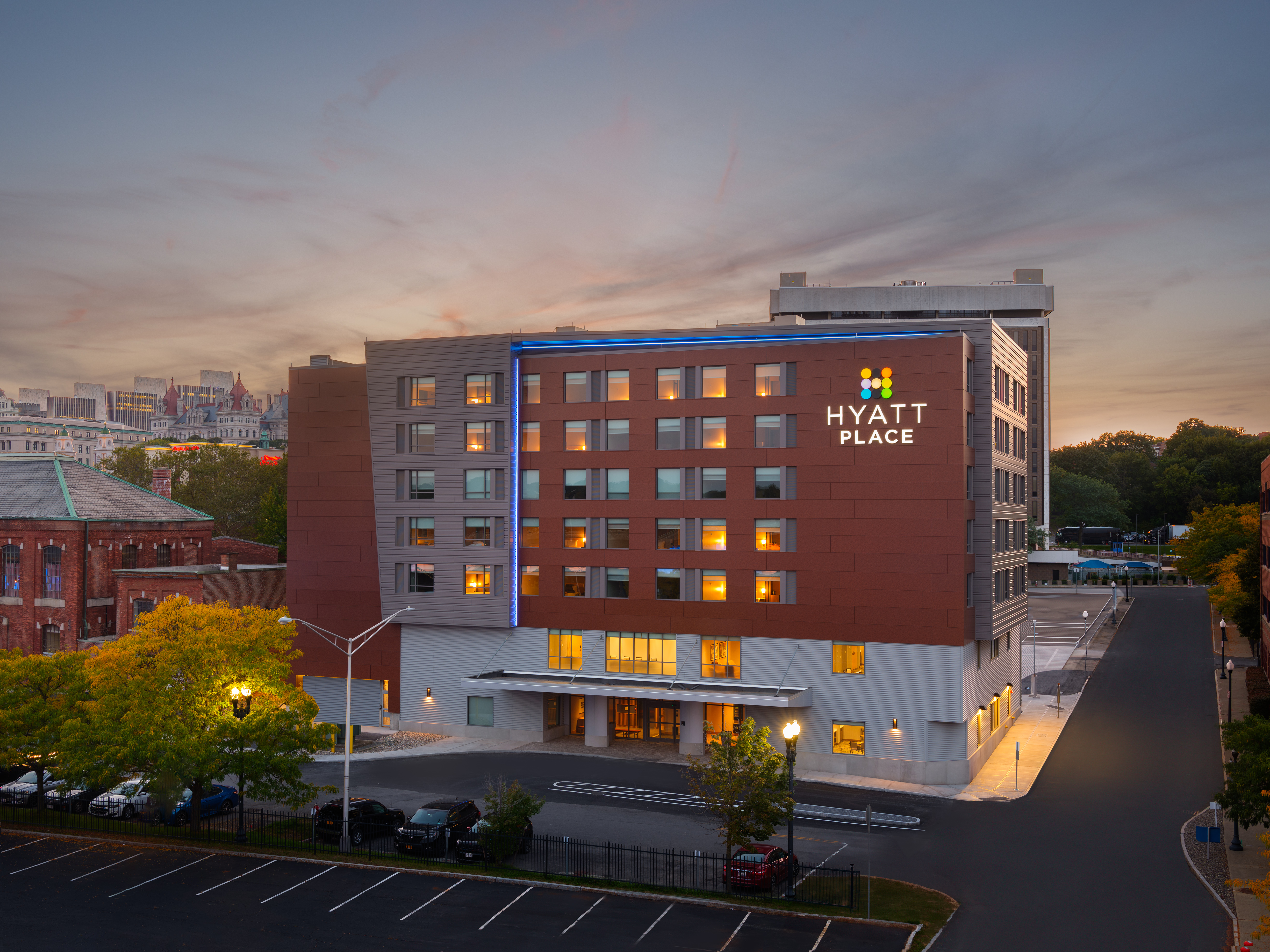
At the state level, C-PACE is active in multiple communities where it is providing benefits to CRE owners and developers. Last year, Nuveen Green Capital provided $6.4M in C-PACE financing for the new, fully electrified Albany Hyatt Place Hotel in the state’s capital, which also marked the first C-PACE financed deal alongside the New York Green Bank. Located in downtown Albany, the project is estimated to have created ~120 construction jobs and will help serve the needs of travelers in and around the city.
As we see success stories in New York and other states, such as Pennsylvania, California, and Texas, they demonstrate the power of C-PACE as a triple-win solution to provide owners and developers with efficient financing, while enabling them to address sustainability mandates as they build greener buildings – all of which, in turn, helps the environment.
The stage is set
As the New York CRE industry catches a glimpse of C-PACE’s impact, the groundswell of attention and positive impact around decarbonization will ideally continue to set the stage for C-PACE to help the city achieve its climate goals in the near-future.
For more information on C-PACE, visit: nuveen.com/greencapital
Michael Doty is a senior director, originations at Nuveen Green Capital, Darien, CT.
Tags:
Brokerage
MORE FROM Brokerage
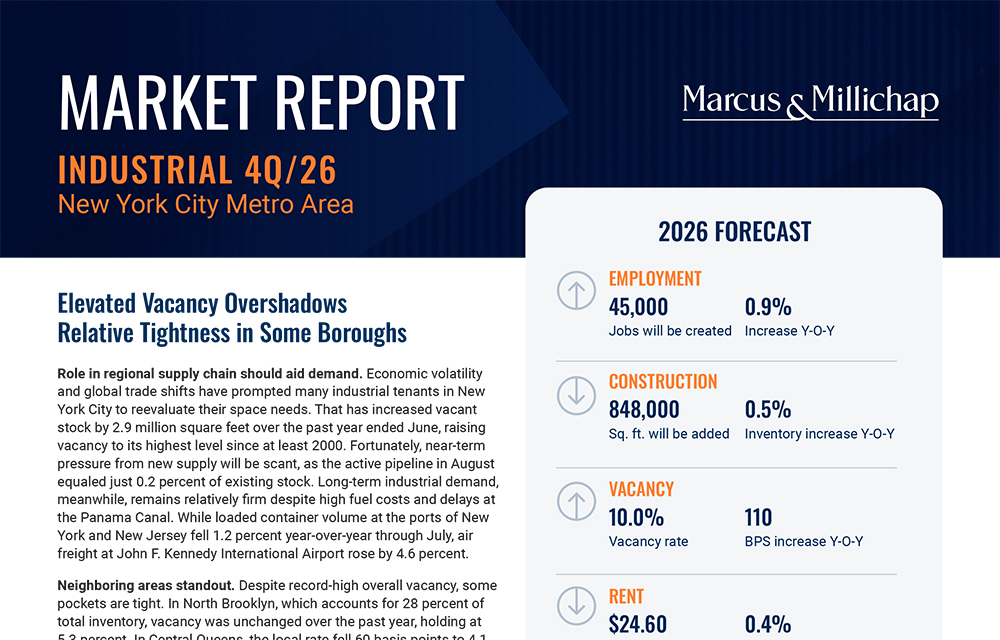
Marcus & Millichap releases fourth-quarter 2026 NYC industrial market report
Manhattan, NY Marcus & Millichap has published its fourth-quarter 2026 New York City Industrial Market Report. “New York City’s industrial market is showing a clear




 (2).gif)

Columns and Thought Leadership

New York’s streets are full again, and the retail numbers prove it - by Noam Aziz
Walk down any New York block this year and you can feel it. The sidewalks are crowded, the storefronts are lit, and the energy that defines this city is back at full volume.

Hunt commercial real estate question and answer: Fortune 500 wisdom - by David Hunt
Yes, there are lessons to be learned from the largest companies in America when comes to managing your real estate. But the decision to buy or lease real estate may not be one of

Hunt CRE question and answer: Choosing a real estate agent - by David Hunt
First, we will only work with one agent exclusively. The primary reason is that we want that agent to legally represent our client’s interests. In New York State, a real estate agent has a fiduciary

The art of investing in real estate - by Thomas Donovan
Real estate investing is as much an art as it is a skill. No one can time the market, or the factors that drive it, perfectly. Location, zoning, size, transportation, and neighborhood density give you a baseline for
.gif)