



News:
Brokerage
Posted: October 17, 2023
The Safe Center collabs with local landlords to provide emergency housing for domestic violence surviviors

Bethpage, NY In observation of National Domestic Violence Awareness Month in October, The Safe Center, a 501 (c)(3) nonprofit, the leading victim service organization on Long Island, is working with Nassau County, NY landlords to expand its “Rapid Rehousing Program” to provide emergency housing to people seeking to escape domestic violence situations who may have nowhere to live.
“One of the biggest barriers to escaping domestic and intimate partner violence (DV/IPV) and abuse is the question of where a victim will go once they leave,” said Elizabeth Bazini, assistant director of Housing at The Safe Center, which helps administer the Rapid Rehousing Program in Nassau County. “Escaping an abusive environment is an enormous act of courage. But for many survivors, that decision can be complicated – and even short-circuited – by the long-term prospects of finding somewhere to live.”
The program assists survivors in securing safe and reliable housing and provides a rent subsidy for a time-limited basis. Participants pay a reduced monthly rent, with modest monthly increases, with the goal that participants pay full rent upon program completion. It is an effective, step-up style program for people who need time-and income-based, progressive rental assistance to help them achieve and maintain housing stability and eventual self-sufficiency. The program relies on landlords to make available unoccupied rental units in their buildings to The Safe Center, which in turn can place survivors (and their children) in need of housing a place to live while they receive counseling, services and help find a permanent home.
“Evidence tells us there are far more victims of domestic violence, interpersonal abuse, child abuse and human trafficking than is obvious on Long Island. We see them every day,” said Joshua Hanson, executive director of The Safe Center. “Abuse adheres to no bounds, whether racial, ethnic, financial, or otherwise. Programs that help survivors need everyone’s participation to be effective.”
Unsurprisingly, landlords play a crucial role in the success of this program. By opening the doors of their residential properties, they provide affordable, safe, and stable housing options, breaking the cycle of violence and enabling survivors to begin rebuilding their lives. Case managers work closely with clients throughout their tenancy to help survivors find employment and make the journey to complete self-sufficiency.
The landlords reap benefits as well, receiving rental subsidies, security deposits and guaranteed rental income as well as the knowledge that they are helping people turn difficult pages in their lives.
“We are happy to help and be able to offer units as it's our way of keeping our mother’s spirit alive and know first-hand how difficult it can be to find a safe space for women and their children,” said Jaret Martino, founder of Stronger Than Pretty LLC and son of DV survivor.
“We’re renting with a cause, not just reneging to fill an apartment, renting to give someone a chance to start over and be secure. Great communication with the safe center staff and reliability on any concerns,” said Richard Etienne, of MY Builder Loan, which works with The Safe Center to offer apartments to survivors in need.
Because DV and IPV are deeply rooted in power and control, victims of domestic violence or abuse may have had their movements and choices restricted by their abusers. As a result, they may have no income or employment history and therefore no ability to help them rent an apartment, find work, or build their resume and credit history.
Together, this network of support and understanding helps everyone at every milestone, empowering survivors of domestic violence to break free from their abusive environments and encouraging more landlords to play an active role in fostering safe havens and brighter futures for those in need.
Tags:
Brokerage
MORE FROM Brokerage
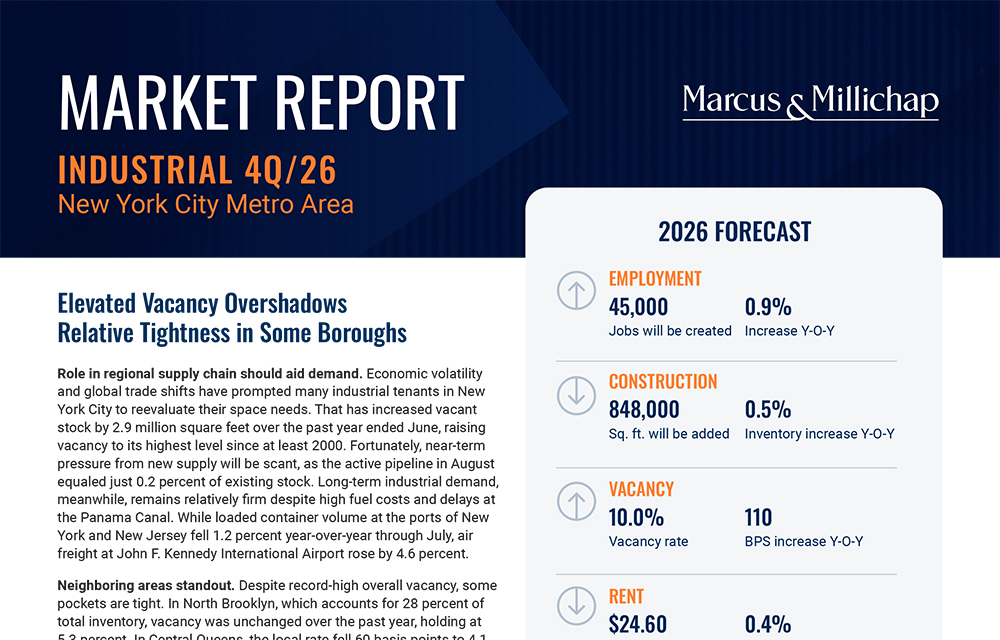
Marcus & Millichap releases fourth-quarter 2026 NYC industrial market report
Manhattan, NY Marcus & Millichap has published its fourth-quarter 2026 New York City Industrial Market Report. “New York City’s industrial market is showing a clear






Columns and Thought Leadership

Hunt commercial real estate question and answer: Fortune 500 wisdom - by David Hunt
Yes, there are lessons to be learned from the largest companies in America when comes to managing your real estate. But the decision to buy or lease real estate may not be one of

The art of investing in real estate - by Thomas Donovan
Real estate investing is as much an art as it is a skill. No one can time the market, or the factors that drive it, perfectly. Location, zoning, size, transportation, and neighborhood density give you a baseline for

New York’s streets are full again, and the retail numbers prove it - by Noam Aziz
Walk down any New York block this year and you can feel it. The sidewalks are crowded, the storefronts are lit, and the energy that defines this city is back at full volume.

Hunt CRE question and answer: Choosing a real estate agent - by David Hunt
First, we will only work with one agent exclusively. The primary reason is that we want that agent to legally represent our client’s interests. In New York State, a real estate agent has a fiduciary
.gif)