


 (2).gif)
News:
Spotlight Content
Posted: July 19, 2016
The rise of the office condominium market: Significant savings, tax exemptions and control by Michael Rudder
 Michael Rudder, Rudder Property Group
New York City office rents have climbed to record highs in recent years and average rental rates have exceeded $72 per s/f. Whether a burgeoning small company or an established brand, many businesses cannot support the drastic increase in the cost of leasing office space. These businesses are looking for a more stable and ultimately profitable solution.
Purchasing an office condominium can stabilize a business’s expenses and allow them to have control of their future.
Office condominiums exist in every major market in the U.S. and are particularly prevalent in Europe and in Asia. However, in New York, office condominiums have always been a small but growing niche. There are 10.5 million s/f of office condominiums in New York, which represents only 2% of the 500 million s/f office market.
The benefits of office condominium ownership include:
Significant Savings
The annual cost of office condominium ownership is historically less than the cost of leasing. Current market lease rates far exceed the annual office condominium carrying costs, which include common charges, utilities and, if applicable, real estate taxes and mortgage payments.
Real Estate Tax Exemption
Certain non-profit and governmental organizations are exempt from paying real estate taxes when they own and occupy an office condominium. Tenants leasing office space are required to pay real estate taxes regardless of their status.
Stabilized Occupancy Costs
Office condominium owners are insulated from the ever-increasing cost of leasing office space. An office condominium owner’s occupancy costs remain reasonably consistent and predictable, allowing for precise operating expense projections and easy budgeting. In comparison, tenants are subject to the fluctuations of the rental market and whims of landlords who may have conflicting objectives.
Control Your Space
Office condominium owners control their own space with the flexibility to dictate all aspects of design and function for their specialized use and occupancy. The investment that a unit owner makes in construction and improvement costs are theirs to keep. Such an investment in improvements under an office lease would be lost by the tenant at lease expiration.
Permanent Upgrades
From office furniture to glass conference rooms, designing and building an office space involves significant capital. When a business cannot renew their lease they lose their investment and have to expend further capital to move and improve elsewhere. By owning office space, a business can justify a higher-end build-out that increases their competitive edge and improves the value of their real estate.
There is tremendous demand from businesses to purchase their office space, however there is a severe lack of available office condominiums for sale. Savvy real estate investors are beginning to capitalize on the strong demand from businesses looking to own their space by converting office rental buildings into office condominiums.
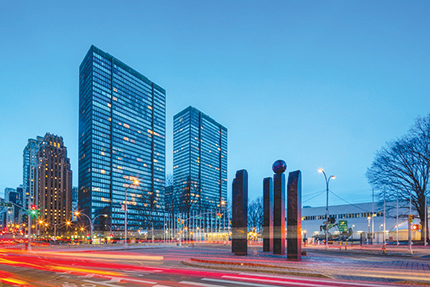 866 United Nations Plaza on East 48th Street and First Avenue - Manhattan, NY
New York’s most recent office condominium conversion is 866 United Nations Plaza on East 48th St. and First Ave. Rudder Property Group has been marketing units for sale in the 471,000 s/f, class A building. 866 United Nations Plaza spans a full city block offering unobstructed light and 360-degree views, including those of the 17-acre tree-lined United Nations campus and the Secretariat Building, as well as the permanently protected vistas over the East River and beyond.
Located in the six-story base of an iconic 38-story glass and aluminum complex, the building’s elegant modern style is designed to complement the architecture of the Secretariat Building and act as an extension of the United Nations campus.
Office condominiums are available in a variety of floor plans and configurations, from efficient 1,000 s/f suites to sprawling full-floor layouts, at a range of price points. One or more units can also be combined to build custom office complexes. Offices on all floors boast high ceilings, large windows with river, city or courtyard views and individually controlled heat and air conditioning.
Rudder Property Group (RPG) specializes exclusively in the conversion and sale of office condominiums. RPG consistently leads the market in office condominium sales and is widely respected throughout the real estate community as the foremost experts on New York’s office condominium market.
Michael Rudder is principal at Rudder Property Group, New York, N.Y.
Tags:
Spotlight Content
MORE FROM Spotlight Content

NYREJ's 2026 Developing Long Island Spotlight is here!
This spotlight showcases projects completed and currently under construction across Long Island as well as highlights improvements made to the region through Industrial and Economic Development Agencies and BIDs.


.png)



Columns and Thought Leadership

CRE Guide Featured Company: Merritt Environmental Consulting Corp.
Merritt Environmental Consulting Corp. (MECC) was established in June of 2009 after being part of a larger engineering firm for almost 20 years. The focus of the company is to assist lending institutions, attorneys, real estate investors, and property owners with environmental concerns. Today, MECC has offices in New York, Florida, and Vermont and has grown into a regional consulting firm serving clients along the East Coast.

Properly serving a lien law Section 59 Demand - by Bret McCabe
Many attorneys operating within the construction space are familiar with the provisions of New York Lien Law, which allow for the discharge of a Mechanic’s Lien in the event the lienor does not commence an action to enforce following the service of a “Section 59 Demand”.

From vacancy to vitality: How adaptive reuse is reshaping Long Island’s CRE landscape - by Andrea Tsoukalas Curto
Adaptive reuse has become one of the most important conversations in commercial real estate today. Long Island has a large inventory of aging retail, office and industrial

2026 Developing Queens: Long Island Board of Realtors advances commercial growth and advocacy in Queens
The Long Island Board of Realtors (LIBOR) Commercial Network continues to play a key role in advancing opportunities and strengthening the commercial real estate landscape across Queens. Through targeted programming and global outreach