



Manhattan, NY The Real Estate Board of New York (REBNY) conducted an analysis comparing the local business environments of the borough’s Community Board 2 in the West Village and Community Board 4 in Hell’s Kitchen.
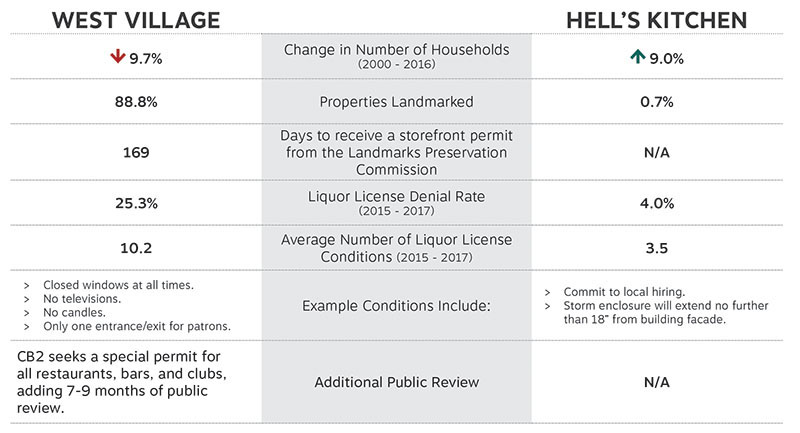
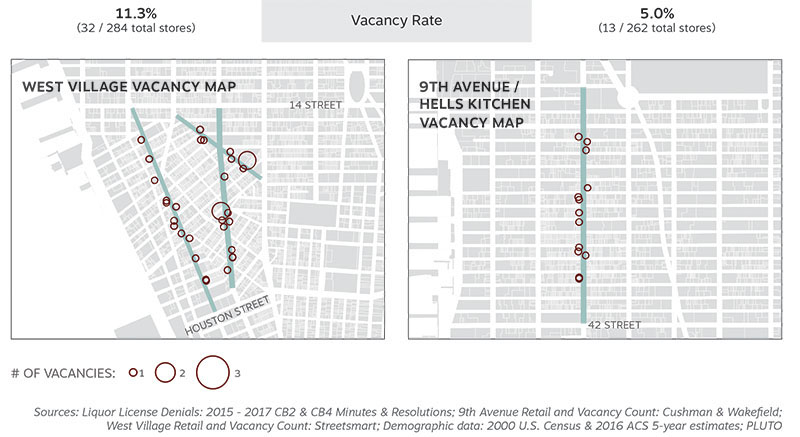
The report found that the West Village retail vacancy rate is more than twice as high as in Hell’s Kitchen. The vacancy is 11.3% in three major West Village retail corridors comprising 284 storefronts, compared to 5% on the Hell’s Kitchen retail corridor of Ninth Ave. with 262 total stores.
The analysis considered retail foot traffic, a component to the success of brick and mortar stores. The report shows retailers in the growing neighborhood of Hell’s Kitchen will have greater chances to grow and thrive as the population has increased by 9% from 2000 to 2016, when it reached 29,157 households, according to the U.S. Census. By comparison the West Village lost 9.7% of its households over the same period (down to 20,213 in 2016), according to the Census.
The report found Community Board 2 denies 25.3% of West Village liquor license applications, while Community Board 4 rejects only 4% in Hell’s Kitchen. Community Board 2 is currently seeking a special permit for all restaurants, bars, and clubs, which would add an additional 7-9 months of public review.
In the West Village, 88.8% of properties are landmarked compared to less than 1% in Hell’s Kitchen. REBNY research shows that landmark districts create barriers to housing production.
“New York City’s retail uses are going through a transition due to a variety of factors, including national and local forces like online shopping and increasingly unfriendly regulations,” said John Banks, REBNY president.
“The restaurant industry, by its very nature is immune to the forces of online shopping, said REBNY Retail Committee co-chair Steven Soutendijk, of Cushman & Wakefield. “At this time when the retail landscape is in a period of transition, we should be looking for ways to help, not hinder our restaurants and cafés. The regulatory requirements imposed at the Community Board level are stifling and burdensome on small businesses.”
“People come to New York for three reasons: to shop, to eat, and to experience our great cultural life, said Mitchell Moss, NYU’s Henry Hart Rice professor of urban policy & planning, director of Rudin Center for Transportation Policy & Management. “There is no place with the creative retail life of New York City. Of course, we have vacancies but that’s because so many people have gone to the internet and so many communities have made it much tougher on what you can sell where. But there’s nothing like the sidewalk to bring customers into a store. Our sidewalks are the gateway to our shops, the great retailers recognize this and they are constantly creating new ways to draw people into their stores.”
“The city’s regulatory environment for small businesses is very challenging and often undermines the ability to succeed,” said Jessica Walker, president and CEO of the Manhattan Chamber of Commerce. “Most business owners avoid high maintenance neighborhoods that add even more hoops to jump through in order to locate there.”
The Real Estate Board of New York (REBNY) is the city’s leading real estate trade association. Founded in 1896, REBNY represents commercial, residential, and institutional property owners, builders, managers, investors, brokers, and salespeople; banks, financial service companies, utilities, attorneys, architects, and contractors; corporations, co-partnerships, and individuals professionally interested in New York City real estate.
REBNY conducts research on various civic matters including tax policy, city planning and zoning, rental conditions, land use policy, building codes, and other city, state, and federal legislation. REBNY regularly publishes market data, policy reports, and broker surveys. In addition, REBNY provides for its members: informational, technical, and technological resources; networking and charitable service opportunities; qualifying and continuing education courses; professional education programs, seminars, and designations; career-changing awards; legal advice; and a wide range of additional member benefits.

.png)

 (2).gif)