



News:
Brokerage
Posted: October 17, 2023
The Factory in Long Island City's latest lease bolsters tenant roster of unique tenant class
.jpg)
Long Island City, NY The tectonic shifts in the commercial office real estate sector around hybrid and remote work environments have been well-documented. However, one sub-sector, the maker space, stands out for its strength during this time. Makers are non-traditional businesses requiring flexible spaces for creating and innovating products requiring on-site production capabilities, efficient loading, and abundant freight elevators. These users include fashion, health and wellness companies, photo and film studios, jewelers, food commissaries, and light manufacturers such as product designers, electronics, mechanical equipment production and mission-critical logistics. The Factory in Long Island City, Queens, has established itself at the forefront of catering to these makers in one of NYC’s most dynamic neighborhoods.
According to Newmark Research, the Manhattan office market is experiencing close to 20% availability and tenant occupancy hovering around 50%. However, The Factory has been able to maintain leasing momentum after announcing a long-term 22,000 s/f renewal by TEI Elevator. Since 2020, The Factory has signed several hundred thousand s/f of these maker tenants. Most recently, in addition to TEI, Ralph Lauren expanded its footprint at the building, La Maison du Chocolat extended its lease, Broadway Stages extended its lease, and Roman Health and Metergy executed new leases. The building houses other maker-inspired tenants, including Bucherer’s (Tourneau) watch repair center and Macy’s photo studio.

The Factory’s ownership, which includes Atlas Capital Group, Invesco, and Partners Group, acting on behalf of its clients, has proven to be attracting companies to the building by regularly hosting networking events, workshops, and exhibitions to provide opportunities for companies to connect, learn, and grow together.
"The Factory’s targeted focus on the ‘tenant experience’ continues to bear fruit as evidenced by these leases," said Newmark executive vice chairman Brian Waterman. Ownership is laser-focused on curating a distinct destination workplace and creating an environment for them to be successful.”
Built in 1926 and originally used by Macy's as a furniture warehouse with direct commercial rail access for deliveries, ownership completed a historically sensitive renovation, creating large, flexible full floors and work-ready converted lofts. High ceilings and brand-new, fully operable windows on every floor provide Manhattan skyline views.
Project amenities include available indoor parking, 24-hour access and security, six freight elevators and loading docks, shuttle service to subway and LIRR, a renovated lobby, a lounge, a food hall featuring dining options, a fitness facility, secure bike storage, tenant-controlled air conditioning and a rotating art exhibition. The building’s on-site amenities and geographical proximity to New York City make it an effective hub for businesses requiring 24/7 capabilities and convenient access to the geographic center of Manhattan.
Tags:
Brokerage
MORE FROM Brokerage
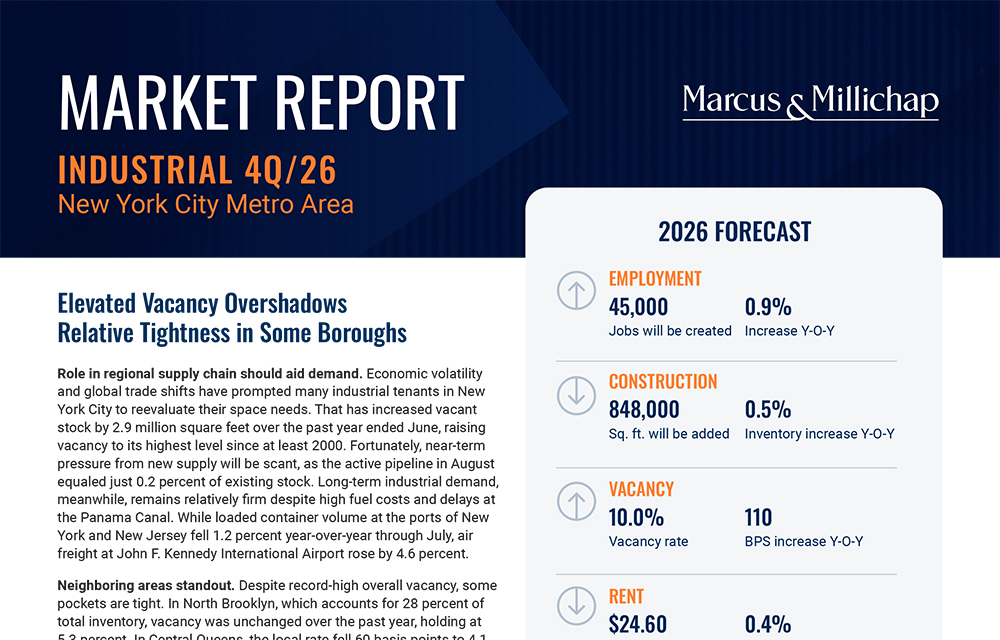
Marcus & Millichap releases fourth-quarter 2026 NYC industrial market report
Manhattan, NY Marcus & Millichap has published its fourth-quarter 2026 New York City Industrial Market Report. “New York City’s industrial market is showing a clear





Quick Hits
 (2).gif)

Columns and Thought Leadership

Hunt CRE question and answer: Choosing a real estate agent - by David Hunt
First, we will only work with one agent exclusively. The primary reason is that we want that agent to legally represent our client’s interests. In New York State, a real estate agent has a fiduciary

New York’s streets are full again, and the retail numbers prove it - by Noam Aziz
Walk down any New York block this year and you can feel it. The sidewalks are crowded, the storefronts are lit, and the energy that defines this city is back at full volume.

The art of investing in real estate - by Thomas Donovan
Real estate investing is as much an art as it is a skill. No one can time the market, or the factors that drive it, perfectly. Location, zoning, size, transportation, and neighborhood density give you a baseline for

Hunt commercial real estate question and answer: Fortune 500 wisdom - by David Hunt
Yes, there are lessons to be learned from the largest companies in America when comes to managing your real estate. But the decision to buy or lease real estate may not be one of
.gif)