



News:
Brokerage
Posted: November 6, 2009
The effects of smartphones and augmented reality on R.E.
Have you ever noticed how many people have cell phones in this day and age? If you take a good look around at the people using flip phones, slider phones and other types of basic cell phones, you would see that there isn't many compared to a few years ago. More people are starting to use smartphones. They have become more affordable and have gotten quite speedy at processing tasks that PDAs could never accomplish.
One of the most popular smartphones on the market for business and casual users is the iPhone. The iPhone has really set the standard for the way a smartphone should be in many ways. I have personally seen many business people as well as friends and family that own an iPhone. A few benefits of owning a smartphone (or an iPhone) are having access to WiFi, GPS, and a high resolution camera. Most smartphones also sport an accelerometer to handle touch screens and the orientation of the screen. There are only a few smartphones that are on the market today that don't include most of these features. These features on smartphones open up a lot of possibilities for what applications can do. In the near future, there will be applications that take full advantage of these features and will create a new technology that is referred to as "augmented reality."
Think of augmented reality as technology that a phone can use to know exactly where it is and the direction it is looking in. Using this in conjunction with smartphone's ability to be connected to the web all the time creates a whole new level of interactivity. Taking your phone and pointing its camera at a building to identify it will soon be a possibility. Getting other images, links, answers, and text based on what you point your phone at could open up many possibilities in the commercial real estate field. For example, you could identify something on your phone and send either the picture, info or both over to a coworker which could save time. You could even send them coordinates to where you are (based on the phone's GPS) which would give your coworker the ability to plug them in to a map application. As mobile Internet gets quicker, more opportunities could open up. Instead of pointing your phone at an inanimate object, you could record a seminar or meeting. Augmented reality would make it possible for your phone to identify where you are, how many people you are looking at, what they are saying (using voice recognition) and how long you have been there. From there, based on phones abilities and applications available, you could stream the entire meeting to a coworker, or even to your site for any of your clients to watch in real time.
This entire concept isn't far away from being reality. Once it does become a reality, I believe we will be seeing lots of changes in the hardware and software that phones utilize. I believe the way people communicate in the commercial real estate field will greatly improve in both efficiency and speed once this specific subject of technology is available to the public. Use your phone to check us out online at www.rejournal.com.
Aaron Wood is the webmaster of Rejournal.com, Norwell, Mass.
Tags:
Brokerage
MORE FROM Brokerage
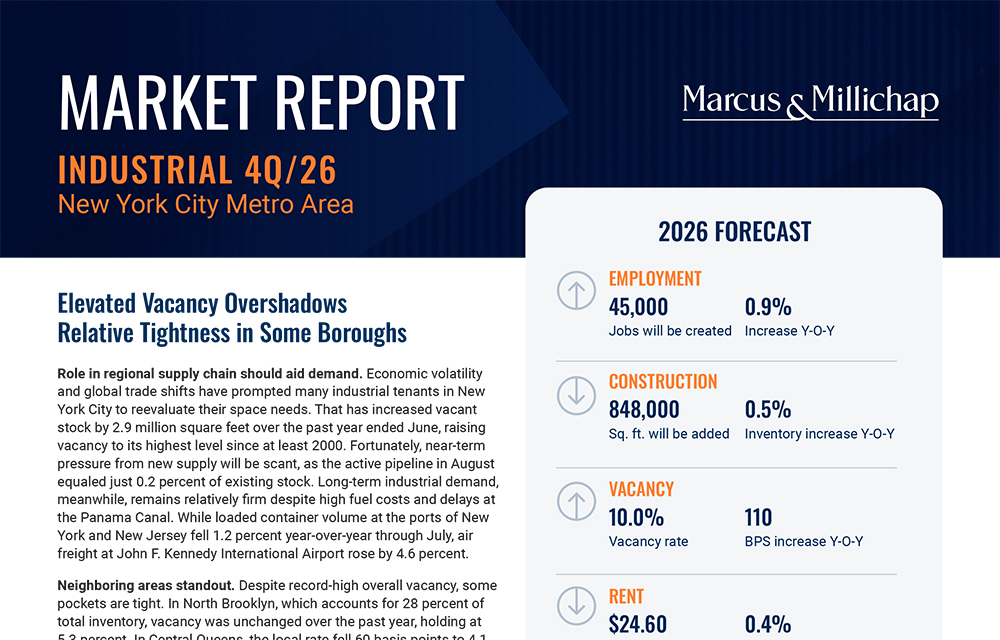
Marcus & Millichap releases fourth-quarter 2026 NYC industrial market report
Manhattan, NY Marcus & Millichap has published its fourth-quarter 2026 New York City Industrial Market Report. “New York City’s industrial market is showing a clear





Quick Hits
 (2).gif)

Columns and Thought Leadership

Hunt CRE question and answer: Choosing a real estate agent - by David Hunt
First, we will only work with one agent exclusively. The primary reason is that we want that agent to legally represent our client’s interests. In New York State, a real estate agent has a fiduciary

The art of investing in real estate - by Thomas Donovan
Real estate investing is as much an art as it is a skill. No one can time the market, or the factors that drive it, perfectly. Location, zoning, size, transportation, and neighborhood density give you a baseline for

New York’s streets are full again, and the retail numbers prove it - by Noam Aziz
Walk down any New York block this year and you can feel it. The sidewalks are crowded, the storefronts are lit, and the energy that defines this city is back at full volume.

Hunt commercial real estate question and answer: Fortune 500 wisdom - by David Hunt
Yes, there are lessons to be learned from the largest companies in America when comes to managing your real estate. But the decision to buy or lease real estate may not be one of
.gif)