



News:
Brokerage
Posted: December 14, 2021
The Doe Fund’s Webster Green Certified LEED Gold
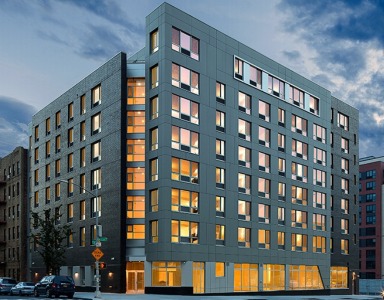
New York, NY The Doe Fund announced its Webster Green residence, which provides affordable and supportive housing for over 100 tenants, received a Leadership in Energy and Environmental Design Gold rating from the U.S. Green Building Council (USGBC). This exclusive certification is proof of a building’s construction and operation at the highest level of sustainability.
Webster Green, part of The Doe Fund’s growing portfolio of 16 affordable, supportive, and transitional residences throughout New York City, opened in 2019 and was designed by Magnusson Architecture and Planning, PC. The $30 million joint venture with Robert Sanborn Development consists of a single, eight-story structure with a mix of studio, one-bedroom, and two-bedroom apartments.
Located on a former greyfield site, the 77,000 s/f building consists of 41 supportive units and 41 affordable units. Residents qualifying for supportive services receive assistance from The Doe Fund, including comprehensive case management, assistance with daily living skills, and referrals for medical, psychiatric and substance abuse treatment, as well as vocational services.
“The Doe Fund is proud to provide the highest-quality affordable and supportive housing to individuals and families facing economic hardship, recovering from homelessness and substance abuse, and living with physical disabilities, mental illness, and HIV/AIDS,” said John McDonald, executive vice president of The Doe Fund. “We believe that everyone deserves to live with dignity, and Webster Green’s LEED Gold certification shows that commitment in action. New York City needs more state-of-the-art affordable and supportive residences for those in need.”
Fernando Vila, the project’s lead architect, said, “Designing for sustainability means designing in a way that respects people’s health. The concept behind Webster Green was always focused on improving the physical and mental wellbeing of residents, so sustainability was a top priority. LEED offered a clear and comprehensive approach to meet the design goals for this development and we couldn’t be prouder of the result.”
“Robert Sanborn Development is committed to developing sustainably-designed, energy efficient affordable and supportive housing. We are extremely proud to have worked with The Doe Fund as a partner on the development of Webster Green, and we celebrate its commitment to providing exceptional living environments for its clients,” said Robert Sanborn.
“LEED is a transformative tool that ensures a building is designed and operated to achieve high performance, improve human health, and protect the environment,” said Mahesh Ramanujam, president and CEO of USGBC. “By prioritizing sustainability, The Doe Fund is leading the way in boldly reimagining what affordable and supportive housing can be.”
Webster Green also won a building award from the Queens & Bronx Building Association in 2019, as well as a Best in American Living Award from the National Association of Home Builders in 2020.
Tags:
Brokerage
MORE FROM Brokerage
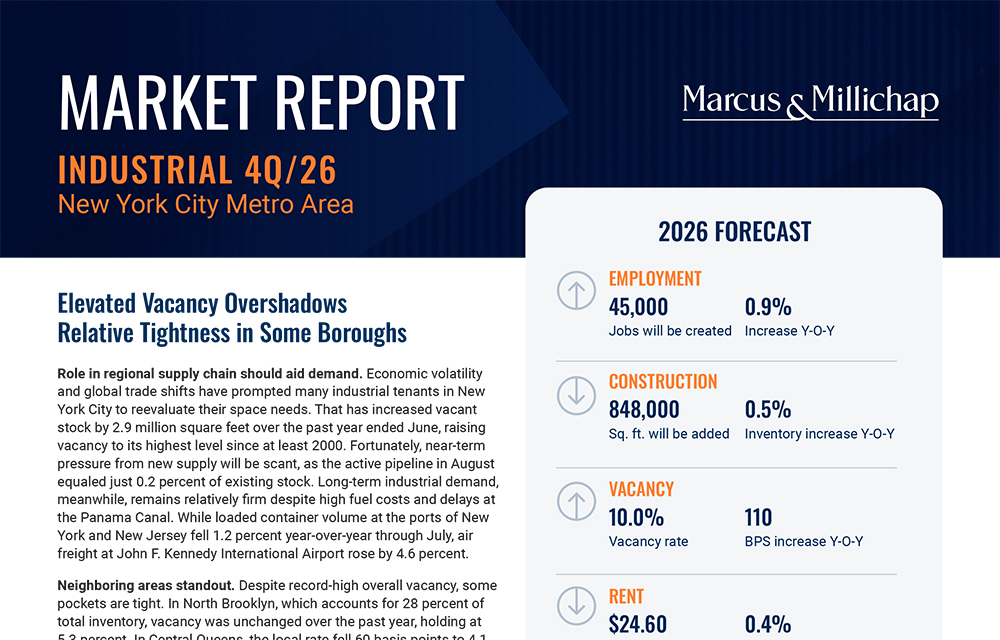
Marcus & Millichap releases fourth-quarter 2026 NYC industrial market report
Manhattan, NY Marcus & Millichap has published its fourth-quarter 2026 New York City Industrial Market Report. “New York City’s industrial market is showing a clear




Quick Hits
 (2).gif)

Columns and Thought Leadership

Hunt CRE question and answer: Choosing a real estate agent - by David Hunt
First, we will only work with one agent exclusively. The primary reason is that we want that agent to legally represent our client’s interests. In New York State, a real estate agent has a fiduciary

Hunt commercial real estate question and answer: Fortune 500 wisdom - by David Hunt
Yes, there are lessons to be learned from the largest companies in America when comes to managing your real estate. But the decision to buy or lease real estate may not be one of

New York’s streets are full again, and the retail numbers prove it - by Noam Aziz
Walk down any New York block this year and you can feel it. The sidewalks are crowded, the storefronts are lit, and the energy that defines this city is back at full volume.

The art of investing in real estate - by Thomas Donovan
Real estate investing is as much an art as it is a skill. No one can time the market, or the factors that drive it, perfectly. Location, zoning, size, transportation, and neighborhood density give you a baseline for
.gif)