



News:
Brokerage
Posted: August 12, 2025
The Business Council of Westchester’s State of the Economy series discusses healthcare
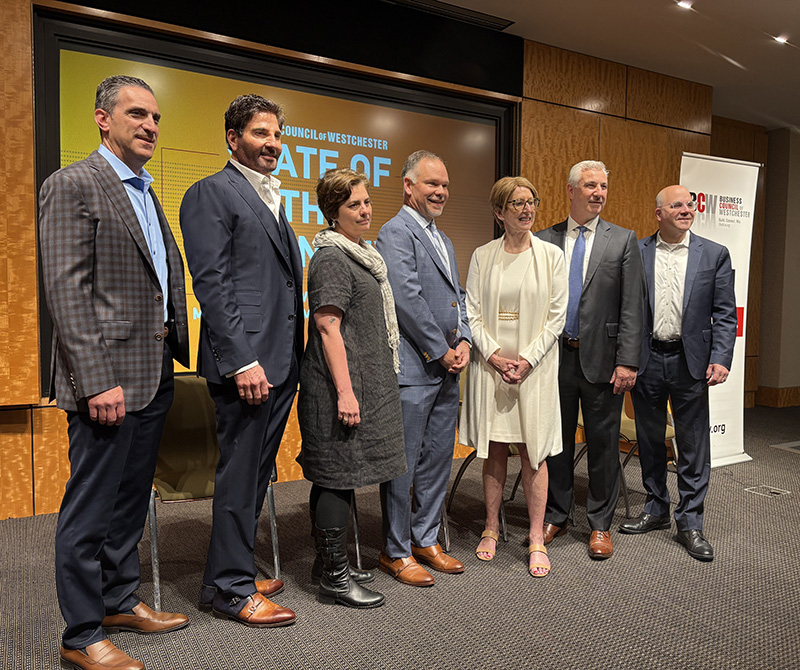
Jennifer Malone-Seixas, regional VP, Westchester/Fairfield, Atria Senior Living; Michael McGoldrick, chairman of the board,
president and CEO, PCSB Bank; BCW president & CEO Marsha Gordon; Paul Dunphey, senior VP and COO, NYP Westchester Hospital
and president, NYP Hudson Valley Hospital; and Dan Blum, CEO, ENT & Allergy.
White Plains, NY Westchester County’s healthcare landscape is undergoing a transformation, according to panelists at the Business Council of Westchester’s (BCW) State of the Economy series.
The panel discussion delved into key trends reshaping medical care in the region. The panelists included Dan Blum, CEO, ENT & Allergy; Paul Dunphey, senior VP and COO, NYP Westchester Hospital and president, NYP Hudson Valley Hospital; Jennifer Malone-Seixas, regional VP, Westchester/Fairfield, Atria Senior Living; and Joe Simone, president, Simone Development Companies.
Panel moderator and BCW president and CEO Marsha Gordon started the conversation by underscoring the regional impact of the healthcare sector. “Local hospitals and health systems represent almost $20 billion in economic activity in the 16th Congressional District, which covers central and southern Westchester. That’s just the hospitals systems in one district,” said Gordon, citing data from the Healthcare Association of New York State. “That includes almost 83,000 jobs generating nearly $5 billion in tax revenue for local and state governments. The health sector provides 4.4 million in outpatient appointments and treated 664,000 patients in emergency rooms in 2023.”
A theme was the increasing integration of artificial intelligence (AI), with panelists highlighting its growing impact on claims adjudication, patient screening, and the crucial task of reading diagnostic tests. AI’s role in streamlining operations and enhancing diagnostic accuracy is set to revolutionize healthcare delivery.
The discussion also addressed the ongoing consolidation of local healthcare into large networks. These systems are now offering comprehensive “cradle-to-grave” care, located within Westchester and providing access to top medical talent from New York City. This shift aims to offer patients a more integrated and accessible healthcare experience.
Westchester County executive Ken Jenkins delivered a greeting, and he commended the healthcare leaders for their vital work and significant contributions to the local economy.
A major development on the horizon is the fall opening of NewYork-Presbyterian The One, Westchester’s newest healthcare facility at 1111 Westchester Ave. in White Plains. This $500 million complex promises to be a game-changer, offering over 90 adult and pediatric care services and featuring leading doctors from Columbia, further solidifying Westchester’s position as a hub for world-class medical care.
The panel emphasized a crucial reorientation of healthcare delivery towards the consumer experience. This new focus prioritizes convenience, speed of care, and strategic location, acknowledging the evolving expectations of patients in today’s fast-paced world.
Addressing the critical challenge of workforce development, the panelists discussed the growing need for new doctors and nurses, especially with an aging population. A promising solution highlighted was the new workforce pipeline created through NewYork-Presbyterian’s partnership with Iona University and the establishment of The NewYork-Presbyterian Iona School of Health Sciences. This collaborative initiative offers a forward-thinking vision for healthcare education, directly connecting students with job opportunities.
Finally, the expansion of senior living communities as the population ages was a key topic, along with the common misconceptions the public holds regarding planning for long-term care. This underscored the need for greater public awareness and education on future care needs.
The panel’s insights revealed how Westchester County is not merely adapting to these changes but actively serving as a blueprint for the consolidation of healthcare and the delivery of world-class medical care in suburban areas.
PCSB Bank was the presenting sponsor of the event, which was held at 360 Hamilton Ave.
Tags:
Brokerage
MORE FROM Brokerage

Residential real estate consultancy and brokerage firm Nancy Packes, Inc. rebrands as NPI
Manhattan, NY The NYC-based premier residential real estate consultancy and brokerage firm, Nancy Packes Inc., has rebranded as NPI. Helmed by Seth Rosner, most recently the firm’s managing partner and now president, the company has been intricately involved in hundreds of Tri-State new developments and conversions, spearheading the full project life cycle, from assessment/pre-dev.






Quick Hits

Columns and Thought Leadership

Hunt commercial real estate question and answer: Fortune 500 wisdom - by David Hunt
Yes, there are lessons to be learned from the largest companies in America when comes to managing your real estate. But the decision to buy or lease real estate may not be one of

A guide to finding the right NYC property management company - by Sanjay Gandhi
Being a small to midsize landlord in NYC is an increasingly demanding endeavor. From navigating complex regulations, increased compliance demands to dealing with tenant issues and remediating violations. It is wise to enlist the assistance of a partner, a professional

Hunt CRE question and answer: Choosing a real estate agent - by David Hunt
First, we will only work with one agent exclusively. The primary reason is that we want that agent to legally represent our client’s interests. In New York State, a real estate agent has a fiduciary

New York’s streets are full again, and the retail numbers prove it - by Noam Aziz
Walk down any New York block this year and you can feel it. The sidewalks are crowded, the storefronts are lit, and the energy that defines this city is back at full volume.
.gif)