



News:
Brokerage
Posted: January 16, 2024
SCALE Lending provides $46 million bridge loan for Arris Grand
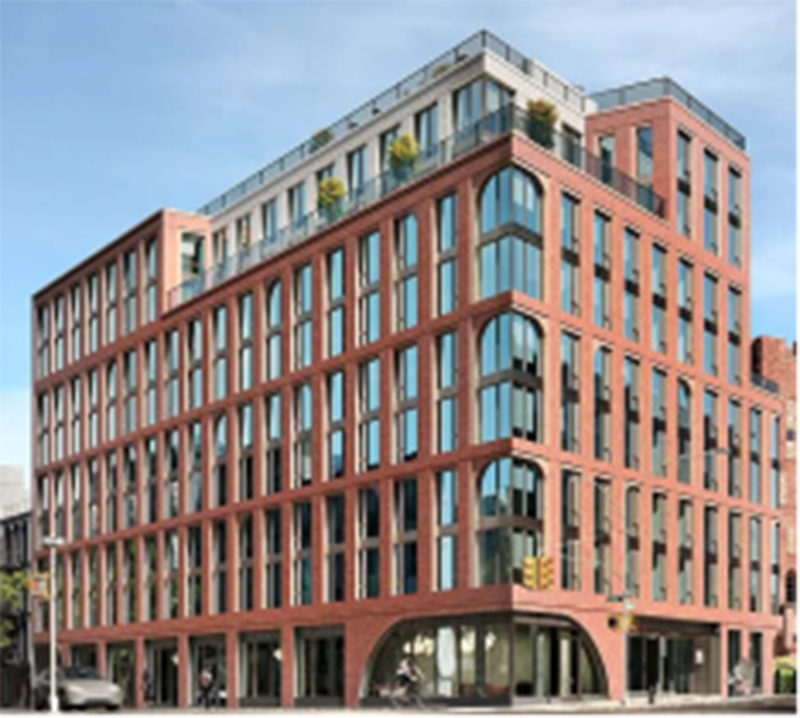
Brooklyn, NY SCALE Lending, the debt financing arm of Slate Property Group, has finalized a $46 million bridge loan for Arris Grand, a newly-completed apartment building in the Clinton Hill neighborhood.
The sponsors will use the proceeds from the bridge loan to pay off the existing construction loan and to aid in the lease-up of the nine-story multifamily building located at 982-998 Fulton St.
Designed by the award-wining architecture firm Fogarty Finger, Arris Grand encompasses 113 rental apartments, ranging from studios to two-bedroom units, and 7,154 s/f of street-level retail at the intersection of Grand Ave. and Fulton.
Completed in late November, the building’s rental apartments are being marketed for lease by Corcoran, while RIPCO is serving as retail leasing broker. Arris Grand features 10,000 s/f of indoor and outdoor amenities, highlighted by a fitness center, roof deck, terrace, and bespoke lounges designed for coworking, gaming and media.
“Arris Grand will serve as an architecturally distinct addition to one of Brooklyn’s quintessential brownstone neighborhoods,” said Martin Nussbaum, co-founder and principal at Slate Property Group. “The project benefits from its strong sponsors, KD Sagamore and Ranger Properties, who have collaborated on a range of successful developments over the past 20 years. With its prime location near multiple transportation hubs, outdoor green spaces, and restaurants, combined with quality construction and extensive amenities, Arris Grand will make for an attractive rental option.”
“SCALE is actively closing loans despite the volatile financial markets for high-quality sponsors in strong locations. The lack of liquidity in the marketplace from traditional lending sources has enabled SCALE to remain a leader in the transitional capital space,” said Daniel Ridloff, managing director of SCALE.
Residents will enjoy the close proximity to an array of popular restaurants and shops in the Vanderbilt Ave in Park Slope, Bedford Ave. in Bed-Stuy and Fulton St. retail corridors. The development is also located between the Franklin Ave. and Clinton – Washington Ave. A and C subway lines, allowing residents an easy commute to Manhattan, Brooklyn, Harlem, Washington Heights and Far Rockaway and Rockaway Beach.
Image Credit: Fogarty Finger
Tags:
Brokerage
MORE FROM Brokerage

200E20TH sells out in Gramercy, penthouse A closes out sales at the CetraRuddy-designed condominium residences
Manhattan, NY 200E20TH, the CetraRuddy-designed architectural masterwork that brought a curved, contemporary sensibility to Gramercy’s Beaux-Arts streetscape, has






Columns and Thought Leadership

The art of investing in real estate - by Thomas Donovan
Real estate investing is as much an art as it is a skill. No one can time the market, or the factors that drive it, perfectly. Location, zoning, size, transportation, and neighborhood density give you a baseline for

New York’s streets are full again, and the retail numbers prove it - by Noam Aziz
Walk down any New York block this year and you can feel it. The sidewalks are crowded, the storefronts are lit, and the energy that defines this city is back at full volume.

Hunt commercial real estate question and answer: Fortune 500 wisdom - by David Hunt
Yes, there are lessons to be learned from the largest companies in America when comes to managing your real estate. But the decision to buy or lease real estate may not be one of

Hunt CRE question and answer: Choosing a real estate agent - by David Hunt
First, we will only work with one agent exclusively. The primary reason is that we want that agent to legally represent our client’s interests. In New York State, a real estate agent has a fiduciary
.gif)