



News:
Brokerage
Posted: July 25, 2011
Ronald Peters - Syracuse China Facility: Bargain sales really do work
The National Emergency Medicine Association has recently closed another real estate transaction through it's subsidiary, Emergency Medicine Support Foundation. This time it was the Syracuse China Facility, an older facility containing approximately 640,000 s/f on approximately 112 acres. Being an older facility, much of the building structure was both functionally and economically obsolete, so a charitable transaction was ultimately an ideal choice for the method of disposition.
The National Emergency Medicine Association is a 501(c)(3) nonprofit organization founded in 1982, committed to trauma prevention and the delivery of quality medical services at each stage of trauma with an emphasis on first response at the time of the emergency.
Their mission is the prevention of injury and illness by addressing health and social issues through education, applied research, technology, and equipment.
Property Background
and History
Syracuse China was founded in the late 1800s as the Onondaga Pottery Company, in Geddes, New York (now part of Syracuse). Syracuse China had become one of the leading suppliers of commercial china for the food service industry. Over time, through various mergers and acquisitions, in 1995, Libbey Inc. of Toledo, Ohio purchased Syracuse China Company.
However, in December of 2008, Libbey, Inc. announced that it would be closing the Syracuse China Facility in the spring of 2009 and they did just that. In April of 2009, Syracuse China Company produced their last plate in Syracuse.
Just after the facility was closed, we approached Libbey and explained the benefits of doing either a Bargain Sale or Donation. Both disposition methods were very good choices given the state of the economy and the condition of their facility. The concept sparked corporate interest; however, the decision was made to try marketing the facility through their Dallas real estate consultants who subsequently implemented a marketing campaign. After about a year of effort, even with some local representation, the efforts proved to be fruitless. Marketing efforts didn't produce the desired results, primarily because the facility was more or less a special use facility since it still contained the kiln that was used in the production process of their products. Being a special use facility generally means the market value may be high since it would require a special user or buyer.
Faced with continued holding cost, ongoing corporate facility management, corporate liability, perhaps the need to spend considerable capital to change the building's special use and the desire to dispose of the facility quickly, a charitable transaction looked attractive. After more discussions with Libbey, they asked for additional information on the charitable mission and how the process would work, as they did want to get the property off the books as soon as possible. At that point we started structuring a charitable transaction.
Structuring The Transaction
We structured a bargain sale for the property. A bargain sale is where a charity buys a property for some price at less than the property's fair market value. This means the corporate seller should be able to deduct as a charitable tax deduction, the difference between the selling price to our charity and the fair market value of the facility, as a tax deduction. The bargain sale terms were negotiated, approved by both parties and contracts were signed.
Since a bargain sale was structured, National Emergency Medicine Association had to raise capital for the purchase or find a suitable takeout purchaser. The decision was made to find a takeout purchaser. To assist with finding a takeout buyer, we recommended a local brokerage group who were then hired for the task.
A takeout was found and the closing took place. The entire process took a little over 4 months.
This transaction provided the corporate owner with very acceptable disposition alternative. Besides being able to assist a charity, this transaction provided a fast disposition option, allowed the corporate ownership to allocate their resources to other business opportunities and stopped the financial drain on corporate resources. Additionally, any unused deduction can be carried forward for 5-years.
The companies who have worked with National Emergency Medicine Association and/or it's team members utilizing charitable transaction s as a disposition strategy include R. J. Reynold's Tobacco Co. - a tract of 452 acres of land, a division of Kodak Company - 146 acres and research center, Trinity Industries - former barge manufacturing facility and Cardinal Health - distribution center.
Ronald Peters is a real estate consultant with Peters & Associates, Saratoga Springs, N.Y.
Tags:
Brokerage
MORE FROM Brokerage
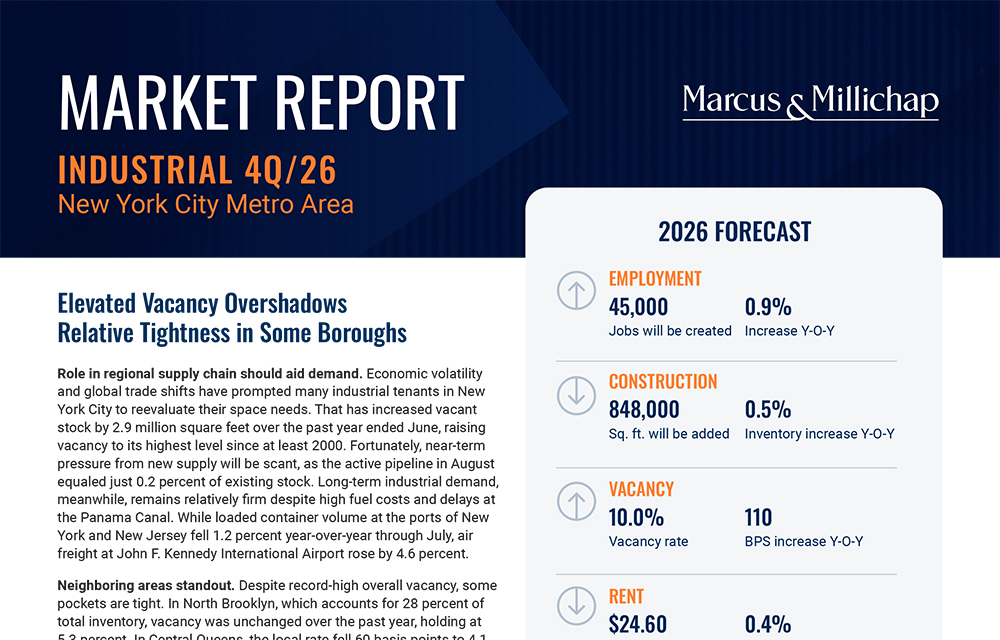
Marcus & Millichap releases fourth-quarter 2026 NYC industrial market report
Manhattan, NY Marcus & Millichap has published its fourth-quarter 2026 New York City Industrial Market Report. “New York City’s industrial market is showing a clear






Quick Hits

Columns and Thought Leadership

Hunt CRE question and answer: Choosing a real estate agent - by David Hunt
First, we will only work with one agent exclusively. The primary reason is that we want that agent to legally represent our client’s interests. In New York State, a real estate agent has a fiduciary

The art of investing in real estate - by Thomas Donovan
Real estate investing is as much an art as it is a skill. No one can time the market, or the factors that drive it, perfectly. Location, zoning, size, transportation, and neighborhood density give you a baseline for

New York’s streets are full again, and the retail numbers prove it - by Noam Aziz
Walk down any New York block this year and you can feel it. The sidewalks are crowded, the storefronts are lit, and the energy that defines this city is back at full volume.

Hunt commercial real estate question and answer: Fortune 500 wisdom - by David Hunt
Yes, there are lessons to be learned from the largest companies in America when comes to managing your real estate. But the decision to buy or lease real estate may not be one of
.gif)