


News:
Owners Developers & Managers
Posted: December 3, 2019
Question of the Month: With so many NYC training laws going into effect, what safety training will I need? - by Peter Simon
 Two Critical Updates: New York City Construction Safety Training Requirements
The construction safety training landscape in New York City shifted dramatically in 2017 with the passage of Local Law 196. The law increased the baseline safety training requirements for many NYC construction sites. The safety training increase was part of a response by the NYC Council to a series of high-profile construction accidents and fatalities. The full implementation, currently slated for September 2020, will require workers at certain construction sites to receive 40 hours of safety training and certain supervisors to receive 62 hours of safety training.
#1 Second Phase of Local Law 196
In effect – on December 1, 2019 the second implementation period for required safety training took effect. This training is required on projects the require a Department of Buildings site safety plan. Phase 2 of the implementation requires worker and supervisor training as per below:
Workers can obtain a limited SST Card (30 hours) by following 1 of 3 options below:
Option 1:
OSHA 10-Hour Class with 20-Hours of Additional Training:
• 8-Hour Fall Prevention
• 8-Hour Site Safety Manager Refresher; and
• 4-Hour Supported Scaffold User and Refresher.
OR
Option 2:
OSHA 30-Hour Class;
OR
Option 3:
100-Hour Training Program Approved by the Department of Buildings.
Supervisors can obtain a Supervisor SST Card by completing 62 hours of training, as follows:
• OSHA 30-Hour Class;
• 8-Hour Fall Prevention;
• 8-Hour Site Safety Manager Refresher;
• 4-Hour Supported Scaffold User and Refresher;
• 2-Hour Site Safety Plan;
• 2-Hour Toolbox Talks;
• 2-Hour Pre-Task Safety Meetings;
• 2-Hour General Electives;
• 2-Hour Specialized Electives; and
• 2-Hour Drug and Alcohol Awareness.
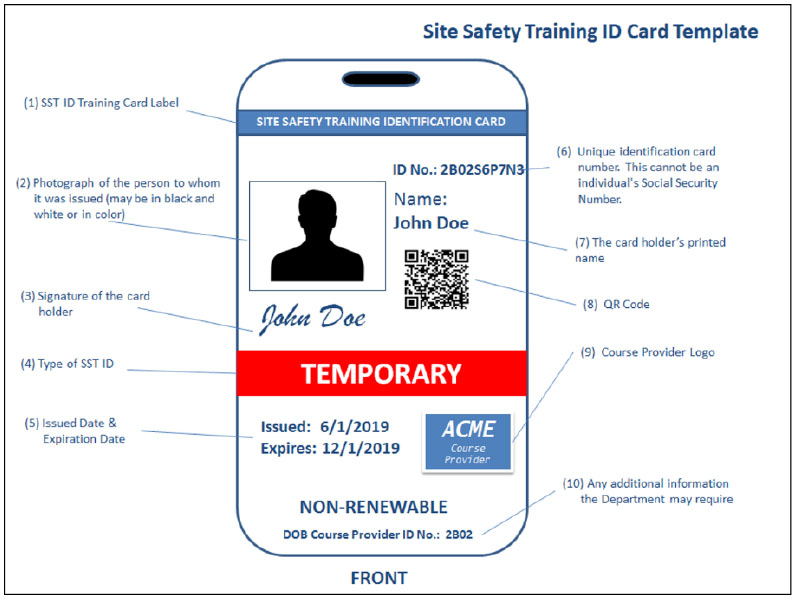 #2 SST Training Cards are Currently Being Issued
The new safety training requirements ultimately result in a full Site Safety Training Card (SST Card) to be carried by workers and supervisors while on a construction project. The full SST card evidences completion of the required training including a list of courses taken and a photograph of the card holder. The full SST card is valid for a five-year period and can be renewed with either an eight-hour worker refresher or 16-hour supervisor refresher. The full implementation and compliance date are scheduled to occur in September of 2020. Language in Local Law 196 also requires an SST card at the second compliance date (December 1st, 2019) as per below:
Local Law 196 Second Compliance Date
“On and after the SST second compliance date, and until the day before the SST full compliance date, ensuring that
(i) each such worker has an SST card, a limited SST card or a temporary SST card; and
(ii) each such worker who is serving as a site safety manager, site safety coordinator, concrete safety manager, construction superintendent or a competent person at such site has an SST supervisor card.”
It is important to take the required LL 196 training and obtain the required SST card as soon as possible. Waiting for the last moment can result in delays or complications as there is usually a training rush just prior to implementation deadlines.
Peter Simon, JD, CSP, is risk manager & director of plans and logistics at Total Safety Consulting, Bayonne, N.J.
MORE FROM Owners Developers & Managers

JVP Development names new sales team at 250 West 96th St.
Manhattan, NY JVP Development has appointed Team Arceon, led by Corcoran Top 25 broker Kristen Suh, as the exclusive sales and marketing team for 250 West 96th St., the 131-residence luxury condominium on the Upper West Side designed by renowned Danish designer Thomas Juul-Hansen. The official announcement comes on the heels of 250 West 96th St.




Quick Hits


Columns and Thought Leadership

NYC's Community Opportunity to Purchase Act is back - and multifamily owners should pay attention - by Ron Cohen
New York City’s Community Opportunity to Purchase Act (COPA) is back, and this latest version could have a much better chance of becoming law. The proposal would give qualified nonprofit organizations

Hunt Commercial Real Estate Q&A: Location, location, location? - by David Hunt
In working with our clients, we break down our search objectives into two categories. The first category involves the specific needs of your business such as warehouse height, amount of office space and number of loading

Don’t leave severance damages behind - by Sebastian Jablonski
When the government takes a portion of a landowner’s property, most assume just compensation stops at the value of the land taken. However, in partial takings, that is only half of the equation.
New York City’s historic rent freeze now rests with the courts - by Ron Cohen
New York City’s first-ever two-year rent freeze is now in the hands of a state Supreme Court judge, and the decision could reset income for owners of roughly one million rent-stabilized apartments housing some 2.4 million residents.