



News:
Brokerage
Posted: January 13, 2020
Project REAP (Real Estate Associate Program) returns to New York City and Chicago
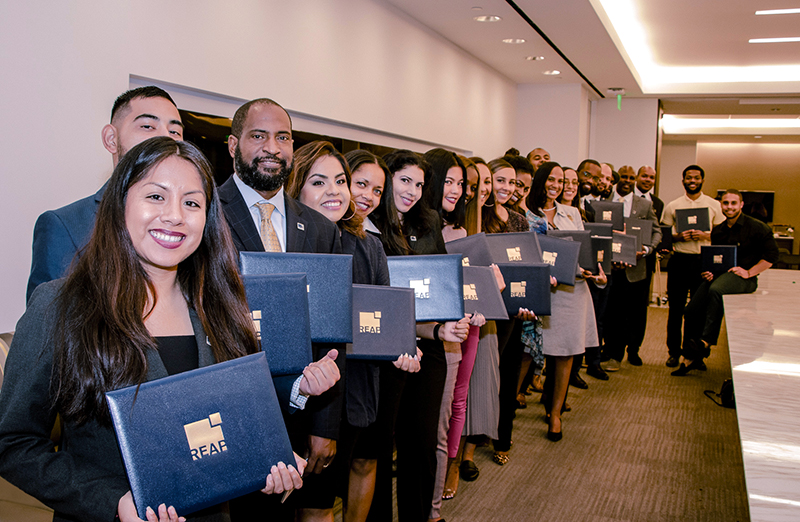
Photo credit: Tommy Allen/Tru Heart Media.
New York, NY Project REAP (Real Estate Associate Program), one of the nation’s leading initiative connecting talented multicultural professionals and commercial real estate (CRE) for over 20 years, is returning to NYC and Chicago starting in mid-March 2020 with a renewed and strengthened focus on creating multicultural CRE communities.
According to REAP program director Osayamen Bartholomew, “We’re looking to build a critical mass by linking our over 1300 REAP graduates to current REAP students, alumni, and sponsors active in CRE. The goal is to create communities of multicultural CRE professionals, market by market.”
Spring 2020 classes, scheduled to launch in mid-March, will include increased programming geared to bolster professional and career opportunities within the larger CRE landscape. The organization anticipates its internal job postings to double, coming from a total of roughly 150 major firms, both in CRE and related industries (i.e. banking, corporate) by the end of 2020.
Classes follow a banner 2019 in five major cities that spanned the nation from New York City, Washington, D.C., Dallas to Los Angeles, and featured the largest graduating class ever in Atlanta, Ga.
REAP alumni come from a wide range of disciplines including architecture, banking, law, marketing and more. Candidates seek to translate their skills to CRE, acquire new knowledge in their chosen field, or explore and forge new career paths. Senior level industry experts serve as instructors for a curriculum that encompasses all aspects of CRE. Requirements for the academy include a four-year undergraduate degree (or current graduating senior) with at least one year of professional work experience. Real estate experience is not required.
Corporate sponsors backing the academies have included CBRE, Walmart, JP Morgan Chase, Microsoft, McDonald’s, as well as major industry associations such as the Urban Land Institute, NMHC (National Multifamily Housing Council) and ICSC (the International Council of Shopping Centers). Past instructors for the academies have included accomplished CRE executives such as Marjorie Tsang (board member, USAA Real Estate Co.); Eric Yarbro (executive managing director, Colliers International); Brad Hutensky (partner, Hutensky Capital); Lisa Gomez (COO/partner, L+M Development); and Jeffrey Brodsky (vice chairman, Related Cos.).
REAP’s 10-week academy in NYC and Chicago will meet Tuesdays and Thursdays from 6:00 - 9:00pm in midtown Manhattan and downtown Chicago. Tuition is $1,000. Visit www.projectreap.org to apply from now through Friday, February 7th, 2020 at 11:59 pm EST. For more information, contact [email protected].
Tags:
Brokerage
MORE FROM Brokerage

Residential real estate consultancy and brokerage firm Nancy Packes, Inc. rebrands as NPI
Manhattan, NY The NYC-based premier residential real estate consultancy and brokerage firm, Nancy Packes Inc., has rebranded as NPI. Helmed by Seth Rosner, most recently the firm’s managing partner and now president, the company has been intricately involved in hundreds of Tri-State new developments and conversions, spearheading the full project life cycle, from assessment/pre-dev.






Columns and Thought Leadership

The art of investing in real estate - by Thomas Donovan
Real estate investing is as much an art as it is a skill. No one can time the market, or the factors that drive it, perfectly. Location, zoning, size, transportation, and neighborhood density give you a baseline for

New York’s streets are full again, and the retail numbers prove it - by Noam Aziz
Walk down any New York block this year and you can feel it. The sidewalks are crowded, the storefronts are lit, and the energy that defines this city is back at full volume.

Hunt commercial real estate question and answer: Fortune 500 wisdom - by David Hunt
Yes, there are lessons to be learned from the largest companies in America when comes to managing your real estate. But the decision to buy or lease real estate may not be one of

Hunt CRE question and answer: Choosing a real estate agent - by David Hunt
First, we will only work with one agent exclusively. The primary reason is that we want that agent to legally represent our client’s interests. In New York State, a real estate agent has a fiduciary
.gif)