


 (2).gif)
News:
Spotlight Content
Posted: March 21, 2017
Product of the Month: Unique power optimization product from Basic Power cuts electricity usage in buildings and factories by 10-20%
 East Stroudsburg, PA Pennsylvania-based Basic Power, Inc. has developed a unique patented approach to energy conservation that is now being made widely available. The Basic Power unit, or BPU, has been proven in over 300 buildings over the last several years, consistently producing kWh savings of between 10% and 20%. It works on both older, less efficient buildings, and on new buildings with state-of-the-art lighting and HVAC, and is available in 480V and 208V models.
 21The company’s new CEO Jim Peet, a NYC-based investment professional brought into lead the company’s expansion, said, “The company has been quietly proving the BPU over the last several years. Now we are moving to aggressively rollout the product.” Trial installations underway include:
• A well-known quick serve restaurant brand, which saw 17.5% savings in its initial trial;
•A New Jersey school district, which reported savings of $40,000 in 2016 with a capital outlay of just $30,000 in the first building to use a BPU;
• A newly commissioned refrigeration warehouse in Texas, which experienced a 25% reduction in monthly kwh; and
• Multiple ESCOs, design/build engineering firms, and the Army Corp. of Engineers, that are planning initial tests.
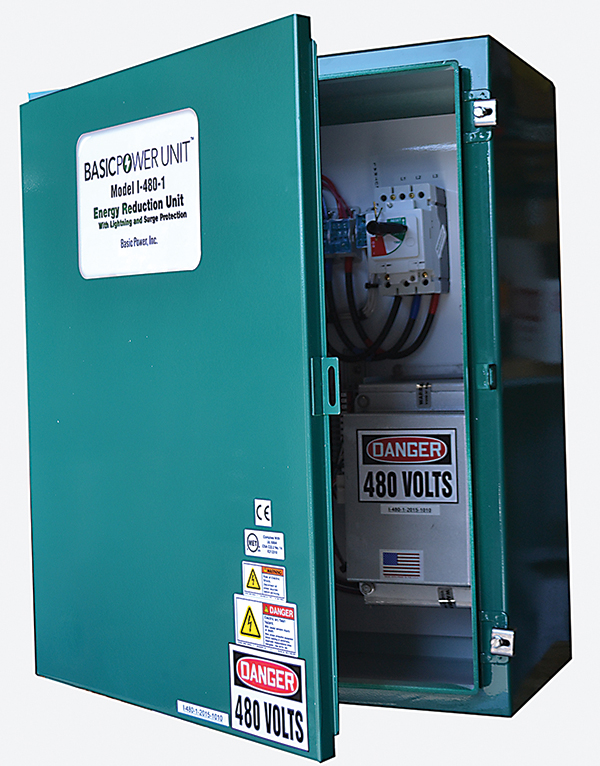 Peet explained that in any building, the normal operation of elevators, HVAC units, compressors, switching power supplies in LEDs and computers, and most other electrical devices creates distortions in the power flow–harmonic distortions, phase imbalances, sags and surges, etc. “These distortions generate heat, which shortens device life. Worse yet, they draw extra power from the grid that you pay for. Our technology removes these distortions, storing the energy from the distortions inside of the BPU. This creates a cleaner flow of power throughout the building, which benefits all the electrical loads. The BPU also feeds the power it has stored back to the building–you are recycling what was formerly waste energy. The BPU allows you to use the energy you pay for,” said Peet.
Peet went on to explain what sets the BPU apart from power conditioning devices currently on the market. “Some people see the capacitors in our unit and think, ‘Power factor correction device.’ But the BPU is different in concept, design and benefits. To name simply the most obvious, a power factor correction device generates minimal savings at best–but the BPU generates substantial savings, reducing the power draw typically by 10-20%. Other key differences include the patented inductors/reactors which are the key elements in the performance of the BPU, and the BPU’s ability to address a range of power issues, not just power factor.”
Many building owners are purchasing the technology to reduce energy bills. The BPU models are priced to produce a pay back on energy savings of approximately 24 months, based upon a kwh rate of 10-12 cents. To demonstrate this, Basic Power has set up a recent installation in Baltimore with remote controls and a permanent meter, to allow the unit to be turned on and off at any time and show in real time the savings from having a unit operate.
Others are motivated by the ancillary benefits of improved power quality. “A very large retail/office building in Chicago with 4 million s/f of space had an audible buzz from harmonic distortion following a major LED lighting retrofit. Tenants were complaining, and rents were at risk. After looking at possible solutions costing hundreds of thousands of dollars, the building tried a BPU at a fraction of the cost. Harmonics were reduced by over 90%, and the problem was solved immediately! Other buildings with significant power quality issues from the grid have installed the BPU to protect their building and equipment,” Peet said.
BuildingsNY is Basic Power’s first major showing in the NYC market. The company can be visited at Booth 156 at BuildingsNY 2017 at the Jacob Javits Convention Center on March 21st and 22nd.
Jim Peet can be contacted directly at [email protected]
Tags:
Spotlight Content
MORE FROM Spotlight Content

Participate in Developing New York Featuring Westchester County - November 24, 2026
Choose how you’d like to participate in this edition of NYREJ’s Developing New York series featuring Westchester County.




.png)

 (2).gif)

Columns and Thought Leadership

From vacancy to vitality: How adaptive reuse is reshaping Long Island’s CRE landscape - by Andrea Tsoukalas Curto
Adaptive reuse has become one of the most important conversations in commercial real estate today. Long Island has a large inventory of aging retail, office and industrial

2026 Developing Queens: Long Island Board of Realtors advances commercial growth and advocacy in Queens
The Long Island Board of Realtors (LIBOR) Commercial Network continues to play a key role in advancing opportunities and strengthening the commercial real estate landscape across Queens. Through targeted programming and global outreach

2026 Developing Long Island: ERG Commercial Real Estate launches its new Retail Leasing division
North Hempstead, NY ERG Retail Leasing is the dedicated leasing division of ERG Commercial Real Estate, an established full-service commercial real estate brokerage for over 35 years.

CRE Guide Featured Company: Merritt Environmental Consulting Corp.
Merritt Environmental Consulting Corp. (MECC) was established in June of 2009 after being part of a larger engineering firm for almost 20 years. The focus of the company is to assist lending institutions, attorneys, real estate investors, and property owners with environmental concerns. Today, MECC has offices in New York, Florida, and Vermont and has grown into a regional consulting firm serving clients along the East Coast.