



News:
Brokerage
Posted: June 21, 2016
Opportunity for sustainable bridge lending platforms by Bodnev
 Michael Bodnev, Cerco Funding LLC
Macroeconomic trends and regulatory reforms are bearing witness to a retrenchment of CMBS financing, creating opportunities for bridge lending funds that can pair certainty of execution with the ready availability of capital.
In the face of over $200 billion in 06/07-vintage CMBS loans coming due between now and 2018, a combination of interest rate uncertainty, geopolitical volatility, and the impending implementation of new risk retention rules is pushing CMBS spreads up and issuance down. Inevitably, finding the possibility of refinancing through the CMBS markets foreclosed to them, some debtors–especially those whose properties have upside potential yet fall outside the latest CMBS parameters–will be pushed to search for alternative sources of credit. As such, well-capitalized private lenders that offer transparency and expedience are well-positioned to fill the liquidity gap.
With $205 billion in CMBS debt coming due in the next two years, some CMBS borrowers will find that their original credit vehicle of choice no longer has room for them. Demanding higher risk premia in the face of Chinese uncertainty, geopolitical volatility in Europe, and historic devaluations in the oil markets, investors have pushed CMBS spreads up by nearly 100 bps on some AAA-rated tranches and as high as 200-300 bps on BBB-minus rated tranches, year over year. Thus, CMBS lenders have found it difficult to price loans efficiently. The result has been a 30% decline in issuance in Q1. This has caused some analysts to cut 2016 issuance forecasts from $100 billion to $60-80 billion, with some admitting that those figures could deteriorate to $40 billion. Naturally, the remaining liquidity in CMBS markets will be allocated to low-leverage refinances and similarly conservative new issuance. This portends a substantial supply-demand gap. Nearly one half of CMBS loans maturing in 2017 carry LTV ratios of 80% and higher. In contrast, the average amount of leverage extended in CMBS deals last year was 63%. Office and retail properties, which are the largest collateral classes in the maturing CMBS pool, carry the greatest refinancing risk. Retail properties especially, are in danger of failing to meet the newly constrained LTV requirements. Further compounding refinancing risk is the anticipated implementation of CMBS risk retention rules under Dodd-Frank in December of this year.
Under the rules, unless a pool consists of tightly constrained, “qualifying” loans, sponsors will be required to retain either an “eligible vertical [or] horizontal interest.” Under the former option, the CMBS sponsor retains 5% of the face value of each class of securities issued in the deal. Under the latter option, the sponsor – or an “unaffiliated” B-piece buyer – retains the most subordinate class of securities issued in an amount equal to 5% of the fair value of all CMBS issued as part of that transaction. By comparison, B-piece buyers today typically purchase about half (2.5%) of what they may now be required to purchase. Furthermore, regardless of which path to compliance is followed, the rules restrict–to the point of paralysis–holders’ ability to sell or hedge their retained securities. Undoubtedly, sponsors and B-piece firms will seek higher risk premia in consideration for their compliance, raising the cost of CMBS capital to borrowers.
While borrowers looking to refinance assets at the extreme ends of the risk spectrum will likely do so with ease or resign themselves to foreclosure, those with core-plus or value-add properties which fail to qualify for CMBS financing may find redress in the private capital markets. Bridge lending funds are well positioned to step in to give stressed and distressed CMBS borrowers the ability to stave off foreclosure and modernize their assets. In some cases, this will entail offering comprehensive financing to take out the legacy CMBS creditor and advance monies to reposition, re-tenant, or otherwise improve the property. Such solutions will allow borrowers to keep their properties, improve performance metrics, and eventually regain access to the broader capital markets. However, in order to capitalize on such opportunities, lenders have to emphasize transparency to provide certainty of execution, agility to react to fast-moving deals, and creativity to build relationships with their clients so that they can rebuild their assets.
Michael Bodnev is with Cerco Funding LLC, New York, N.Y.
Tags:
Brokerage
MORE FROM Brokerage
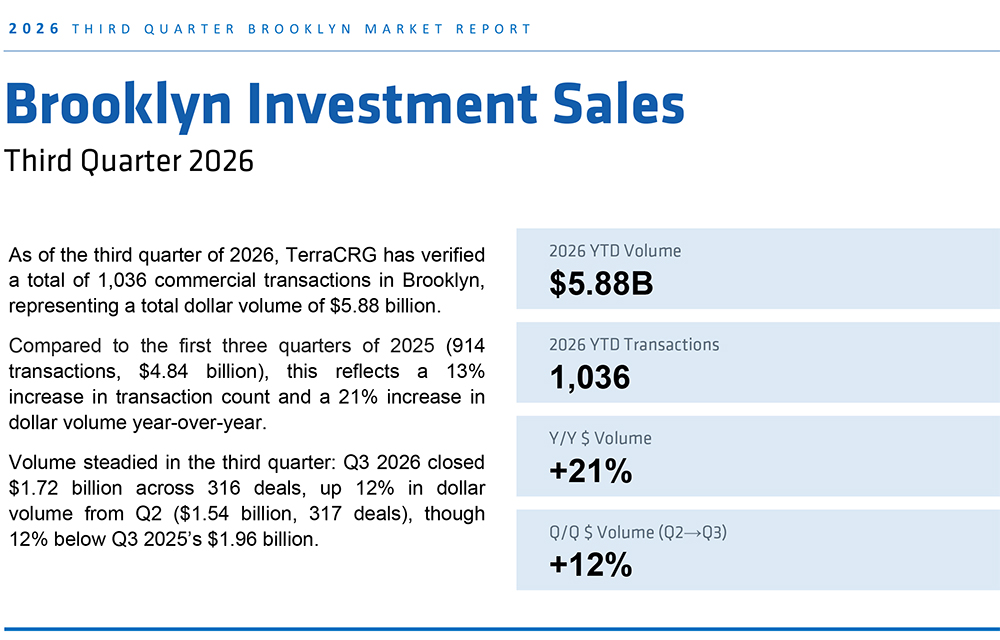
TerraCRG releases 3Q 2026 Brooklyn Market Report: Investment sales reach $5.88 billion tear-to-date, up 21%
Brooklyn, NY TerraCRG released its 3Q 2026 Brooklyn Market Report. Through the first three quarters of 2026, TerraCRG verified 1,036 commercial investment sales in Brooklyn






 (2).gif)

Columns and Thought Leadership

Hunt CRE question and answer: Choosing a real estate agent - by David Hunt
First, we will only work with one agent exclusively. The primary reason is that we want that agent to legally represent our client’s interests. In New York State, a real estate agent has a fiduciary

The art of investing in real estate - by Thomas Donovan
Real estate investing is as much an art as it is a skill. No one can time the market, or the factors that drive it, perfectly. Location, zoning, size, transportation, and neighborhood density give you a baseline for

New York’s streets are full again, and the retail numbers prove it - by Noam Aziz
Walk down any New York block this year and you can feel it. The sidewalks are crowded, the storefronts are lit, and the energy that defines this city is back at full volume.

Hunt commercial real estate question and answer: Fortune 500 wisdom - by David Hunt
Yes, there are lessons to be learned from the largest companies in America when comes to managing your real estate. But the decision to buy or lease real estate may not be one of
.gif)