



News:
Brokerage
Posted: May 18, 2021
Open Access/REAP celebrates completion of inaugural fellowship
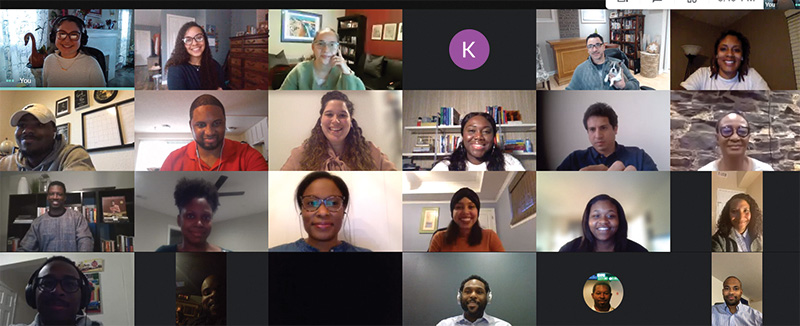
New York, NY “The flow of capital determines–for better or worse–everything!” said Margaret Anadu, global head of sustainability and impact, Goldman Sachs Asset Management, who spoke with candor and passion on Friday, April 23rd, at a virtual culminating event marking the conclusion of the inaugural Open Access fellowship. The effort was created to bring Black and Latinx representation into community development finance, starting with the New Markets Tax Credit program. While the industry often serves communities of color, areas which have been disproportionately hard hit by the pandemic, it is grossly under-represented by BIPOC professionals.
The fellowship that launched on Martin Luther King Day–January 18th, 2021–was developed by Gina Nisbeth, director at Citi, and Jeff Monge, managing partner of Monge Capital, leveraged by Project REAP (Real Estate Associate Program), a leading diversity and inclusion initiative in commercial real estate for over 20 years, and partnered with Novogradac & Co. LLP.
Nisbeth offered an overview of the program and noted the commitment to renew it in 2022. The 12-week virtual fellowship offered on-the-job paid training, mentorships, and networking to a 24-member cohort composed of 13 women and 11 men. She praised the talent of the fellows all of whom hold an undergraduate degree, over half with advanced degrees, and 16 are REAP alumni or current fellows. The group includes individuals employed in related or unrelated industries, attorneys, and other professionals, ranging from early to mid-career level. The program prepares fellows for community development careers in accounting, legal, finance, consultancy, development, and related areas.
Monge interviewed Anadu whom he dubbed “an intentional social warrior [with] the ability to make so much change.” She expressed her deeply rooted personal commitment to community development finance saying that when she began work in urban investment “The sky opened up – I [realized] I can work on deals that impact neighborhoods like the one I grew up in.”
The stakes are high and meaningful, said Anadu, “If I don’t do it, a homeless family won’t have a home, a community won’t have healthcare. The impact is real, and it matters.”
Merrill Hoopengardner, president of the National Trust Community Investment Corp. (NTCIC), one of the 18 firms sponsoring the fellows, said, “There have been some positive changes in the industry...A lot [of people] are figuring out how to tackle this field and get out of the lanes we’ve been in.” The change is easier to accomplish in a smaller organization, she said, noting that four or five people on the NTCIC executive management team are women.
David Gibson, senior VP, manager specialty tax credit investments with PNC Bank, agreed that the goal is to retain diverse talent at the mid-career level and above. He said, “Having that known challenge, the idea of what this could be, could translate across our real estate team.”
He applauded the fellows saying, “We’ve received more than we’ve given.”
Multiple fellows were offered positions with their sponsors and others created their own firms following completion of the program including:
Brianne Lund, Monge Capital fellow, has been retained full-time by the firm. Said Lund, “Open Access was an invaluable experience that opened my eyes to community development finance. I was able to learn from a wide spectrum of industry leaders all while connecting with my awe-inspiring cohort.”
Desiree Thomas, TruFund Capital fellow, has been retained full-time by the firm. Thomas noted her appreciation of Open Access “for providing a diverse group of professionals with access and exposure to community development finance, specifically New Markets Tax Credit”
Claudia Diaz, the Open Access program manager, has started her own consulting firm, Diaz Consulting, and will continue building the program. Says Diaz, “I’m excited to be an active contributor to an initiative that pushes to increase representation. Community development finance needs to reflect the communities it works with.”
Danielle Salters who interned with New Jersey Community Capital (NJCC) credits the program for, as she says, “launch[ing] a career into the world of impact investing.” Her newly formed consulting company is EquiCap Consulting LLC with NJCC as her first client.
The fellows were enthusiastic in the kudos granted to Open Access.
Anika Wright, who interned for Advantage Capital while studying for her MBA, won the program’s Networking Challenge Award. Said Wright, “[This was] my first introduction to community development finance and it really helped me decide where to take my career and gave me a whole network of contacts.”
Steven McClendon, who completed his fellowship with The Reinvestment Fund sponsored by Chase said, “I feel so grateful. This is fundamentally complex – It’s a gift to see something nuanced. [It was] a wonderful experience.”
Christen Jade Richardson, who worked for Greenline Ventures, called Open Access, “A saving grace for me. I was able to tap into and see the deals. It helped me network with people in the community. It was amazing. I know I want to be in the community development space – It’s been an awakening.”
Ashley McMichael who worked at Novogradac & Company LLP said, “I feel like I know where to start – I have much more knowledge about community development finance. I’m very excited.”
Monge assured fellows that their skills are transferable, noting the value of the perspective that comes from knowledge and understanding of a community’s dynamic. “Being a person of color in community development finance is a plus,” he said. Monge previously noted, “This is not just the right thing to do, the proper representation influences our allocation of resources, the projects we fund and the impacts we create and achieve in the communities.”
CAPTIONS: 1 – Anika Wright won the Open Access Networking Challenge for accumulating the most points during virtual networking sessions.
2 – The Open Access fellows all hold undergraduate degrees, half have advanced degrees, 16 are alumni or current fellows in a Project REAP (Real Estate Associate Program) commercial real estate program.
The Open Access Fellows were:
|
Fellow |
Fellowship |
Headquarters |
|
Trevor Nelson |
Advantage Capital |
New Orleans, LA |
|
Anika Wright |
Advantage Capital |
New Orleans, LA |
|
Jaquis McCullough |
Baker Tilly US, LLP |
Chicago, IL |
|
Melanie McNeely |
Chicago Community Loan Fund |
Chicago, IL |
|
Ja’Shar Hartley |
Cinnaire |
Lansing, MI |
|
John Moore |
Classic Lake Consulting |
Los Angeles, CA |
|
Ed Chatmon |
Cleveland Development Advisors |
Cleveland, OH |
|
Christen Richardson |
Greenline Ventures |
Denver, CO |
|
Isaiah Williams |
Greenline Ventures |
Denver, CO |
|
Chabeli Caceres |
Monge Capital |
Newark, NJ |
|
Chima Joseph |
Monge Capital |
Newark, NJ |
|
Brianne Andrea Lund |
Monge Capital |
Newark, NJ |
|
Giovanni Araujo |
National Trust Community Investment Corp. |
Washington, DC |
|
Danielle Salters |
New Jersey Community Capital |
New Brunswick, NJ |
|
Jocelyn Moore |
New Markets Support Company |
Chicago, IL |
|
Rob Ebanks |
New Markets Support Company |
Chicago, IL |
|
Allison Bernstein |
Novogradac & Company LLP |
San Francisco, CA |
|
Ashley McMichael |
Novogradac & Company LLP |
San Francisco, CA |
|
Jessica Washington |
Novogradac & Company LLP |
San Francisco, CA |
|
Nicole Dillard |
Stonehenge Capital |
Columbus, OH |
|
Ono Uwhebetine |
PNC Financial Services Group |
Pittsburgh, PA |
|
Marcus Jones |
TELACU |
Los Angeles, CA |
|
Steven McClendon |
Reinvestment Fund |
Philadelphia, PA |
|
Desiree Thomas |
TruFund Financial Services |
New York, NY |
In addition to paid fellowship sponsorships, other programmatic financial sponsors include JPM Chase, U.S. Bank, Citi, PNC Bank, Novogradac, Dudley Ventures, Advantage Capital, NTCIC, and Monge Capital.
Tags:
Brokerage
MORE FROM Brokerage

Adirondack Capital Partners arranges $45 million sale of West Chelsea development site to Toll Brothers
Manhattan, NY Adirondack Capital Partners (ACP) closed the $45 million sale of 126/128 Tenth Ave. and 456 W. 18th St. to Toll Brothers City Living. The acquisition forms part of a broader






Quick Hits
 (2).gif)

Columns and Thought Leadership

New York’s streets are full again, and the retail numbers prove it - by Noam Aziz
Walk down any New York block this year and you can feel it. The sidewalks are crowded, the storefronts are lit, and the energy that defines this city is back at full volume.

A guide to finding the right NYC property management company - by Sanjay Gandhi
Being a small to midsize landlord in NYC is an increasingly demanding endeavor. From navigating complex regulations, increased compliance demands to dealing with tenant issues and remediating violations. It is wise to enlist the assistance of a partner, a professional

Hunt commercial real estate question and answer: Fortune 500 wisdom - by David Hunt
Yes, there are lessons to be learned from the largest companies in America when comes to managing your real estate. But the decision to buy or lease real estate may not be one of

Positive forecast for New York’s pro-housing push? - by Philip Butler
New York’s housing crisis remains a hot button topic despite growing consensus that varied and affordable housing is desperately needed statewide. Governor Hochul has recently introduced several initiatives to overcome N.Y.’s anti-housing
.gif)