



News:
Brokerage
Posted: December 8, 2015
Omni celebrates grand opening of the $4.9 million Steuben Place Apartments
 Kathy Sheehan, Mayor of Albany
 Council, Capitalize Albany Corporation, and Berkshire Bank.”
James Rubin, commissioner/CEO of New York State Homes and Community Renewal said, “HCR is proud of the role we’ve played in making Albany a 24-hour community. This revitalization project includes affordable and market rate apartments that bring residents and businesses downtown. Under governor Cuomo’s leadership, HCR is working side-by-side with public and private partners like Omni and the City of Albany on projects like Steuben Place that breathe new life into communities.”
Over half of residential conversion projects completed in downtown Albany to date have received assistance from the State, through New York State Homes and Community Renewal. The funding is taking blighted, vacant buildings and breathing new life through the creation of apartments and commercial spaces, bringing new residents, neighborhood services and amenities, and new jobs to Downtown. These conversion projects have also assisted in lowering the central business district’s vacancy rate by 2% in just one year.
“The opening of the Steuben Place Apartments is yet another great step for the City of Albany,” said Senator Neil Breslin. “We continue to see new investments made in both commercial and residential spaces throughout the Capital City, further demonstrating that Albany is a city on the rise. I commend Omni Development for bringing this important project to fruition.”
As part of Governor Cuomo’s Regional Economic Development Council Initiative, the project received New York State Main Street Grant monies which resulted in three affordable units, with additional funding made available through Berkshire Bank. New York State Homes and Community Renewal’s (HCR) New York Main Street Funds were granted to Capitalize Albany to help renovate the commercial space as part of the fourth round of the Consolidated Funding Application. This project was also made possible in part due to financial assistance provided by the City of Albany Industrial Development Agency in the form of mortgage recording, sales and real property tax abatement.
“The momentum in Albany is undeniable,” said Reginelli, president of Capitalize Albany Corporation and CEO of the City of Albany Industrial Development Agency. “We are thrilled to have Omni stepping into the Downtown residential arena and providing mixed-use opportunities during a critical growth period for both the residential and retail markets. As implementation of Impact Downtown Albany continues, we are capturing Albany’s potential through dedicated stakeholders like Omni Development, support from our economic development partners, and Governor Cuomo’s visionary understanding that creating strong urban centers leads to regional economic growth.”
“Today is another great day for our District as we celebrate new, modern apartments, as well as our newest Downtown residents,” said Steffens. “This transformational undertaking represents not just this project, but what lays ahead for our Capital City. As we welcome these neighbors, it is another chance to highlight our 24/7 community that features world-class dining, arts, and entertainment. As our District’s largest property owner, Omni has long understood the value of investing here, and it is exciting to see their first foray into Downtown residential come to fruition.”
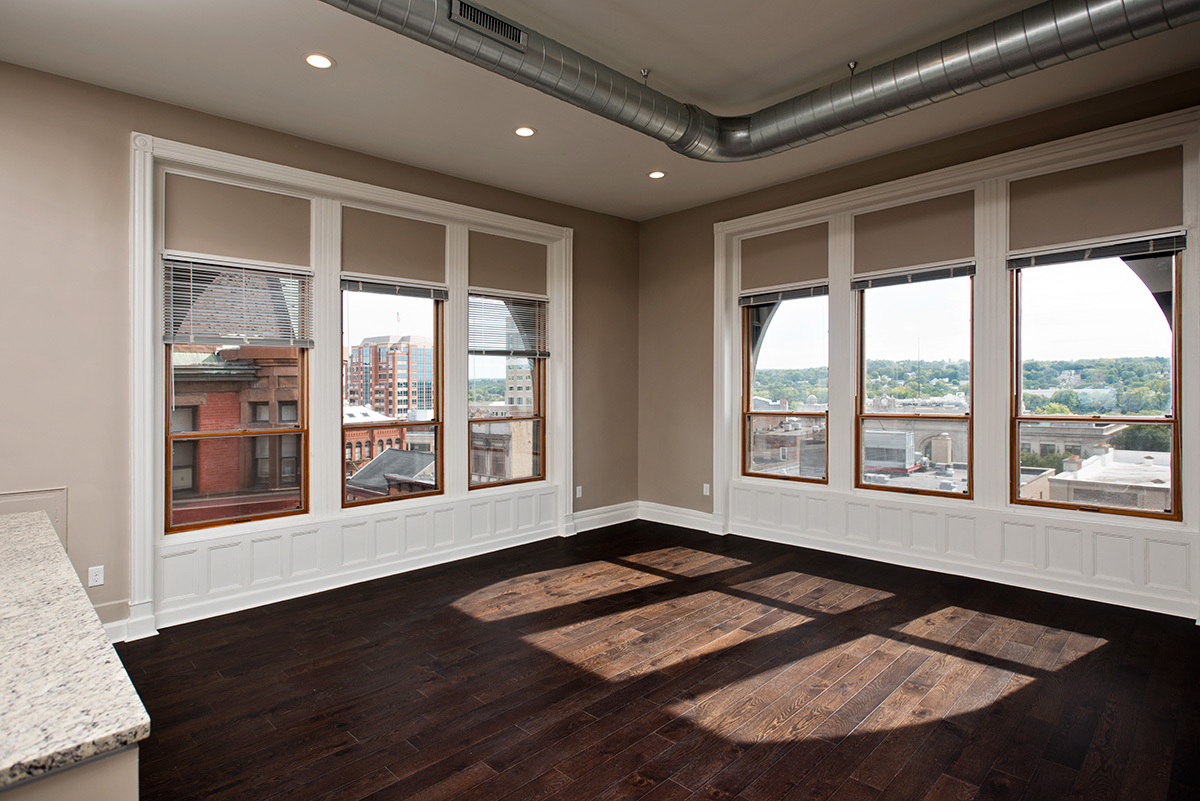
Featuring 11’ ceilings and spacious living area, custom California Closets, fully-equipped modern kitchen, original wood trim and wainscoting hardwood floors, large windows, and passenger and freight elevators, units range in price from $950 to $1,900 and include parking, high-speed internet, wifi, cable, dedicated storage space, and an on-site 24-hour fitness center. The 2,600-square-foot ground-level retail space will a house Downtown market slated to open late fall.
During the event, thanks were expressed to Darius Shahinfar, City of Albany Treasurer, Tracy Metzger, chairperson of the IDA Board, and Jeffrey Sperry, Capitalize Albany Corporation boardmember for their support.
Council, Capitalize Albany Corporation, and Berkshire Bank.”
James Rubin, commissioner/CEO of New York State Homes and Community Renewal said, “HCR is proud of the role we’ve played in making Albany a 24-hour community. This revitalization project includes affordable and market rate apartments that bring residents and businesses downtown. Under governor Cuomo’s leadership, HCR is working side-by-side with public and private partners like Omni and the City of Albany on projects like Steuben Place that breathe new life into communities.”
Over half of residential conversion projects completed in downtown Albany to date have received assistance from the State, through New York State Homes and Community Renewal. The funding is taking blighted, vacant buildings and breathing new life through the creation of apartments and commercial spaces, bringing new residents, neighborhood services and amenities, and new jobs to Downtown. These conversion projects have also assisted in lowering the central business district’s vacancy rate by 2% in just one year.
“The opening of the Steuben Place Apartments is yet another great step for the City of Albany,” said Senator Neil Breslin. “We continue to see new investments made in both commercial and residential spaces throughout the Capital City, further demonstrating that Albany is a city on the rise. I commend Omni Development for bringing this important project to fruition.”
As part of Governor Cuomo’s Regional Economic Development Council Initiative, the project received New York State Main Street Grant monies which resulted in three affordable units, with additional funding made available through Berkshire Bank. New York State Homes and Community Renewal’s (HCR) New York Main Street Funds were granted to Capitalize Albany to help renovate the commercial space as part of the fourth round of the Consolidated Funding Application. This project was also made possible in part due to financial assistance provided by the City of Albany Industrial Development Agency in the form of mortgage recording, sales and real property tax abatement.
“The momentum in Albany is undeniable,” said Reginelli, president of Capitalize Albany Corporation and CEO of the City of Albany Industrial Development Agency. “We are thrilled to have Omni stepping into the Downtown residential arena and providing mixed-use opportunities during a critical growth period for both the residential and retail markets. As implementation of Impact Downtown Albany continues, we are capturing Albany’s potential through dedicated stakeholders like Omni Development, support from our economic development partners, and Governor Cuomo’s visionary understanding that creating strong urban centers leads to regional economic growth.”
“Today is another great day for our District as we celebrate new, modern apartments, as well as our newest Downtown residents,” said Steffens. “This transformational undertaking represents not just this project, but what lays ahead for our Capital City. As we welcome these neighbors, it is another chance to highlight our 24/7 community that features world-class dining, arts, and entertainment. As our District’s largest property owner, Omni has long understood the value of investing here, and it is exciting to see their first foray into Downtown residential come to fruition.”
Featuring 11’ ceilings and spacious living area, custom California Closets, fully-equipped modern kitchen, original wood trim and wainscoting hardwood floors, large windows, and passenger and freight elevators, units range in price from $950 to $1,900 and include parking, high-speed internet, wifi, cable, dedicated storage space, and an on-site 24-hour fitness center. The 2,600-square-foot ground-level retail space will a house Downtown market slated to open late fall.
During the event, thanks were expressed to Darius Shahinfar, City of Albany Treasurer, Tracy Metzger, chairperson of the IDA Board, and Jeffrey Sperry, Capitalize Albany Corporation boardmember for their support.
Tags:
Brokerage
MORE FROM Brokerage

Ones To Watch: Innovators In Commercial Real Estate: Lisa Nickerson, Infinityy
What I’m most proud of is the human impact of what we’re building. Technology should do more than improve efficiency — it should make




Quick Hits

Columns and Thought Leadership

Hunt commercial real estate question and answer: Fortune 500 wisdom - by David Hunt
Yes, there are lessons to be learned from the largest companies in America when comes to managing your real estate. But the decision to buy or lease real estate may not be one of

Hunt CRE question and answer: Choosing a real estate agent - by David Hunt
First, we will only work with one agent exclusively. The primary reason is that we want that agent to legally represent our client’s interests. In New York State, a real estate agent has a fiduciary

The art of investing in real estate - by Thomas Donovan
Real estate investing is as much an art as it is a skill. No one can time the market, or the factors that drive it, perfectly. Location, zoning, size, transportation, and neighborhood density give you a baseline for

New York’s streets are full again, and the retail numbers prove it - by Noam Aziz
Walk down any New York block this year and you can feel it. The sidewalks are crowded, the storefronts are lit, and the energy that defines this city is back at full volume.
.gif)