



News:
Brokerage
Posted: November 23, 2021
New York Real Estate, Development, & Public Policy experts discuss barriers to commercial development
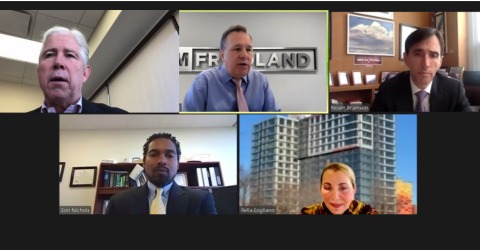
New York, NY Commercial development plays an imperative role in the success and longevity of a community. But, the road to its execution can be riddled with legal, ethical and environmental hinderances. Real estate experts joined leading development and public policy professionals to discuss commercial development complexities and their resolutions in a virtual panel Nov. 18 hosted by Fordham University’s Real Estate Institute, the Hudson Gateway Association of Realtors, Inc. (HGAR) and OneKey® MLS.
“Breaking Down Roadblocks in Commercial Development” featured Noam Bramson, mayor, City of New Rochelle, N.Y; Arthur Collins, principal and president, Collins Enterprises LLC; Rella Fogliano, founder and CEO, MacQuesten Development LLC and MacQuesten Construction Management LLC; and Eon Nichols, partner and vice-chair, Real Estate, Corporate, Finance and Non-Profit Groups, Cuddy & Feder LLP.
“We’re delighted to be partnering with the Hudson Gateway Association of Realtors and its Commercial Investment Division for today’s event,” said Andrea Marais, associate dean, strategic marketing and enrollment, School of Professional and Continuing Studies, Fordham University. “REI has a strong focus on commercial real estate, which comes through in our curriculum for our Master's in Real Estate, RE Development and Construction Management, in our professional certificate programs, and in our undergraduate degree for professionals in real estate.”
“This is such an important topic for our colleagues in the commercial market and it’s a pleasure to partner with Fordham’s Real Estate Institute,” said Richard Haggerty, CEO, HGAR, and president/chief strategic growth officer, OneKey® MLS. “We believe in collaborating and sharing best practices for conducting business. Together, we can all work smarter.”
Bramson highlighted the region’s surge of growth in the 1980s and 1990s as a result of vehicle accessibility and usage. Now, the commercial development focus has changed as “people rediscover the virtues of compact, walkable transit-served neighborhoods where goods and services are all readily accessible, where transportation costs are somewhat lower,” Bramson said, and emphasized the future of commercial development looks bright. “The change, which may have created some challenges for our region in the post ‘80s, ‘90s period, is now opening up new opportunities for urban centers that have the infrastructure to support growth but which have not been previously seen as ripe for it.”
The discussion was moderated by John Barrett, managing director/investment sales Division, RM Friedland, and president, Commercial and Investment Division of HGAR. The hour-long session identified key areas for commercial development focus, including zoning and zoning adjustments, construction and property costs, PILOT (payment in lieu of taxes) programs, and how to effectively communicate plans to both the public and governing municipalities.
“When it comes to the process of entitlements for all these municipalities—essentially the developer has become conversant with every element of the project,” said Collins. “Density, school-children generation, parking, traffic impact, building height, sun and shadows—all of this comes into play and we know by virtue of doing it a number of times what we are generating.”
Nichols agreed, saying increased transparency will improve efficiency and productivity across the board in commercial development. “Having clarity and being able to communicate to the developers exactly what they can get in terms of a PILOT really helps and gives certainty to folks who want to develop there. When I look at other municipalities where there’s no clarity in terms of a PILOT, the deals linger for years, months.”
Barrett asked the panel to share advice to Fordham University real estate students on how to excel in commercial development. “In today’s world, to start on your own is extremely difficult,” said Fogliano, and noted as an impediment the high cost of land. “Work for a developer first and absorb as much as possible. Learn about the current landscape and its intricacies.”
Tags:
Brokerage
MORE FROM Brokerage
Residential real estate consultancy and brokerage firm Nancy Packes, Inc. rebrands as NPI
Manhattan, NY The NYC-based premier residential real estate consultancy and brokerage firm, Nancy Packes Inc., has rebranded as NPI. Helmed by Seth Rosner, most recently the firm’s managing partner and now president, the company has been intricately involved in hundreds of Tri-State new developments and conversions, spearheading the full project life cycle, from assessment/pre-dev.






Columns and Thought Leadership

New York’s streets are full again, and the retail numbers prove it - by Noam Aziz
Walk down any New York block this year and you can feel it. The sidewalks are crowded, the storefronts are lit, and the energy that defines this city is back at full volume.

The art of investing in real estate - by Thomas Donovan
Real estate investing is as much an art as it is a skill. No one can time the market, or the factors that drive it, perfectly. Location, zoning, size, transportation, and neighborhood density give you a baseline for

Hunt commercial real estate question and answer: Fortune 500 wisdom - by David Hunt
Yes, there are lessons to be learned from the largest companies in America when comes to managing your real estate. But the decision to buy or lease real estate may not be one of

Hunt CRE question and answer: Choosing a real estate agent - by David Hunt
First, we will only work with one agent exclusively. The primary reason is that we want that agent to legally represent our client’s interests. In New York State, a real estate agent has a fiduciary
.gif)