



News:
Brokerage
Posted: May 16, 2023
NEW is recipient of 2022 WANTO funding, two-year grant of $714,000
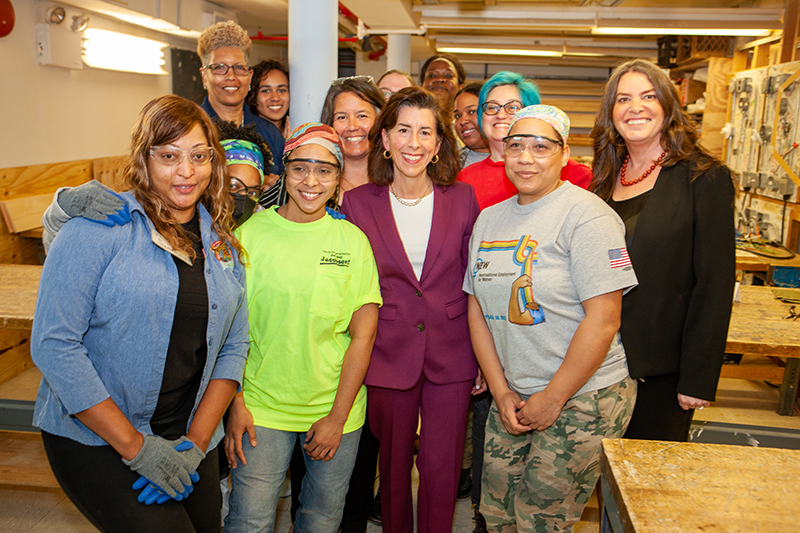
Row two: Maria Buckmire, Wendy Chun-Hoon, Women’s bureau director, USDOL, Jeannie Lockwood, Kathleen Culhane, president, NEW;
Marie Sullivan, Fox Williams, Nancy Matias, Abigail Wendt, Alecia Flemming-Fletcher, Dana Torres, and Janice Grier.
Washington, DC NEW is the recipient of 2022 WANTO funding, a two-year grant of $714,000.
To continue its support of the Biden-Harris administration’s infrastructure, manufacturing and clean energy investments, the U.S. Department of Labor announced the availability of $5 million to fund up to 14 grants to attract and support women in gaining access to Registered Apprenticeship Programs in industries where they are underrepresented such as construction, manufacturing and cybersecurity.
The Women in Apprenticeship and Nontraditional Occupations grants are administered by the department’s Employment and Training Administration and Women’s Bureau.
Nontraditional Employment for Women (NEW ) is the recipient of 2022 WANTO funding, a two-year grant in the amount of $714,000. To enter a lucrative and sustainable field like construction, women must have access to resources that address their specific needs in the industry. As a WANTO funding recipient they are able to offer no-cost, comprehensive training in both the hard and soft skills needed to thrive in a trade career including advanced training programs, an expanded employer base with direct entry into Registered Apprenticeship Programs, wrap around social services including the nontraditional childcare pilot program in partnership with the North American Building Trade Unions, and a growing number of opportunities available to women through those employers.
Thirty percent of NEW graduates are single parents and heads of households, in which access to child care assistance is a challenge. More than 82% of individuals accessing NEW’s services identify as a minority, additionally 80% come from low-income backgrounds and are underemployed working minimum wage jobs, with 75% receiving some form of public assistance such as SNAP or TANF.
Funding and partnership received by WANTO enables NEW to enroll up to 350 individuals each year and connect them with career opportunities. NEW believes that equitable economic opportunities for tradeswomen means increasing union construction projects as well as creating stability and efficiency of long-term construction by advocating for diversity goals on projects. Projects such as the USDOT Raise grants for New York City that prioritize diversity goal setting and tradeswomen hours for the lifetime of the project.
WANTO funding has allowed NEW to grow in capacity with the hiring of more staff dedicated to recruitment, employment and career placement, as well as retention. Additionally, WANTO funding supports NEW recruitment posters that are now in more than 200 NYC subway stations and have increased inquiries about our program by more than 500%. Soon these posters will be in subway cars and on bus shelters. These posters also caught the eye of major news networks- like Univision and after their broadcast at a NEW Signature Project job site last week, the influx of calls to enroll was overwhelming. WANTO funding means that NEW can provide dues assistance to apprentices, purchase their first tool kit, provide metro cards, and clothing and boots when needed. This funding not only helps to support program curriculum, recruitment, and placement but is also helping to put tools in hands and retain women in these highly gender segregated but transformative careers.
Nontraditional Employment for Women (NEW) prepares, trains, and places women in careers in the skilled construction, utility, and maintenance trades, helping women achieve economic independence and a secure future for themselves and their families. At the same time, NEW provides a pipeline of qualified workers to the industries that build, move, power, green, and maintain New York.
Since 1978, NEW has been a groundbreaking model that works - for women and for New York City. NEW places and supports low-income women in trades careers through advanced training programs, an expanded employer base, and a growing number of opportunities available to women through those employers.
NEW’s goal is to increase the number of women employed in trade careers, specifically those that offer strong wages, benefits, training and potential for advancement. These career paths have been historically less accessible to women but offer the opportunity to fundamentally transform one’s income and wealth. NEW focuses on placing and retaining graduates with New York City trade unions, public utilities, transportation authorities, and building operations companies. NEW’s objective is to continue to deepen efforts to train and prepare women for careers that provide sustainable financial support and stability for themselves and their families.
Tags:
Brokerage
MORE FROM Brokerage

Law Firm Nutter expands space to 11,438 s/f at 5 Grand Central East
Manhattan, NY According to the Durst Organization, full-service law firm Nutter is expanding their office at 5 Grand Central East to 11,438 s/f. Nutter will take the entire 25th floor, in addition to renewing the firm’s existing office space on the 27th floor of the building.




 (2).gif)

Columns and Thought Leadership

A guide to finding the right NYC property management company - by Sanjay Gandhi
Being a small to midsize landlord in NYC is an increasingly demanding endeavor. From navigating complex regulations, increased compliance demands to dealing with tenant issues and remediating violations. It is wise to enlist the assistance of a partner, a professional

Positive forecast for New York’s pro-housing push? - by Philip Butler
New York’s housing crisis remains a hot button topic despite growing consensus that varied and affordable housing is desperately needed statewide. Governor Hochul has recently introduced several initiatives to overcome N.Y.’s anti-housing

Hunt commercial real estate question and answer: Fortune 500 wisdom - by David Hunt
Yes, there are lessons to be learned from the largest companies in America when comes to managing your real estate. But the decision to buy or lease real estate may not be one of

New York’s streets are full again, and the retail numbers prove it - by Noam Aziz
Walk down any New York block this year and you can feel it. The sidewalks are crowded, the storefronts are lit, and the energy that defines this city is back at full volume.
.gif)