


News:
Owners Developers & Managers
Posted: April 5, 2016
Metropolitan Transportation Authority’s Fulton Center receives LEED Silver designation from USGBC
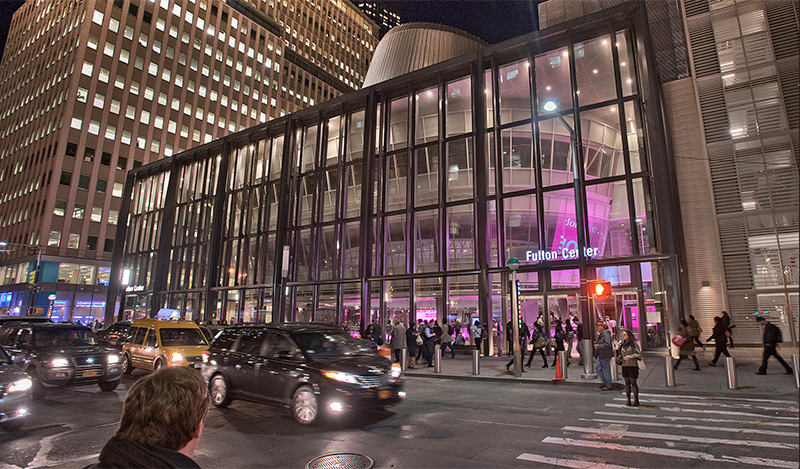 The Fulton Center - Manhattan, NY
Manhattan, NY The Metropolitan Transportation Authority (MTA) has been awarded LEED Silver certification for the Fulton Center on Broadway between Fulton and Dey Sts. in the Financial District.
The Fulton facility is one of the first subway stations to receive a LEED rating. The LEED rating system, developed by the U.S. Green Building Council (USGBC), is the foremost program for buildings, homes and communities that are designed, constructed, maintained and operated for improved environmental and human health performance.
The Fulton Center was designed as a demonstration of an environmentally responsible 21st century rail transit center. It achieved LEED certification for implementing practical and measurable strategies in sustainable site development, water savings, energy efficiency, materials selection and indoor environmental quality.
The facility achieves more than 25 percent in energy savings compared to a baseline building of similar type. Half of the energy used at the Fulton Center comes from renewable sources. Additionally, daylighting from the iconic oculus reduces electricity use, while low flow plumbing fixtures reduce water consumption by 40%.
“The Fulton Center has been the recipient of a number of awards and honors, but this designation is truly special,” said MTA Capital Construction (MTACC) president Michael Horodniceanu. “It shows how we married the old with the new to create a state of the art transportation hub, shopping destination and office facility while keeping the environment top of mind.”
Encased in a glass and steel shell, the bright and modern facility dramatically improves the commuter experience and will accommodate up to 300,000 daily riders using the 2, 3, 4 5, A, C, J, Z and R subway lines. Construction of the Fulton Center included restoration of the 125-year-old Corbin Building, which will provide additional public access to the facility. The Fulton Center houses nearly 66,000 s/f of revenue generating retail and commercial space and the MTA’s largest digital media program, both of which are being managed and operated by Westfield Corp., an international developer and operator of iconic retail properties and a leader in digital sales and sponsorship.
A new 350-ft.-long pedestrian tunnel constructed under Dey St. between Broadway and Church St. expands intermodal transit options by offering a connection to the R Subway line, built outside of fare control, and ultimately to PATH trains at the World Trade Center complex. These transit options will expand to include transfers to the E Subway at the World Trade Center Transit Hub, and the 1 Subway line once the Cortlandt St. Station is rebuilt.
In order to ensure the new complex is accessible to all of our customers, ten escalators and fifteen American with Disabilities Act (ADA) elevators have been installed. The public restroom facilities include two ADA accessible bathrooms on the concourse and the street level.
The $1.4 billion Fulton Center project was funded with $847 million from a special Congressional appropriation granted after September 11, 2001. Known as the Lower Manhattan Recovery Grants, those funds were intended for local transit agencies to repair, replace, and enhance transportation infrastructure in Lower Manhattan. The MTA provided $130 million in local funds. The project also received $423 million from the American Recovery and Reinvestment Act (ARRA), the largest single award for the Federal Transit Administration’s ARRA projects.
Other MTA facilities achieving LEED status include Mother Clara Hale Bus Depot in Harlem, the Corona Maintenance Shop in Queens and Metro-North Railroad’s office building at 525 North Broadway in North White Plains.
Contractors working on the Fulton Center project under the leadership of MTACC Project Executive Uday Durg included Citnalta Construction Corp., Gramercy Group, Inc., Skanska USA Civil Northeast, Inc., WDF, Inc., Plaza/Schiavone JV, and Judlau Contracting, Inc. Consultants included Arup, Grimshaw, HDR, Page Ayers Cowley Architects, Parsons Brinckerhoff/LendLease JV, and Jamie Carpenter Associates.
MORE FROM Owners Developers & Managers

Rodeo Drive’s new power map: Who owns the brands, and what comes next - by Joseph Aquino
A walk along Rodeo Drive still delivers the expected theater: immaculate storefronts, bold architecture and the names that define global luxury. But a closer look at the doors—and at the construction walls


Quick Hits


Columns and Thought Leadership

Don’t leave severance damages behind - by Sebastian Jablonski
When the government takes a portion of a landowner’s property, most assume just compensation stops at the value of the land taken. However, in partial takings, that is only half of the equation.

NYC's Community Opportunity to Purchase Act is back - and multifamily owners should pay attention - by Ron Cohen
New York City’s Community Opportunity to Purchase Act (COPA) is back, and this latest version could have a much better chance of becoming law. The proposal would give qualified nonprofit organizations
New York City’s historic rent freeze now rests with the courts - by Ron Cohen
New York City’s first-ever two-year rent freeze is now in the hands of a state Supreme Court judge, and the decision could reset income for owners of roughly one million rent-stabilized apartments housing some 2.4 million residents.

Hunt Commercial Real Estate Q&A: Location, location, location? - by David Hunt
In working with our clients, we break down our search objectives into two categories. The first category involves the specific needs of your business such as warehouse height, amount of office space and number of loading