



News:
Brokerage
Posted: May 3, 2016
Mayor de Blasio and New York City Economic Development Corp. celebrate opening of South Bronx Health Center
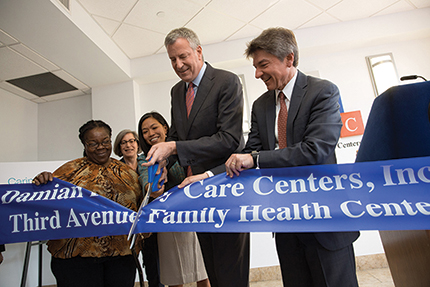 Bronx, NY Mayor de Blasio, New York City Economic Development Corp. (NYCEDC) president Maria Torres-Springer and council speaker Melissa Mark-Viverito recently celebrated the grand opening of the Damian Family Care Center’s Third Avenue Family Health Center, a new community health center providing more than 10,000 people in the area with access to healthcare regardless of a patient’s ability to pay.
“Today, we take another step towards expanding availability to primary care, and providing high-quality and comprehensive healthcare to everyday New Yorkers,” said mayor Bill de Blasio. “No New Yorker should have to decide between their basic needs and their healthcare costs. Damian Center will be accessible to all Bronx residents, regardless of their income.”
The Third Avenue Family Health Center opens as part of the Caring Neighborhoods Initiative, a vital part of the administration’s commitment to reduce health disparities through building primary care capacity in neighborhoods where New Yorkers have faced limited options for convenient and affordable health care services.
The city committed $20 million over two years in its Fiscal Year 2016 budget to cover pre-development and start-up operating costs for new health centers.
The Third Avenue Family Care Center opening is a result of concerted efforts to build stronger neighborhoods and address longstanding health disparities. Because of the administration’s efforts, the Damian Family Care Center is able to take over a previous for-profit medical facility while doubling the average number of patient visits per year and ensuring primary care is available to all regardless of ability to pay.
The Damian team, led by president and CEO Peter Grisafi, is committed to improving the compensation, benefits and job quality for their staff at the Third Avenue Family Health Center, which consists of 90% Bronx residents. Through the support from NYCEDC’s Community Health Center Expansion Program, Damian was able to preserve 60 jobs during the site takeover, and continues to create new staff positions.
As part of Caring Neighborhood’s strategic approach to expanding primary care, NYCEDC’s Community Health Center Expansion Program provides a range of support to Federally Qualified Health Centers (FQHCs) and FQHC look-alikes. There are over 30 non-profit health centers that already provide high-quality primary care in New York City and seek to expand their services in high-needs neighborhoods. The program seeks to accelerate the creation of these health centers by making available on a competitive basis up to $8 million in grants, real estate assistance to help identify new health center sites in underserved neighborhoods including potentially city-affiliated properties, and one-on-one technical assistance, among other benefits.
This effort is the latest in NYCEDC’s portfolio of programs to generate shared prosperity for all New Yorkers. As the city’s primary engine for economic growth, NYCEDC is committed to strengthening neighborhoods and growing quality jobs by building community assets and ensuring that those community assets – like community health centers – have the resources to scale up.
NYCEDC’s Healthcare Desk leads healthcare enterprises to more equitable and profitable business models for both workers and employers through programs addressing health technology adoption, payment reform, real estate transformation, and health inequities.
The Caring Neighborhoods initiative complements the Department of Health and Mental Hygiene’s (DOHMH) initiative to support the integration of public health and primary care in high-need neighborhoods by revitalizing its underutilized buildings to co-locate community-based organizations and providers of medical, dental and mental health services. It also complements the administration’s work to improve healthcare access for immigrant New Yorkers, as recently detailed in a report by the Mayor’s Task Force on Immigrant Health Care Access.
As noted in the report, FQHCs are critical healthcare safety-net providers, delivering culturally competent primary care in community-based settings in neighborhoods with high concentrations of immigrant New Yorkers.
The healthcare sector is the leading employer in New York City, providing 515,500 jobs, 18,500 of which were created over the last year. In 2015, the federal government awarded $8.6 million in New Access Point annual operating grant funding for FQHCs in New York City; the de Blasio administration provided letters of support for many of these applicants.
Tags:
Brokerage
MORE FROM Brokerage

Koeppel Rosen inks 16-year 33,783 s/f lease for coworking firm Nomadworks at 122 West 27th St.
Manhattan, NY According to Koeppel Rosen LLC, leasing and management agent for the Rosen family portfolio, Nomadworks has signed a new 16-year, two-month lease totaling 33,783 s/f at 122 West





Quick Hits
 (2).gif)

Columns and Thought Leadership

Hunt CRE question and answer: Choosing a real estate agent - by David Hunt
First, we will only work with one agent exclusively. The primary reason is that we want that agent to legally represent our client’s interests. In New York State, a real estate agent has a fiduciary

New York’s streets are full again, and the retail numbers prove it - by Noam Aziz
Walk down any New York block this year and you can feel it. The sidewalks are crowded, the storefronts are lit, and the energy that defines this city is back at full volume.

The art of investing in real estate - by Thomas Donovan
Real estate investing is as much an art as it is a skill. No one can time the market, or the factors that drive it, perfectly. Location, zoning, size, transportation, and neighborhood density give you a baseline for

Hunt commercial real estate question and answer: Fortune 500 wisdom - by David Hunt
Yes, there are lessons to be learned from the largest companies in America when comes to managing your real estate. But the decision to buy or lease real estate may not be one of
.gif)