



News:
Brokerage
Posted: April 11, 2023
Markus joins Siebert Williams Shank as a senior advisor and managing director
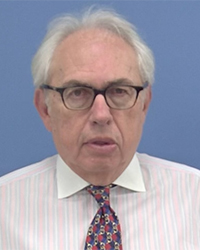
Manhattan, NY Siebert Williams Shank & Co. (SWS) has hired Marvin Markus, a financial industry veteran whose decades of experience will further strengthen and expand the capabilities of the firm’s infrastructure division.
“With the addition of Marvin Markus, our firm is adding a senior banker with a long track record of success for some exceptionally well-respected clients and major, large-scale transactions. We are thrilled that he selected Siebert Williams Shank for the next and greatest stage of his career,” said Suzanne Shank, president & CEO.“Siebert Williams Shank is strong because of the remarkable talent and professionals we are attracting to be part of our firm. Even in times when other firms have paused their hiring initiatives, we have remained focused on strategic growth.”
Markus was the lead banker in the rebuilding of Lower Manhattan following the 9-11 terrorist attacks under the “Liberty Bond” program, including Towers One, 3, 4 and 7 of the World Trade Center, and the Manhattan headquarters for Goldman Sachs and IAC. He has been a trusted advisor to public sector clients, including: the Empire State Development Corporation, Metropolitan Transportation Authority, Port Authority of New York & New Jersey, United Nations Development Corporation, and Veterans Administration, along with the U.S. Departments of Agriculture, Education, Transportation and Housing and Urban Development.
Markus, a 40-year veteran of infrastructure investment and banking, will serve as a senior advisor and managing director. In this role, he will strengthen the infrastructure and real estate practice of SWS, lending his experience to financing initiatives that intersect the municipal markets, including real estate and structured finance and securitization.
Over the course of his career, Markus worked at Goldman Sachs, Paine Webber, Kidder Peabody, and Bear Stearns, where he held senior roles and led significant financings. These included tax-exempt projects on behalf of numerous governmental clients at the federal, state, and local level, as well as international sovereign entities.
William Thompson, Siebert Williams Shank partner, chief administrative officer and former New York City Comptroller said, “I have known and collaborated with Marvin for many years and have seen first-hand the dynamic impact and fresh perspective he can add on behalf of clients. This will be a dynamic fit to the Siebert Williams Shank team.”
Markus also served two terms as chair of the New York City Rent Guidelines Board and the New York City Redistricting Commission. Prior to his move into investment banking, he was the deputy commissioner of the city’s Department of Housing Preservation & Development and led its policy and intergovernmental affairs.
“I am thrilled to join a first-class investment banking operation. Siebert Williams Shank’s reputation for expertly executed funding of top infrastructure projects is second to none. I could not imagine a better fit and be able to continue facilitating the most important transactions of our time,” said Markus.
Dually headquartered in New York, NY and Oakland, CA, SWS is an independent non-bank financial services firm that offers investment banking, sales and trading, research, and advisory services. SWS counts 74 Fortune 100 companies among its clients.
Tags:
Brokerage
MORE FROM Brokerage
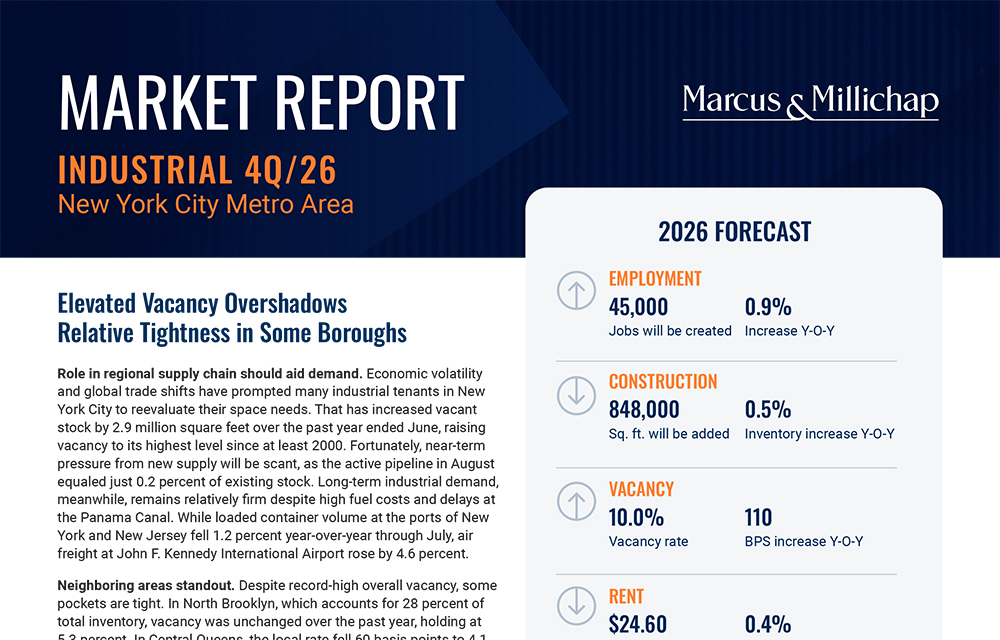
Marcus & Millichap releases fourth-quarter 2026 NYC industrial market report
Manhattan, NY Marcus & Millichap has published its fourth-quarter 2026 New York City Industrial Market Report. “New York City’s industrial market is showing a clear






Quick Hits

Columns and Thought Leadership

New York’s streets are full again, and the retail numbers prove it - by Noam Aziz
Walk down any New York block this year and you can feel it. The sidewalks are crowded, the storefronts are lit, and the energy that defines this city is back at full volume.

Hunt CRE question and answer: Choosing a real estate agent - by David Hunt
First, we will only work with one agent exclusively. The primary reason is that we want that agent to legally represent our client’s interests. In New York State, a real estate agent has a fiduciary
The art of investing in real estate - by Thomas Donovan
Real estate investing is as much an art as it is a skill. No one can time the market, or the factors that drive it, perfectly. Location, zoning, size, transportation, and neighborhood density give you a baseline for

Hunt commercial real estate question and answer: Fortune 500 wisdom - by David Hunt
Yes, there are lessons to be learned from the largest companies in America when comes to managing your real estate. But the decision to buy or lease real estate may not be one of
.gif)