M&T Bank






Commercial real estate is undergoing a shift. New properties are using smart technology like never before, and existing properties need to evolve to be more efficient for both owners and tenants. In New York City, the experts at M&T Bank track these trends in their role as the capital providers for a number of large and influential real estate projects.
The NYREJ recently sat down with Matt Petrula, senior group manager of commercial real estate, Blair Ridder, NYC regional president, and John Chiti, group manager, not-for-profit, of M&T Bank. Here, they share the trends they are watching in New York City and the details about their work on The Shed, the recently opened 200,000 s/f arts center, called a “feat of architectural engineering” by The New York Times.
Q: What trends are you tracking in commercial real estate?
Petrula: There’s more smart-building technology today than even a few years ago. New construction projects are greener, more efficient, and more connected than ever before. Because these trends can also save money for owners of existing buildings, we’re seeing a number of landlords investing heavily in technology to modernize older buildings in their portfolios. One of our customers recently created a proprietary smart building product, which they are selling to other landlords. They are essentially selling a new technology to their direct competitors, so there’s a lot of opportunity in the space.
Ridder: We’re seeing more mobility, especially from bigger companies. It feels like there’s been more movement of headquarters recently, especially in New York, where we’ve watched a steady flow of companies settling into Hudson Yards and Manhattan West. Those West Side communities were nonexistent a few years ago, now there’s a boom in construction on the West Side all the way down to Brookfield Place.
Petrula: Some of the allure of the West Side for large companies is that they can move into new and highly efficient spaces, as Blair was saying. They can move from an old 40,000 s/f space into a 25,000 s/f space in a modern building because that building is much more efficient.
Q: So building owners and operators are seeing more value from efficient, smaller spaces?
Petrula: The shift toward a mobile workforce has certainly left companies with less pressing space requirements. Tenants are also realizing they just don’t need to rent space that they are not using on a regular basis. Operators, who are paying attention, provide hourly or daily spaces for additional workers, meetings, or conferences.
Think about conference rooms and how often their lights are off and they are empty. That space could be as much as 30% of the floor area in an office, and it is being used sparingly. Building owners have taken to setting aside one floor and fitting it out as shared conference space that can be reserved by their tenants. Tenants use the rooms on an ad hoc basis for large meetings and pay on a per diem basis for the hours that they use it.
Ridder: Offices are increasing in terms of the density of people and existing office inventory is just not built for that. New commercial spaces are more efficient – they have better vertical transportation, smarter heating and cooling, and shared bathroom space. These efficiencies have long-term savings for owners, while also allowing tenants to increase density; that keeps occupancy costs down and simultaneously keeps their employees happy. Building owners who pay attention to that are ahead of the curve.
For example, I spoke to one growing company who had a key performance indicator (KPI) on employees to bathroom stalls. When the ratio got too high, it was time for more office space.
Therefore, to better illustrate my claim, you can cram in many more people into a space than the infrastructure can support.
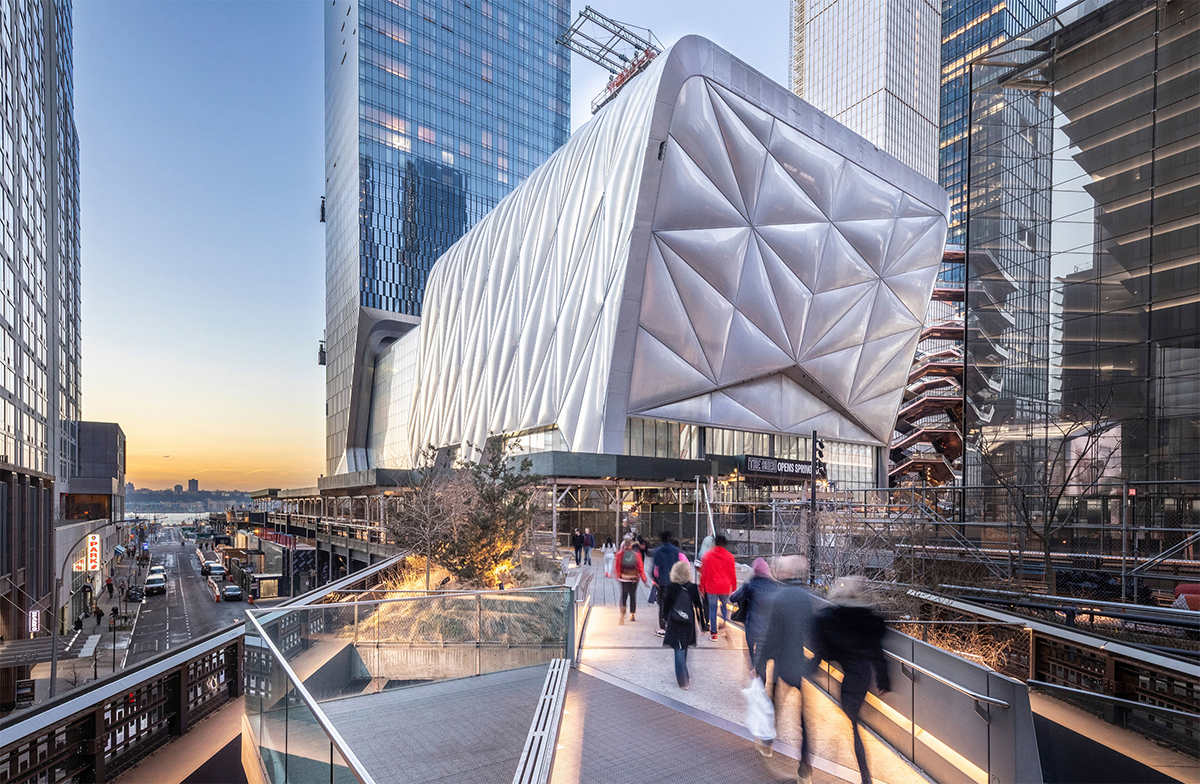
Q: In addition to having expertise in commercial real estate, M&T has deep experience in the non-profit space. Can you tell us a bit about your recent work on The Shed in Hudson Yards?
Chiti: M&T has a rich history of financing cultural institutions – it’s something that makes us all proud and brings us closer to the communities in which we live and work. We’ve helped arts centers, orchestra buildings, and many other institutions in the past, so The Shed seemed like a natural fit for our team. It is this incredible intersection of our two core competencies in Manhattan: commercial real estate and the not-for-profit space.
Ridder: For this project, we watched it come to life from the inside. The banker for the relationship has been on 45 site visits in four years during construction. We met in-person with the engineers whenever they needed to talk about anything.
Being able to sit down with all the major decision makers, at one table helped us to quickly work through the project and solution items before they grew out of hand.
Petrula: Being located close by and having local, in- market decision makers who know the customers well really benefits the project and relationship.
Q: What does your position as a community bank mean for a massive future-forward project like The Shed?
Petrula: New York City is filled with bankers who bank the world, but M&T has always been a community bank – and this model continues to serve us well in Hudson Yards and beyond. In many ways, The Shed exemplifies what we do best – digging in to understand a customer’s unique needs and developing a flexible solution to help meet their goals.
Chiti: We define what we do based on who our clients are. We have specialty lines of business, which include not-for-profit organizations in the education sector, social services, and religious organizations. The Shed is a cultural not-for- profit. While The Shed, by size, is the biggest we’ve looked at, it’s no different in terms of the way we approach the business – that is always defined by the need and the mission of the organization. There was a natural connection between our community bank and the project. The Shed is essentially a startup being built smack in the middle of the biggest private development in the history of the country.
Ridder: The building is a great symbol for New York City, but also a great symbol for what we think is important – funding culture in the communities in which we live and work.
Cultural institutions are truly what make New York City worthy of distinction. M&T Bank works to understand what’s important to its beloved New York City community by investing in spaces, such as The Shed that make this city dynamic. Visit our not-for-profit banking page and our commercial real estate page to learn more.
Matt Petrula is a senior group manager of commercial real estate, Blair Ridder is NYC regional president, and John Chiti is a group manager, not-for-profit, at M&T Bank, New York, N.Y.







.gif)