



News:
Long Island
Posted: July 12, 2022
Long Island Real Estate Group executive board elects new slate of officers
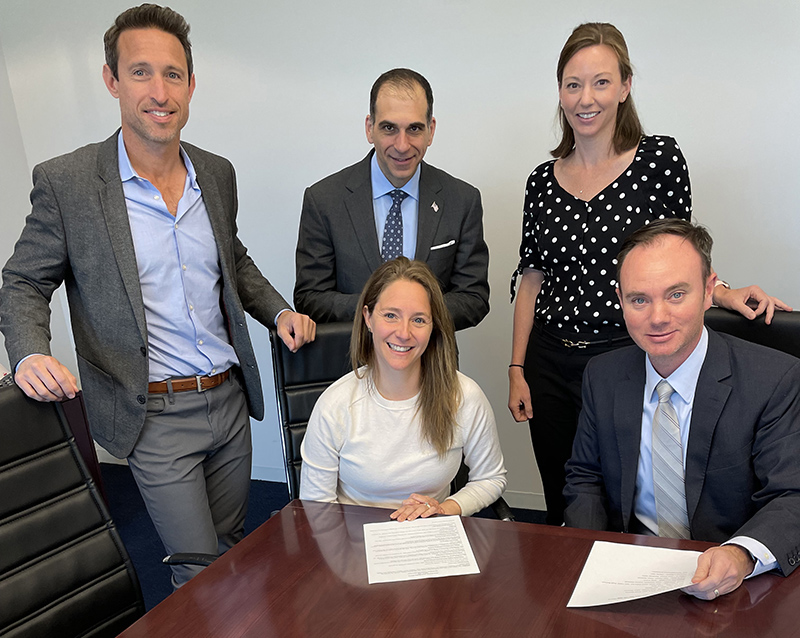
Cara Cronin. Shown seated (from left) are: Alison Brennan and
Sean Cronin.
Westbury, NY The executive board of the Long Island Real Estate Group (LIREG), a networking and philanthropic organization composed of almost 400 professionals in the real estate industry and allied trades on Long Island, elected a new slate of officers who will guide the organization’s mission for the next year.
Alison Brennan and Sean Cronin were re-elected as co-presidents. Brennan is CEO of First Development Corp., where she focuses her work on leasing, management, financing and real estate development. Sean Cronin is partner at Cronin & Cronin Law Firm, where he specializes in negotiating tax certiorari matters for prominent developers, national REITs and local area property owners.
Re-elected as co-vice president is Bram Weber of Weber Law Group, where he is one of Long Island’s most active real estate attorneys. Joining him as co-vice president is Lee Passavia, principal at Domus Group, a full service real estate firm focused on all phases of sustainable development.
Re-elected as treasurer of LIREG is Charles Alter, a partner in Louis Lefkowitz Realty Inc., a property ownership and management firm. And serving as secretary will be Cara Cronin, partner at Cronin & Cronin Law Firm, where she represents commercial property owners in tax certiorari matters in Nassau County, Suffolk County, New York City and Upstate NY.
Given the difficulties of networking and fund-raising during the pandemic, LIREG’s co-presidents said they were proud of how their organization was able to further its mission. “I’m incredibly proud of how our Board and membership were able to navigate the past two years through COVID,” Sean Cronin said. “At a time when many networking groups were challenged to generate a great deal of activity, we were able to continue to have live programs that people were able to participate in and feel comfortable.”
LIREG’s “Under The Tent” events, featuring prominent speakers from the Long Island development and real estate community, utilized outdoor spaces that allowed for physical distancing, while offering the option for online participation.
“These events aligned with our philanthropic mission to raise funds for worthwhile real estate projects for charitable organizations on Long Island,” Sean Cronin said. “Despite everything, we were able to have a highly successful year raising funds.”
Brennan praised her fellow officers and executive board members for their “great accomplishment” in recently surpassing the $2 million mark in total funds raised for charitable real estate projects since LIREG’s founding in 2004. “It’s been a test to lead this organization during the pandemic,” she said. “I’m proud of the work the whole Board and the membership has done to continue to connect with each other while accomplishing our philanthropic goals.”
For more information about LIREG, its charitable projects and upcoming events, visit LIREG.org.
LIREG is a networking and philanthropic group composed of almost 400 professionals in the real estate industry and allied trades on Long Island. Since its founding in 2004, LIREG has contributed more than $2 million to numerous real estate-related projects undertaken by charities on Long Island.
Tags:
Long Island
MORE FROM Long Island

Suffolk County IDA supports expansion of A&Z Pharmaceuticals
Hauppauge, NY The Suffolk County Industrial Development Agency (IDA) has granted preliminary approval of a financial incentive package that will assist a manufacturer in expanding its business by manufacturing more prescription (Rx) pharmaceuticals in addition to its existing over-the-counter




Quick Hits
