



News:
Brokerage
Posted: August 18, 2020
Lendlease, L+M secure Daiwa House as equity partner for 100 Claremont
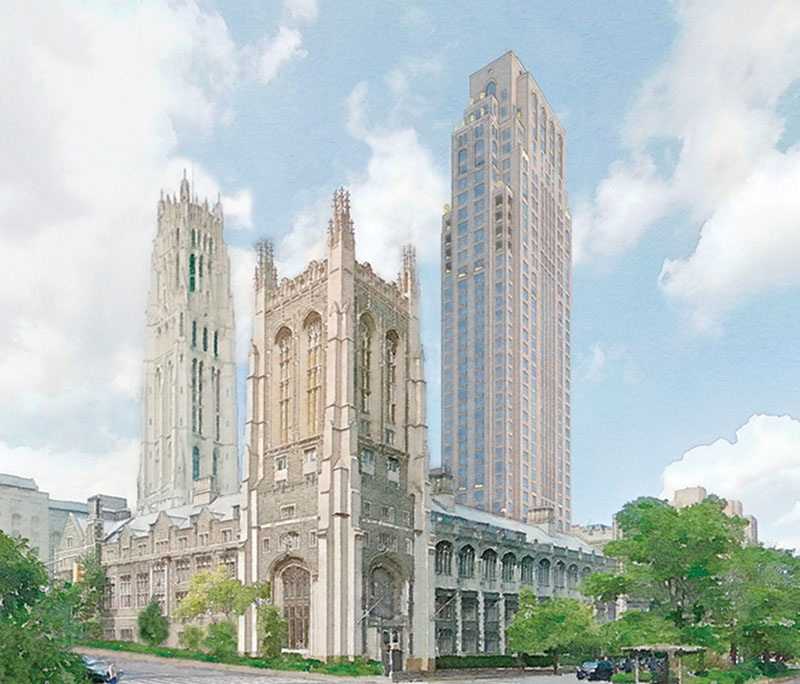
Image courtesy of Robert A.M. Stern Architects
Manhattan, NY Lendlease and L+M have brought on a new joint venture partner, Daiwa House Texas Inc., to create a new mixed-use development at 100 Claremont Avenue. The project, designed by New York architecture firm Robert A.M. Stern Architects, is a 354,000 s/f mixed-use building including residential and academic components, immersed in the cultural and academic neighborhood of Morningside Heights. Its estimated completion date is Spring 2023.
Daiwa House is providing Lendlease and L+M, the two development partners, with equity investment for the project. Daiwa House Texas Inc. is a wholly-owned subsidiary of Japan-based Daiwa House Industry Co., Ltd.
“With the addition of Daiwa House we have solidified a world-class partnership for the development of 100 Claremont Ave., which will allow us to deliver much needed new classroom facilities and high-quality housing for the academic community and neighborhood of Morningside Heights,” said Melissa Román Burch, executive general manager at Lendlease. “We’re proud to combine Lendlease and L+M Development Partners’ extensive New York City and U.S. expertise with Daiwa House’s added global perspective to bring this important project to life.”
“We are proud to be partnering with Lendlease and L+M on this important mixed-use project,” said Greg Taketa, executive vice president at Daiwa House Texas Inc. “This development partnership has been years in the making and we are thrilled to see it come to fruition with the recent closing of construction financing and continuation of construction of 100 Claremont Ave.”
The JV Partnership secured a $250 million construction loan in June from global financial services firm Barings. Barings is an international investment management firm owned by Massachusetts Mutual Life Insurance Company.
When fully constructed, 100 Claremont will integrate with the broader campus and surrounding neighborhood and will provide 54,000 s/f of modern classrooms, academic offices and faculty-designated apartments. The remainder of the building comprises 165 condominium residences with a mix of one-, two-, three- and four-bedroom units. The new building will meet the U.S. Green Building Council standards for LEED Gold Certification, and V2 of the WELL Building Standard.
The JV partnership has pledged $5 million toward the community to protect and support its neighbors. $1.1 million over the course of five years will go to community groups based in Morningside Heights, including a newly created fund by the Morningside Height Community Coalition at the New York Community Trust called the Morningside Heights Community Fund, and to P.A.’L.A.N.T.E, a group that fights homelessness and the displacement of vulnerable tenants. The remaining $3.9 million pledged will be released at the completion of the project and will enable social justice programming to develop the next generation of community leaders.
Tags:
Brokerage
MORE FROM Brokerage

Adirondack Capital Partners arranges $45 million sale of West Chelsea development site to Toll Brothers
Manhattan, NY Adirondack Capital Partners (ACP) closed the $45 million sale of 126/128 Tenth Ave. and 456 W. 18th St. to Toll Brothers City Living. The acquisition forms part of a broader






Columns and Thought Leadership

New York’s streets are full again, and the retail numbers prove it - by Noam Aziz
Walk down any New York block this year and you can feel it. The sidewalks are crowded, the storefronts are lit, and the energy that defines this city is back at full volume.

Hunt commercial real estate question and answer: Fortune 500 wisdom - by David Hunt
Yes, there are lessons to be learned from the largest companies in America when comes to managing your real estate. But the decision to buy or lease real estate may not be one of

Positive forecast for New York’s pro-housing push? - by Philip Butler
New York’s housing crisis remains a hot button topic despite growing consensus that varied and affordable housing is desperately needed statewide. Governor Hochul has recently introduced several initiatives to overcome N.Y.’s anti-housing

A guide to finding the right NYC property management company - by Sanjay Gandhi
Being a small to midsize landlord in NYC is an increasingly demanding endeavor. From navigating complex regulations, increased compliance demands to dealing with tenant issues and remediating violations. It is wise to enlist the assistance of a partner, a professional
.gif)