


 (2).gif)
News:
Spotlight Content
Posted: November 20, 2018
Lee & Associates NYC welcomes 10-person leasing and sales team
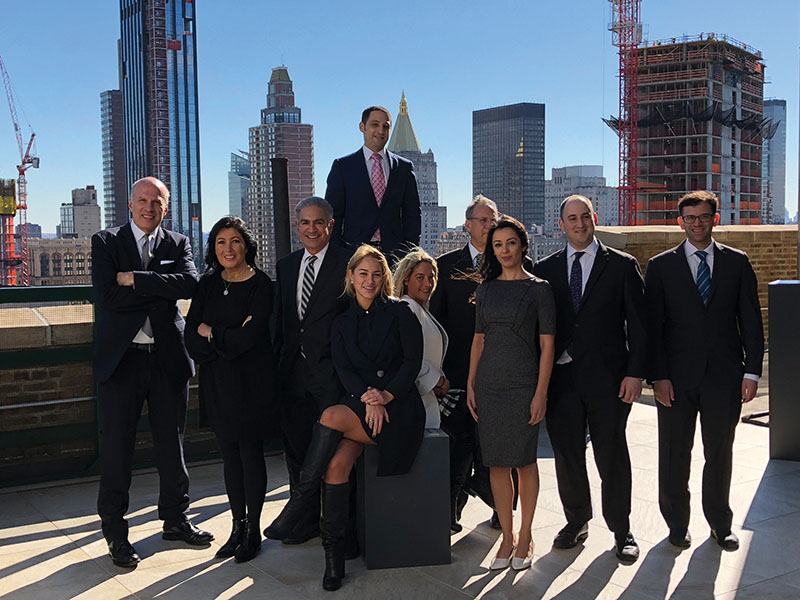
Manhattan, NY Lee & Associates NYC LLC welcomes additions of Gregory Gang, Catherine O’Toole and Corey Abdo, all executive managing directors/principals at Lee NYC. They will be leading a team consisting of Milana Kakuriyeva, Stephanie Moore, David Scher, Stephen Tarter, David Toran, Ari Waldman and Meagan O’Toole-Raneri.
The group comes to Lee from Advisors Commercial Real Estate and will be working throughout Manhattan, Brooklyn and Queens. The team was the number two producer nationwide at Coldwell Banker Commercial Advisors. Gang, O’Toole and Abdo were in the top ten producers across the country.
“We are thrilled to welcome this team which has a stellar track record in the industry,” said Joel Herskowitz, COO of Lee NYC. “The group’s business is equally divided between agency assignments and tenant representation. This diverse group of individuals knows the New York City commercial real estate market inside and out and we’re very excited to witness all they will accomplish at Lee & Associates.”
The new team will coalesce with Lee NYC’s existing leasing and sales practices, while also introducing different perspectives and backgrounds into the mix. They were attracted to Lee NYC’s reputation in the marketplace and cohesive company culture. Lee’s advanced platform includes research and marketing departments as well as the way in which Lee NYC gives back to the community were also attractive to the group.
The team has relocated the headquarters of David Donahue to 13,735 s/f (the entire 32nd floor) at 1407 Broadway. They also relocated the New York offices of TouchBistro to the 37th floor of the same building. Other transactions include the group’s assistance with the two-floor lease at 256 West 36th St. for iLoftSpace, a high-end coworking company that incorporates state-of-the-art technology, as well as their negotiation of the 15,000 s/f lease at 359 Broadway for Blood Manor which brands itself as New York City’s premier haunted house attraction. The team also represented Fundera in their expansion to 20,000 s/f at 123 William St.
Tags:
Spotlight Content
MORE FROM Spotlight Content

NYREJ's 2026 Developing Long Island Spotlight is here!
This spotlight showcases projects completed and currently under construction across Long Island as well as highlights improvements made to the region through Industrial and Economic Development Agencies and BIDs.


.png)

 (2).gif)

Columns and Thought Leadership

2026 Developing Queens: Long Island Board of Realtors advances commercial growth and advocacy in Queens
The Long Island Board of Realtors (LIBOR) Commercial Network continues to play a key role in advancing opportunities and strengthening the commercial real estate landscape across Queens. Through targeted programming and global outreach

Properly serving a lien law Section 59 Demand - by Bret McCabe
Many attorneys operating within the construction space are familiar with the provisions of New York Lien Law, which allow for the discharge of a Mechanic’s Lien in the event the lienor does not commence an action to enforce following the service of a “Section 59 Demand”.

CRE Guide Featured Company: Merritt Environmental Consulting Corp.
Merritt Environmental Consulting Corp. (MECC) was established in June of 2009 after being part of a larger engineering firm for almost 20 years. The focus of the company is to assist lending institutions, attorneys, real estate investors, and property owners with environmental concerns. Today, MECC has offices in New York, Florida, and Vermont and has grown into a regional consulting firm serving clients along the East Coast.

From vacancy to vitality: How adaptive reuse is reshaping Long Island’s CRE landscape - by Andrea Tsoukalas Curto
Adaptive reuse has become one of the most important conversations in commercial real estate today. Long Island has a large inventory of aging retail, office and industrial