



News:
Brokerage
Posted: May 15, 2018
Law: Tenant beware: Regarding landlords filing for bankruptcy - by Gerard Luckman
Notwithstanding that they may be unenforceable, landlords include clauses in commercial leases to address the prospect that the tenant may file for bankruptcy. Based on a recent Circuit Court decision and trends in bankruptcy practice, perhaps tenants should also insist on provisions in their leases to protect against the risks of the landlord filing for bankruptcy.
In 2017, the Ninth Circuit Court of Appeals (In re Spanish Peaks Holdings II LLC) joined the Seventh Circuit in authorizing a debtor’s sale of its building free and clear of its leases; considering such leases to be “interests” under bankruptcy code Section 363. Typically, tenants expect that a landlord will either move to assume or reject a lease; not try to sell free and clear of the tenant’s rights. Notably, in Spanish Peaks, the debtor did not move to reject the leases under Section 365 and argued that it did not then trigger the tenant protections of Section 365(h). Under Section 365(h), upon a rejection of its lease, the tenant may either deem the lease terminated or remain in possession and retain all of its rights under the lease while setting off damages caused by the landlord’s nonperformance. In Spanish Peaks, since the landlord did not reject the lease, and instead sold free and clear of it, the tenant was limited to seeking adequate protection of its interests under Section 363(e). What constitutes “adequate protection” is determined on a case by case basis and very fact specific, ranging from simply providing a claim in the bankruptcy case to being allowed to remain in possession. The risk to tenants is clear.
In order to protect against that risk, tenants should consider including in their leases a clause specifying what constitutes “adequate protection” whether in the nature of liquidated damages or injunctive relief, especially where damages may be difficult to quantify.
Gerard Luckman is a partner at Forchelli Deegan Terrana LLP, Uniondale, N.Y.
Tags:
Brokerage
MORE FROM Brokerage
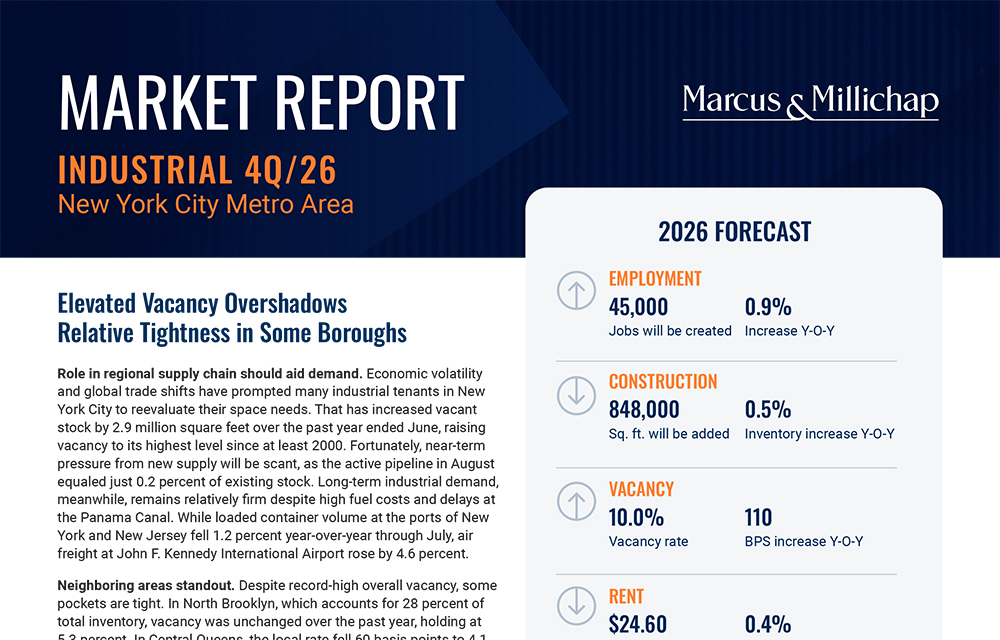
Marcus & Millichap releases fourth-quarter 2026 NYC industrial market report
Manhattan, NY Marcus & Millichap has published its fourth-quarter 2026 New York City Industrial Market Report. “New York City’s industrial market is showing a clear





Quick Hits

Columns and Thought Leadership

New York’s streets are full again, and the retail numbers prove it - by Noam Aziz
Walk down any New York block this year and you can feel it. The sidewalks are crowded, the storefronts are lit, and the energy that defines this city is back at full volume.

Hunt commercial real estate question and answer: Fortune 500 wisdom - by David Hunt
Yes, there are lessons to be learned from the largest companies in America when comes to managing your real estate. But the decision to buy or lease real estate may not be one of

The art of investing in real estate - by Thomas Donovan
Real estate investing is as much an art as it is a skill. No one can time the market, or the factors that drive it, perfectly. Location, zoning, size, transportation, and neighborhood density give you a baseline for

Hunt CRE question and answer: Choosing a real estate agent - by David Hunt
First, we will only work with one agent exclusively. The primary reason is that we want that agent to legally represent our client’s interests. In New York State, a real estate agent has a fiduciary
.gif)