



News:
Brokerage
Posted: May 16, 2023
Kelvin receives $30 million in Series A funding to decarbonize legacy building stock globally

Kelvin, a leader in intelligent, decarbonized HVAC solutions for legacy buildings, announced the closing of $30 million in Series A funding. The rebranding from Radiator Labs to Kelvin reflects the company's growth beyond radiators, including expansion into the US and European markets and targeting older building decarbonization where emissions reduction is a vital climate goal. The Series A round was led by climate-focused venture capital firm 2150, with participation from the Schmidt Family Foundation, the Partnership Fund for NYC, and several previous investors. The funds will be used to hire talent and build a scalable platform for accelerating the adoption of economically and environmentally sustainable HVAC options worldwide.
Kelvin's scope has broadened to include other decarbonized HVAC applications, such as heat pump and thermal battery systems, allowing legacy buildings to electrify up to 80% of their heating needs at under 10% of traditional full electrification costs. Like the Cozy, Kelvin’s first product, these solutions are also easily installed through a subscription agreement, making them affordable for all buildings regardless of access to capital.
Kelvin’s flagship product, the Cozy, is an insulated radiator cover that enhances heating efficiency by preventing overheating and fuel wastage. Implementing Cozys throughout a building can result in up to 45% lower heating costs, increased comfort for residents, and decreased building emissions. The Cozy is installed in more than four thousand apartments across the northeastern United States, and has undergone extensive independent validation by multiple agencies.
Kelvin offers a no-money-down subscription, removing capital barriers to decarbonization for all communities and promoting a financially-driven transition, especially benefiting lower-income communities. As a qualified technology for the Inflation Reduction Act's investment tax credit and other state and utility energy efficiency incentives, Kelvin’s decarbonization and efficiency solutions help buildings comply with local emissions, energy efficiency, and electrification regulations, including New York City's Local Law 97.
Since 2011, Kelvin has sold over 15,000 intelligent HVAC solutions to a diverse range of customers, including universities, large real estate portfolios, COOPs, city agencies, and housing authorities.
"Our new identity as Kelvin symbolizes the next phase of our broader mission: to provide energy-efficient temperature control that benefits building owners, tenants, and the larger communities they serve," says Dr. Marshall Cox, CEO and co-founder of Kelvin. "With this new capital, we're excited to expand our team and platform, helping more buildings in more cities meet electrification goals while reducing operating costs."
"Kelvin's hybrid electrification approach aligns with our support of breakthrough technologies that transform urban environments into sustainable cities of the future," said Christian Hernandez, Partner and co-founder, 2150. "Having demonstrated their ability to bring smarter, more sustainable heating and cooling to New York for over a decade, we're eager to see them apply their unique expertise to more cities across the U.S. and the world, offering an affordable, effective path to lower building emissions."
“We’ve been a customer, partner, and investor of Kelvin’s for 8 years now. Their technology solves a crucial issue for us on the path towards our decarbonization goals.” said Michael Rudin, Executive Vice President, Rudin.
Tags:
Brokerage
MORE FROM Brokerage
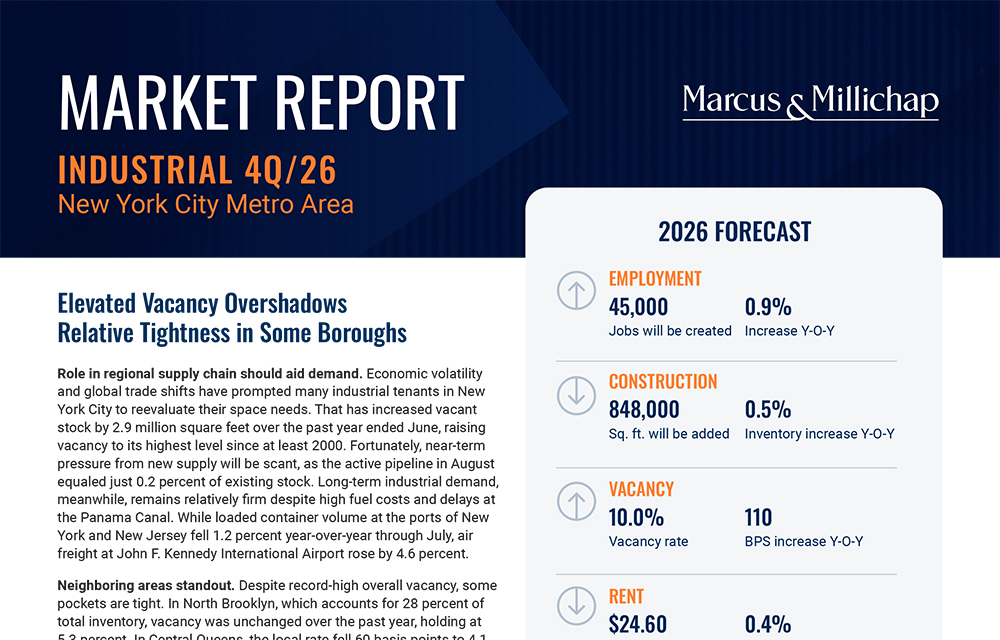
Marcus & Millichap releases fourth-quarter 2026 NYC industrial market report
Manhattan, NY Marcus & Millichap has published its fourth-quarter 2026 New York City Industrial Market Report. “New York City’s industrial market is showing a clear






 (2).gif)

Columns and Thought Leadership

Hunt CRE question and answer: Choosing a real estate agent - by David Hunt
First, we will only work with one agent exclusively. The primary reason is that we want that agent to legally represent our client’s interests. In New York State, a real estate agent has a fiduciary

Hunt commercial real estate question and answer: Fortune 500 wisdom - by David Hunt
Yes, there are lessons to be learned from the largest companies in America when comes to managing your real estate. But the decision to buy or lease real estate may not be one of

New York’s streets are full again, and the retail numbers prove it - by Noam Aziz
Walk down any New York block this year and you can feel it. The sidewalks are crowded, the storefronts are lit, and the energy that defines this city is back at full volume.

The art of investing in real estate - by Thomas Donovan
Real estate investing is as much an art as it is a skill. No one can time the market, or the factors that drive it, perfectly. Location, zoning, size, transportation, and neighborhood density give you a baseline for
.gif)