



News:
Brokerage
Posted: July 13, 2015
Investment Sales: Is $1,000 per s/f for Manhattan multifamily buildings the new norm?
More and more we hear multifamily sellers demand the quick self evaluated metric of $1,000 per s/f for their properties. Setting aside the in-depth analysis to properly underwrite a deal, we are seeing this metric of $1,000 as an achievable price point for multifamily properties in prime Manhattan. For example, I recently handled the sale of 350 West 18th St., which traded for $10 million or $1,014 per s/f. It previously traded for $557 per s/f in 2006 and $111 per s/f in 2000, so we can see the value has increased tenfold over the last 15 years.
It's interesting to have seen prices increase sharply for walk-up buildings in prime Manhattan over recent months, and there's no surprise as to why savvy owners now demand the once imagined $1,000 per s/f price point. The charm of neighborhoods like the West Village, Greenwich Village, SoHo and Chelsea is closely tied to the density of walk-up buildings, which constrain the supply and inflate rental prices, and in turn, increases transaction values.
We've experienced what some would consider all-time highs for rental units in Manhattan, with a median monthly rent at $3,380, up 2.4% from a year earlier, according to a recent report. It's clear that gross rents have increased and are factoring into this trend of $1,000 per s/f.
Now there is also rent stabilization as a key variable to consider due to the most recent state and local regulatory constraints. Investors are wary of buildings that are a majority of rent regulated units, because even though the artificially low rents present greater upside potential, the uncertainty surrounding upcoming legislation is making free market status much more desirable. In the aforementioned 350 West 18th St., 77% of the apartments are free market status with an average monthly rent of $2,300. In Chelsea, this property has considerably greater rental value yet to be achieved.
Where does this leave us? I believe we'll continue to see prices rise, but let's be realistic. Not every property will attract a buyer willing to assume the risk if all other factors don't point in the direction of value-add.
Shoy McKen is the director of Besen & Associates, New York, N.Y.
Tags:
Brokerage
MORE FROM Brokerage
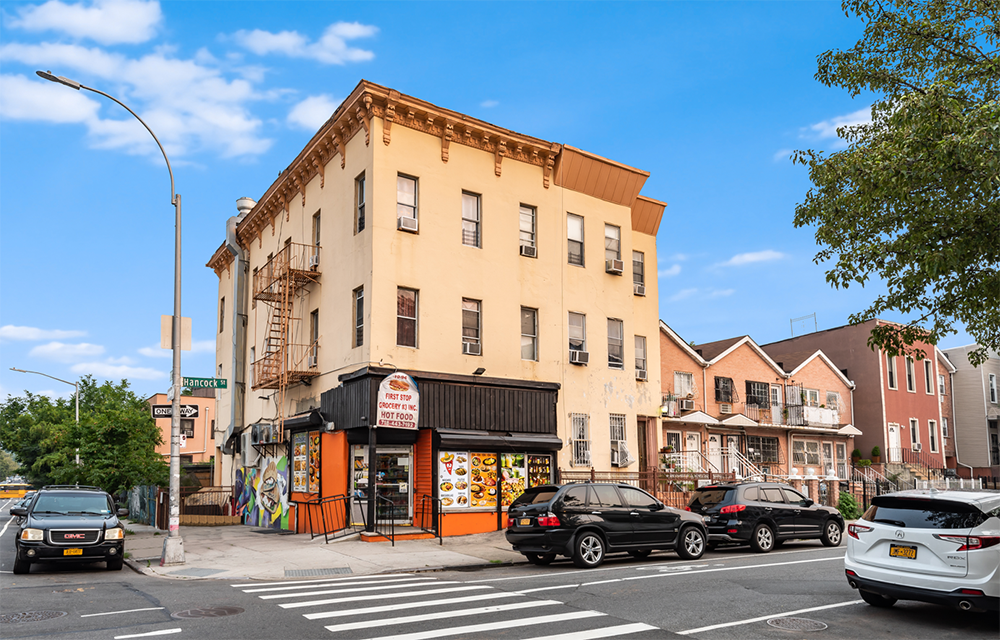
Investment Property Realty Group closes $1.75 million sale of 1094 Hancock Street in Brooklyn
Brooklyn, NY Investment Property Realty Group (IPRG), a New York-based commercial investment firm, has closed the sale of 1094 Hancock St., a mixed-use building in the Bushwick section, for $1.75 million.


Quick Hits

Columns and Thought Leadership

A guide to finding the right NYC property management company - by Sanjay Gandhi
Being a small to midsize landlord in NYC is an increasingly demanding endeavor. From navigating complex regulations, increased compliance demands to dealing with tenant issues and remediating violations. It is wise to enlist the assistance of a partner, a professional

Hunt commercial real estate question and answer: Fortune 500 wisdom - by David Hunt
Yes, there are lessons to be learned from the largest companies in America when comes to managing your real estate. But the decision to buy or lease real estate may not be one of

New York’s streets are full again, and the retail numbers prove it - by Noam Aziz
Walk down any New York block this year and you can feel it. The sidewalks are crowded, the storefronts are lit, and the energy that defines this city is back at full volume.

Hunt CRE question and answer: Choosing a real estate agent - by David Hunt
First, we will only work with one agent exclusively. The primary reason is that we want that agent to legally represent our client’s interests. In New York State, a real estate agent has a fiduciary
.gif)