



News:
Brokerage
Posted: August 27, 2012
Insights for the Real Estate Investment Trusts: Excerpts from REITport, published by Berdon
50% Transfer Tax Discount
Extended To 2014
This discount helped promote the forming of REITs and now it's extended through August 31, 2014! Under this New York State law, if you transfer property to an existing REIT, the state and city transfer tax can be reduced by 50%. Among the many requirements to qualify, in exchange for the property, you must take REIT shares whose value equals at least 50% of the property contributed and hold them for two years. If the transfer is to a newly-formed REIT, the value of your shares must be equal to 40% of the transferred property.
Mixed-Use Can
Deliver Benefit Of QHP
An IRS ruling¹ gives healthcare REITs a much clearer picture of what it takes for a mixed use property to be considered a qualified health care property (QHP) and for the rents received to be treated as rents from real property.
In the matter, a healthcare REIT planned to acquire mixed-use communities and lease them to a wholly owned taxable REIT subsidiary (TRS). The communities included independent living (IL) and assisted living (AL) residences that were blended in the same building or property. All the AL units were licensed, where required, by the state they were located in. A resident could transition from an IL to an AL unit without necessarily having to physically move. These conditions fulfilled the requirements of a QHP².
But, an additional layer is required for the rents received from the TRS that is leasing the communities to qualify as rents from real property: The TRS needs to engage an "eligible independent contractor" (EIK) to manage the community. In this ruling, the service concluded that since the proposed manager had a history of operating similar facilities, it qualified as an EIK³.
¹ PLR 201125013
² Section 856(e)(6)(D)(i).
³ Cf. PLR 200825034 (manager of lodging facilities considered "actively engaged" in managing lodging facilities although only managed two such facilities at time engaged by TRS).
Infrastructure REITs Get Clarity
On Rents From Real Property
For infrastructure REITS, a recent IRS ruling¹ has helped clarify some uncertainties relating to rents from real property. In the ruling, a corporation that owned communications sites and towers intended to elect REIT status. The IRS held that:
Real estate assets generating rent from real property include:
* Rooftop sites and towers (this includes a REIT's interest in lease rights granted by an unrelated owner of the building or rooftop housing the equipment);
* Loans from a REIT to its taxable REIT subsidiary secured by real property.
The following income qualifies as rents from real property:
* Rents attributable to goodwill and other real estate intangibles that are considered real estate assets;
* Rent under a license/lease for tower space;
* Income from customary services to tenants in the same geographical area that are specified in the leases.
The 15% rents from the personal property limit can be calculated on a separate or aggregate basis when renting units in a multiple unit project under similar leases.
¹ PLR 201129007
Sean Kanousis is a tax principal and a member of the firm's REIT team advising on tax, management and compliance issues at Berdon LLP, New York City and Long Island.
Tags:
Brokerage
MORE FROM Brokerage
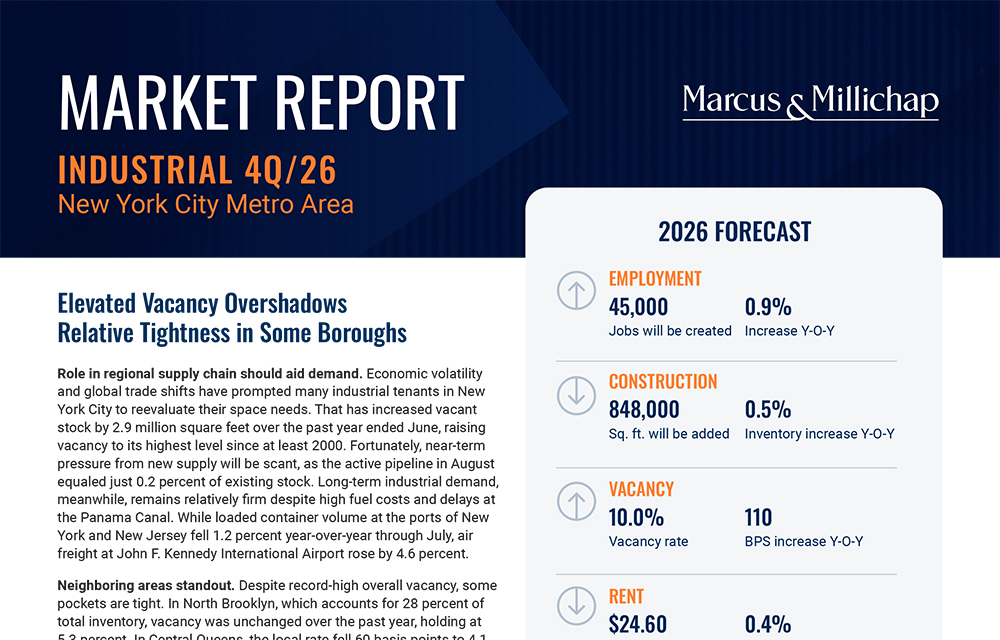
Marcus & Millichap releases fourth-quarter 2026 NYC industrial market report
Manhattan, NY Marcus & Millichap has published its fourth-quarter 2026 New York City Industrial Market Report. “New York City’s industrial market is showing a clear






Columns and Thought Leadership

New York’s streets are full again, and the retail numbers prove it - by Noam Aziz
Walk down any New York block this year and you can feel it. The sidewalks are crowded, the storefronts are lit, and the energy that defines this city is back at full volume.

Hunt commercial real estate question and answer: Fortune 500 wisdom - by David Hunt
Yes, there are lessons to be learned from the largest companies in America when comes to managing your real estate. But the decision to buy or lease real estate may not be one of

Hunt CRE question and answer: Choosing a real estate agent - by David Hunt
First, we will only work with one agent exclusively. The primary reason is that we want that agent to legally represent our client’s interests. In New York State, a real estate agent has a fiduciary

The art of investing in real estate - by Thomas Donovan
Real estate investing is as much an art as it is a skill. No one can time the market, or the factors that drive it, perfectly. Location, zoning, size, transportation, and neighborhood density give you a baseline for
.gif)