



News:
Brokerage
Posted: February 13, 2024
Industry City signs three new industrial leases totaling 33,496 s/f
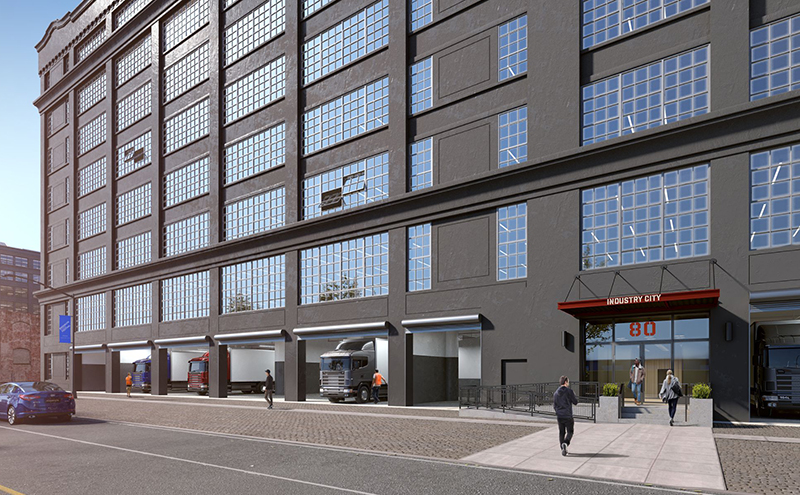
Brooklyn, NY Three new industrial deals totaling 33,496 s/f were signed at Industry City, the 35-acre mixed-use complex comprising 16 waterfront buildings in Sunset Park. The new leases include:
• Pvilion, a solar power product manufacturer producing tents, canopies, and other outdoor structures opened its 13,554 s/f space in Building 8. The space will serve as a manufacturing space, product showroom, and executive offices for the staff.
• CitiBin, a company that designs and manufactures trash and recycling enclosures, whose executives currently occupy creative office space at Industry City, signed a 4,631 s/f industrial lease in Building 26. The new, consolidated space will serve as an assembly and storage facility for CitiBin inventory as theyvacated their 3PL spaces in NJ and Red Hook.
• Highline Commerce, a third-party logistics startup, is expanding beyond its current 27,000 s/f space with an additional 15,311 s/f lease in Building 7. This expansion comes just two years after the initial signing.
“We are thrilled to welcome Pvilion to Industry City and deepen our relationships with CitiBin and Highline Commerce, who already call the campus home,” said Jeff Fein, senior vice president of leasing at Industry City. “These deals represent the ongoing need for space to manufacture, produce, assemble, and fulfill orders, and we can efficiently provide these businesses with additional space as they scale. CitiBin has been an office tenant since 2017, but bringing their industrial operations to IC exemplifies our ability to be there for the varied real estate needs of our tenants.”
Fein leads the in-house leasing team at Industry City and represented the campus in all deals; Bert Rosenblatt, managing principal at Cresa, represented CitiBin.
“We’ve been a part of the Industry City community and witnessed its amazing transformation alongside the growth of our own business,” said Liz Picarazzi, founder and CEO of CitiBin. “Having our office and showroom in the same location as our industrial and fulfillment operations has been a game-changer for us as business owners. It not only boosts efficiency but also enables all our employees to enjoy the perks of this vibrant campus. Not to mention, it is really nice to pay only one rent check every month.”
Tags:
Brokerage
MORE FROM Brokerage

200E20TH sells out in Gramercy, penthouse A closes out sales at the CetraRuddy-designed condominium residences
Manhattan, NY 200E20TH, the CetraRuddy-designed architectural masterwork that brought a curved, contemporary sensibility to Gramercy’s Beaux-Arts streetscape, has




 (2).gif)

Columns and Thought Leadership

New York’s streets are full again, and the retail numbers prove it - by Noam Aziz
Walk down any New York block this year and you can feel it. The sidewalks are crowded, the storefronts are lit, and the energy that defines this city is back at full volume.

Hunt CRE question and answer: Choosing a real estate agent - by David Hunt
First, we will only work with one agent exclusively. The primary reason is that we want that agent to legally represent our client’s interests. In New York State, a real estate agent has a fiduciary

Hunt commercial real estate question and answer: Fortune 500 wisdom - by David Hunt
Yes, there are lessons to be learned from the largest companies in America when comes to managing your real estate. But the decision to buy or lease real estate may not be one of

The art of investing in real estate - by Thomas Donovan
Real estate investing is as much an art as it is a skill. No one can time the market, or the factors that drive it, perfectly. Location, zoning, size, transportation, and neighborhood density give you a baseline for
.gif)