



News:
Brokerage
Posted: November 12, 2012
Work begins on $16.9 million Western Gateway Bridge
Governor Andrew Cuomo recently revealed that construction has begun on a $16.9 million project to rehabilitate the Western Gateway Bridge that carries Rte. 5 between the city and the village of Scotia in Schenectady County. The project includes the construction of a new, multi-use, shared lane across the bridge to connect bicycle and pedestrian pathways on both sides of the Mohawk River, and is funded through the NY Works program.
"Adding a multi-use lane to the Western Gateway Bridge is a perfect example of the NY Works program in action: taking into account the needs of the local community, and then coordinating and putting forward a plan to get the project started now," governor Cuomo said. "Through the NY Works program we will continue to fund critical infrastructure improvements across New York State to create jobs and make the state a better place to live for all our residents."
New York State Department of Transportation commissioner Joan McDonald said, "With relatively low-cost changes, a standard bridge rehabilitation has been transformed into a project that fits well with the communities it serves and creates a multi-modal structure that will improve safety for motorists, bicyclists and pedestrians alike. A direct bicycle and pedestrian link between two active neighborhoods provides safer commuting options and encourages recreational and sustainable travel between downtown Schenectady and Scotia."
The work is being conducted through the "design-build" method, whereby design and construction run concurrently saving time and money, and shortening travel inconveniences. The project originally called for simply replacing the bridge deck and sidewalks but in response to community input, NYSDOT expanded the project to include additional pedestrian and bicycle amenities to enhance existing infrastructure and better fit into the community.
The existing bridge has two travel lanes in each direction, which are now restricted to one lane in each direction. The lane closures will remain in place until construction is completed at the end of next year.
The existing bridge has two, 12-foot travel lanes in each direction, with narrow shoulders and four-foot sidewalks on each side. The lanes will be reconfigured to include one, 11-foot travel lane in each direction, plus one, 14-foot shared-use lane in each direction. The shared-use lanes will accommodate both motorists and bicyclists following the signed state Bike Route 5 over the bridge.
The west side of the bridge will feature a five-foot sidewalk, which will comply with current Americans with Disabilities Act standards. The east side of the bridge will feature a 10-foot multi-use path for pedestrians and bicyclists. The multi-use path will connect existing paths on both sides of the river and attach Schenectady's downtown area and Schenectady Community College with Scotia parks, a library and other village amenities. It also is consistent with the City of Schenectady Urban Bike Route Master Plan, created in 2001.
The work is part of a $31.3 million contract through the NY Works program for critical repairs to 13 bridges in the North Country and Capital Region. The construction contractor for the project is Kubricky Construction Corp. of Wilton, Saratoga County and the design consultant is VHB Engineering, Surveying & Landscaping Architecture of Albany.
Design-build is a centerpiece of the NY Works program, providing a cost effective way to move construction projects quickly by allowing design and construction teams to innovate and develop best methods to improve New York's bridges and highways. To expedite job creation and critical infrastructure repair projects across the state, Governor Cuomo worked with the Legislature last year to put the design-build process in place. Design-build allows for the combining of design and construction services into single contracts to help expedite repair work to vital infrastructure and save taxpayer money.
NY Works focuses on improving bridges that are in fair condition and bringing them to good condition. This rehabilitation work will better preserve the state's infrastructure and guard against the need for more costly, in-depth construction. Bundling projects sites within close geographic locations into a single contract enables DOT to lower expenses and obtain lower bids.
Tags:
Brokerage
MORE FROM Brokerage
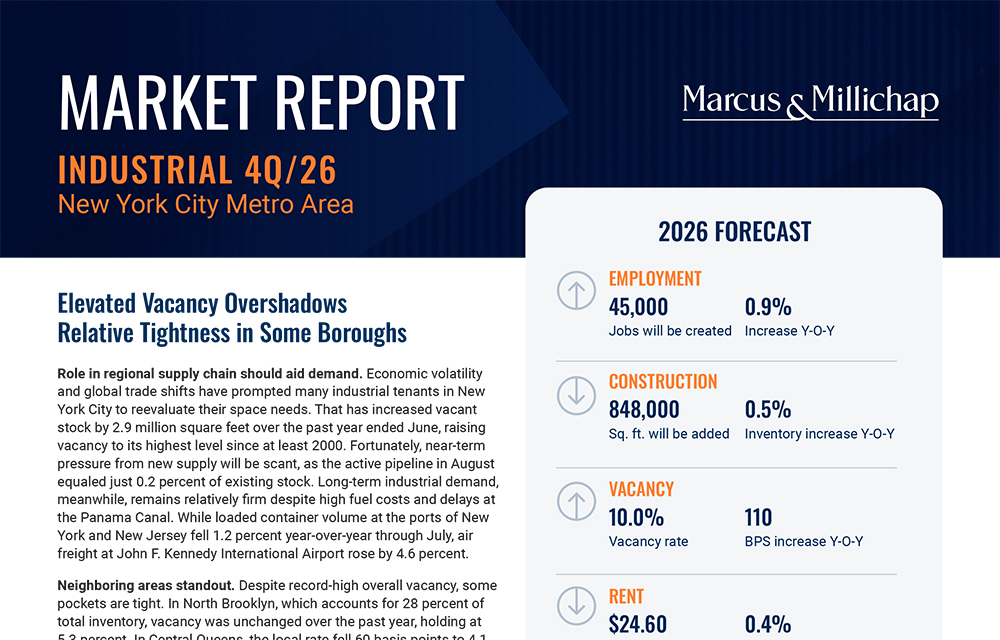
Marcus & Millichap releases fourth-quarter 2026 NYC industrial market report
Manhattan, NY Marcus & Millichap has published its fourth-quarter 2026 New York City Industrial Market Report. “New York City’s industrial market is showing a clear







Columns and Thought Leadership

Hunt CRE question and answer: Choosing a real estate agent - by David Hunt
First, we will only work with one agent exclusively. The primary reason is that we want that agent to legally represent our client’s interests. In New York State, a real estate agent has a fiduciary

The art of investing in real estate - by Thomas Donovan
Real estate investing is as much an art as it is a skill. No one can time the market, or the factors that drive it, perfectly. Location, zoning, size, transportation, and neighborhood density give you a baseline for

Hunt commercial real estate question and answer: Fortune 500 wisdom - by David Hunt
Yes, there are lessons to be learned from the largest companies in America when comes to managing your real estate. But the decision to buy or lease real estate may not be one of

New York’s streets are full again, and the retail numbers prove it - by Noam Aziz
Walk down any New York block this year and you can feel it. The sidewalks are crowded, the storefronts are lit, and the energy that defines this city is back at full volume.
.gif)