


News:
Owners Developers & Managers
Posted: October 2, 2026
Rodeo Drive’s new power map: Who owns the brands, and what comes next - by Joseph Aquino
A walk along Rodeo Drive still delivers the expected theater: immaculate storefronts, bold architecture and the names that define global luxury. But a closer look at the doors—and at the construction walls between them—reveals a more consequential story. The street is becoming a contest for long-term control of scarce real estate, even as its retail roster remains more varied than the familiar names LVMH, Kering and Richemont suggest.
I reviewed the street and identified 41 existing branded storefronts or boutiques, plus a signed Canada Goose construction site. About seven of those locations belong to Kering brands, seven to LVMH, five to Richemont and one to Hermès. The remaining 21 represent independent houses, family-controlled companies and other public or private groups. These are storefront counts from reviews from my survey, not a complete census of Rodeo Drive. The two Louis Vuitton stores — 295 North Rodeo Drive and the men’s store at 420 — are counted separately.
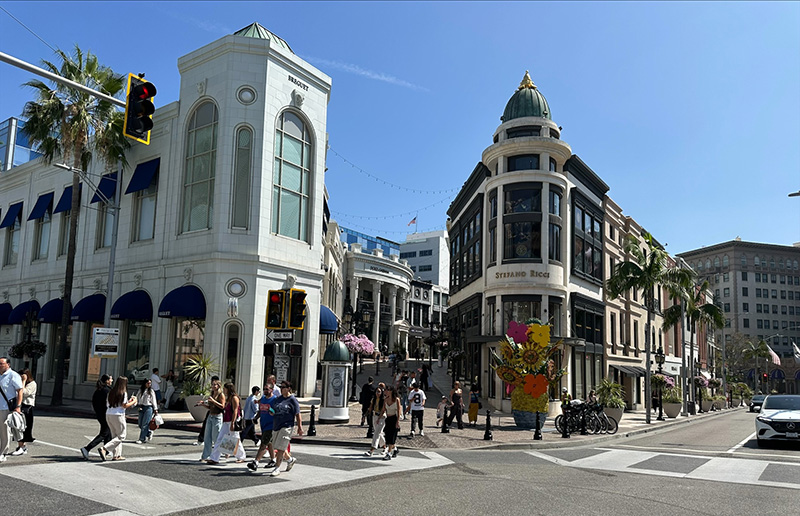
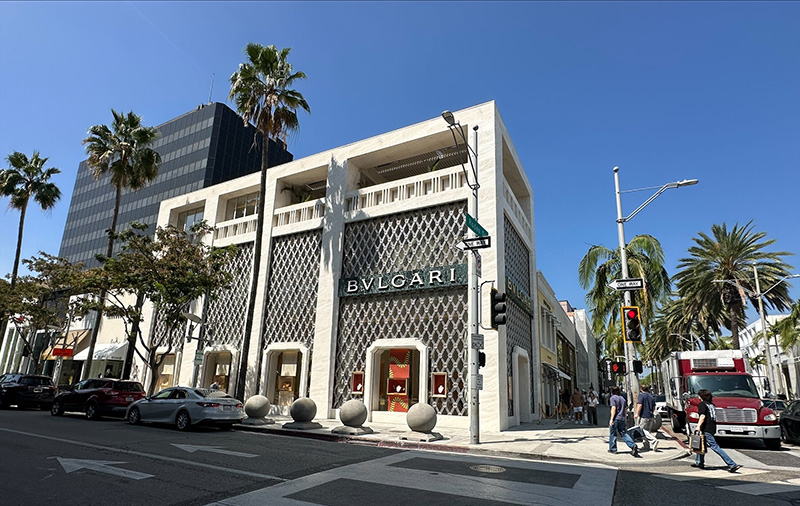
The ownership clusters are striking. Kering appears at Gucci, Balenciaga, Saint Laurent, Alexander McQueen, Brioni, Boucheron and Pomellato. Its jewelry and fashion houses share the street but occupy distinct addresses and identities. Richemont’s presence spans Van Cleef & Arpels, IWC, Vacheron Constantin, Cartier and Piaget. LVMH’s doors include Louis Vuitton, Celine, Dior, Loewe, Loro Piana and Bulgari. The distribution helps explain why Rodeo is more than a concentration of expensive shops: each group can present several parts of its portfolio within a few blocks.
It would be a mistake, however, to call every brand outside those groups an independent. Goyard and Dolce & Gabbana remain privately held independent houses. Stefano Ricci is family owned. Tory Burch is a private company with investors, while Amiri has a minority investment from OTB. Other boutiques belong to different corporate structures: Harry Winston and Breguet to Swatch Group, Jimmy Choo to Capri Holdings, MCM to Sungjoo Group and Moncler to its own publicly traded group. Ferragamo and Brunello Cucinelli are standalone listed companies with strong family or founder influence. Armani is still outside the major luxury conglomerates, although its succession plan now contemplates selling a minority stake.
One storefront illustrates why the brand-owner and building-owner columns must be kept separate. Hermès operates its own boutique at 434 North Rodeo Drive. It also acquired control of property occupied by Tom Ford, Moncler and Balenciaga in a transaction reported at approximately $400 million. Those tenants do not become Hermès brands because Hermès controls their building. Tom Ford is a further ownership wrinkle: Estée Lauder owns its name and intellectual property, while Zegna Group runs the fashion business.
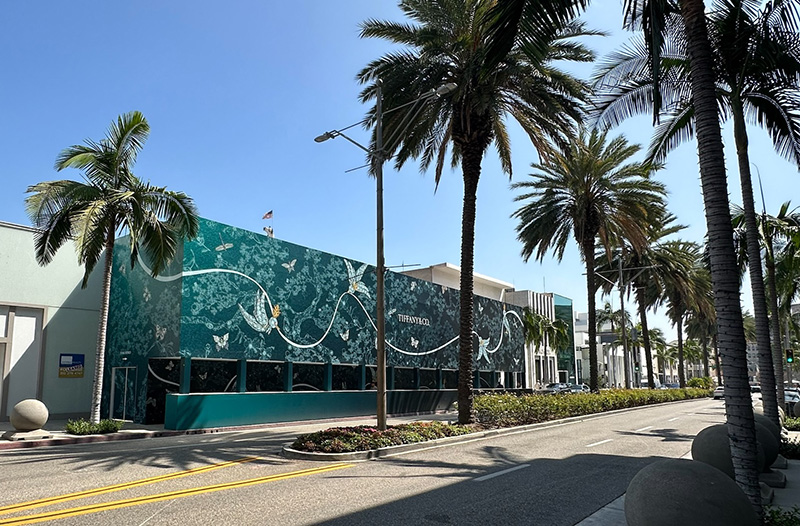
Construction offers a second map of the street’s future. At 360 North Rodeo, Tiffany & Co. is planning a flagship to replace its current boutique at 210. Cartier currently trades at 411 North Rodeo while a new building is planned at 370. David Yurman’s 371 North Rodeo location is wrapped for work, and the jeweler directs customers to a temporary boutique at 9460 Brighton Way. Jessica McCormack has identified 437 North Rodeo for a future store, expected in 2027. The Canada Goose facade at 418 is another project site; a sign on a construction barrier should not be mistaken for an open store.
These projects matter beyond their eventual ribbon cuttings. A temporary move can preserve a brand’s Beverly Hills customer relationships during years of building work. A larger new flagship can make room for private appointments, more product categories and events. For an owner or broker, the questions extend to frontage, access, neighboring construction, the timing of possession and whether an established customer can still find the brand during the transition.
There is also a useful correction to the street’s shorthand. Versace now belongs with Prada Group, while Jimmy Choo remains with Capri. Cartier’s current address is 411, not the planned 370 project. Louis Vuitton’s 420 men’s store should not be confused with either its 295 boutique or the proposed much larger project at the north end of Rodeo. Addresses, operating status and ownership can change on different clocks.
The lesson from my survey is that Rodeo Drive’s competitive advantage is being reinforced at two levels. The boutiques sell luxury today; the ownership and redevelopment decisions shape how brands will compete there years from now. For anyone evaluating the corridor, the most revealing document may be neither a storefront nor a brand directory alone, but a current map that connects each door to its tenant, its corporate owner and its next move
The article is subject to errors and omissions.
Joseph Aquino is president of JAACRES, Manhattan, N.Y.
MORE FROM Owners Developers & Managers

76% of flex operators plan to expand in the next 12 months driven by increasing occupancy, according to Workthere survey
Manhattan, NY Savills flexible office specialist Workthere, has revealed that more than three quarters (76%) of the flex operators surveyed worldwide as part of its 2026 Flexmark

Quick Hits
 (2).gif)

Columns and Thought Leadership

Don’t leave severance damages behind - by Sebastian Jablonski
When the government takes a portion of a landowner’s property, most assume just compensation stops at the value of the land taken. However, in partial takings, that is only half of the equation.
NYC's Community Opportunity to Purchase Act is back - and multifamily owners should pay attention - by Ron Cohen
New York City’s Community Opportunity to Purchase Act (COPA) is back, and this latest version could have a much better chance of becoming law. The proposal would give qualified nonprofit organizations
Hunt Commercial Real Estate Q&A: Location, location, location? - by David Hunt
In working with our clients, we break down our search objectives into two categories. The first category involves the specific needs of your business such as warehouse height, amount of office space and number of loading
New York City’s historic rent freeze now rests with the courts - by Ron Cohen
New York City’s first-ever two-year rent freeze is now in the hands of a state Supreme Court judge, and the decision could reset income for owners of roughly one million rent-stabilized apartments housing some 2.4 million residents.