



News:
Brokerage
Posted: November 20, 2009
Improper use of background checks can be costly
Recently, two companies separately agreed to pay civil penalties totaling a combined $77,000 to resolve accusations that they violated the Fair Credit Reporting Act in connection with their hiring processes. The Federal Trade Commission (FTC) brought separate lawsuits in federal court against Quality Terminal Services, LLC and Rail Terminal Services, LLC. In both lawsuits, the FTC alleged that the companies contracted with a credit agency to conduct background checks on employees and applicants, including criminal record reviews, and then made hiring and firing decisions based on those background checks. The FTC also alleged that each company failed to provide the employees with the notices required by the Fair Credit Reporting Act.
These cases are an important reminder that the act applies to most employers that conduct background checks on employees and applicants and highlight the need for them to understand and follow the requirements of the act. The act is implicated when an employer hires a third party to conduct background checks and seek employees' and job applicants' credit records, criminal histories and other background information.
The act requires an employer to provide the applicant or employee with notice before it takes adverse action, which includes dismissal or rejection of an employment application, based on a consumer report. The employer must also provide the employee with a copy of the report, identify the agency that provided the report to the employer, and inform the affected individual of his or her right to obtain a free copy of the report to dispute its accuracy.
The cases against Quality Terminal and Rail Terminal illustrate that the FTC can bring an action on behalf of employees, but employees also have the ability to bring their own action for violations of the act. The result could be equally damaging, as a successful employee in such an action can recover attorneys' fees and three times their actual damages.
Any employer that is using a third party to conduct background checks on employees or applicants should ensure that it is familiar with, and following, the requirements of the act.
Daniel Morris is a counsel at Clifton Budd & DeMaria LLP, New York, N.Y.
Tags:
Brokerage
MORE FROM Brokerage
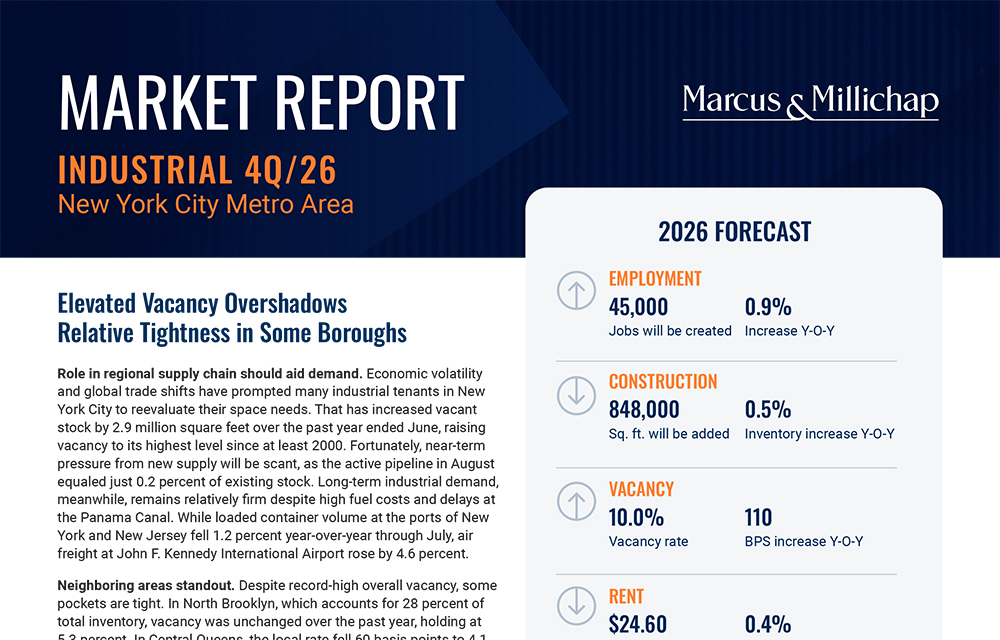
Marcus & Millichap releases fourth-quarter 2026 NYC industrial market report
Manhattan, NY Marcus & Millichap has published its fourth-quarter 2026 New York City Industrial Market Report. “New York City’s industrial market is showing a clear





Quick Hits

Columns and Thought Leadership

Hunt CRE question and answer: Choosing a real estate agent - by David Hunt
First, we will only work with one agent exclusively. The primary reason is that we want that agent to legally represent our client’s interests. In New York State, a real estate agent has a fiduciary

The art of investing in real estate - by Thomas Donovan
Real estate investing is as much an art as it is a skill. No one can time the market, or the factors that drive it, perfectly. Location, zoning, size, transportation, and neighborhood density give you a baseline for

Hunt commercial real estate question and answer: Fortune 500 wisdom - by David Hunt
Yes, there are lessons to be learned from the largest companies in America when comes to managing your real estate. But the decision to buy or lease real estate may not be one of

New York’s streets are full again, and the retail numbers prove it - by Noam Aziz
Walk down any New York block this year and you can feel it. The sidewalks are crowded, the storefronts are lit, and the energy that defines this city is back at full volume.
.gif)