



News:
Brokerage
Posted: October 7, 2011
Hudson Realty Capital acquires $139 million Colorado portfolio of 97 ADC loans
A consortium led by Hudson Realty Capital LLC (HRC), a Manhattan-based real estate fund manager, has won the FDIC Small Investor Program (SIP) RADC structured-sale. The group acquired a $139 million Colorado portfolio of 97 acquisition, development and construction (ADC) loans in partnership with the Federal Deposit Insurance Corp. (FDIC). HRC is partnering with Soundview Real Estate Partners and JCR Capital Investment Corp. in the joint acquisition.
The Colorado portfolio is Hudson's second FDIC-structured sale acquisition. The company, along with Soundview, also closed on the FDIC's southeastern pool of 109 commercial real estate assets acquired last December. The certified Minority-Owned Business Enterprise (MBE) was awarded the latest loan pool as part of the SIP, designed to attract emerging firms.
"Hudson commends the FDIC on their Small Investor Program and their efforts to offer smaller loan pools to increase the diversity of bidders," said David Loo, Hudson's managing director and co-founder.
As the asset manager for the newly acquired portfolio, Hudson will work to resolve the residential and commercial property ADC loans over the next several years. The assets include vacant land, lots, residential development inventory and multi-family and mixed-use properties located throughout Colorado.
According to Renee Lewis, managing director, portfolio investments, Hudson expects to achieve the highest asset value over the hold period through workouts, restructurings, discounted payoffs, foreclosures, repositioning and sales.
"The addition of the Colorado loan portfolio, along with the Southeastern pool, demonstrates the rapid expansion of Hudson's portfolio investment platform, where we expect to see even more opportunities in the near future," said Lewis.
Headquartered in New York City, HRC maintains regional offices in Portland, Maine and Fort Myers, Florida, which oversees Hudson's portfolio investments. The real estate fund manager has closed more than $3.5 billion in transactions since the formation of its initial two funds in 2003 and currently has more than $2.5 billion in assets under management.
Hudson's activities include originating, participating in, servicing, restructuring and/or acquiring high-yield, special-situation debt and mezzanine loans. The company also invests directly in real estate and the acquisition of under-performing real estate assets and other real estate-related instruments.
Established as a Minority-Owned Business Enterprise (MBE), Hudson is certified by the Empire State Development Agency (ESDA). The company is widely acknowledged for its commitment to diversity and has been named among the New York Area's largest privately held companies and largest minority-owned companies, as well as one of the Top 25 lenders nationally.
###
About Hudson Realty Capital
Tags:
Brokerage
MORE FROM Brokerage
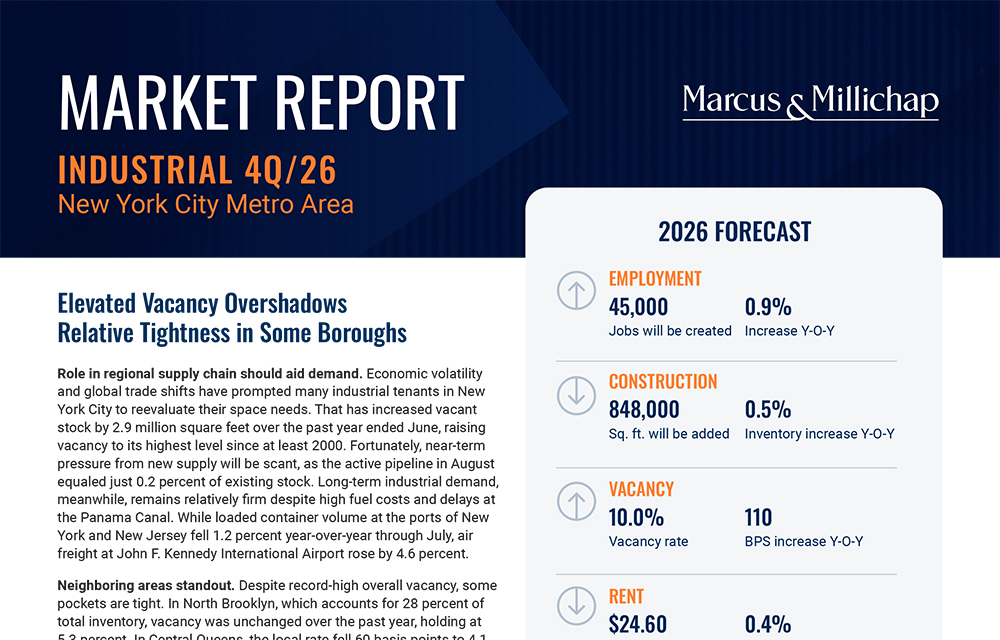
Marcus & Millichap releases fourth-quarter 2026 NYC industrial market report
Manhattan, NY Marcus & Millichap has published its fourth-quarter 2026 New York City Industrial Market Report. “New York City’s industrial market is showing a clear





Quick Hits

Columns and Thought Leadership

New York’s streets are full again, and the retail numbers prove it - by Noam Aziz
Walk down any New York block this year and you can feel it. The sidewalks are crowded, the storefronts are lit, and the energy that defines this city is back at full volume.

The art of investing in real estate - by Thomas Donovan
Real estate investing is as much an art as it is a skill. No one can time the market, or the factors that drive it, perfectly. Location, zoning, size, transportation, and neighborhood density give you a baseline for

Hunt commercial real estate question and answer: Fortune 500 wisdom - by David Hunt
Yes, there are lessons to be learned from the largest companies in America when comes to managing your real estate. But the decision to buy or lease real estate may not be one of

Hunt CRE question and answer: Choosing a real estate agent - by David Hunt
First, we will only work with one agent exclusively. The primary reason is that we want that agent to legally represent our client’s interests. In New York State, a real estate agent has a fiduciary
.gif)