



News:
Brokerage
Posted: February 4, 2020
How much money can a cost segregation study save for you? Part Four - by Christie Ellis

This is part four of a four-part series.
There is only one key question that remains: How much money could a cost segregation study save for you? Let’s consider a few studies and then summarize what we’ve learned together over the last three articles.
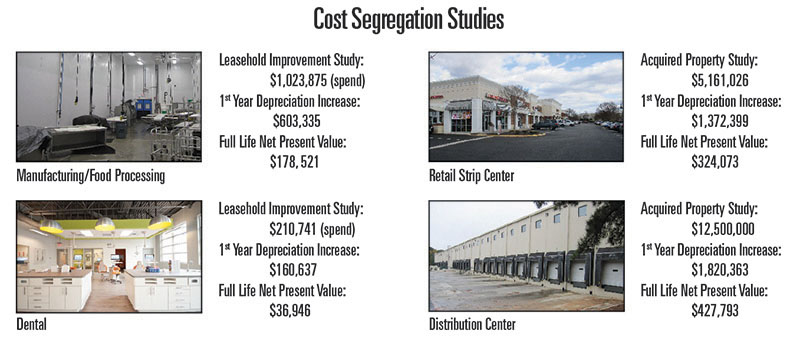
The results as seen in the chart are what was specifically achieved for these clients. In order to determine your own available savings, you should reach out to a quality provider today, while tax season is in full swing.
I became a cost segregation consultant because after years of working as a management consultant, I realized there was a faster and easier way to make a tremendous impact on the businesses I served. As someone who has grown and sold small businesses, it is my passion to help other businesses succeed. Cost segregation is used by all “big business.” But it is available to you too.
Whether your building is worth hundreds of millions of dollars, or your leasehold improvements are only valued at a couple hundred thousand, this tool is available, and effective for you. Keep in mind our summary below, and I hope you have your own cost segregation success story in the near future.
What is Cost Segregation?
Cost segregation utilizes the power of the very foundation of the world’s financial system. By reducing your taxable income, and as a result, your income taxes due, you are free to make the time value of your money work for you.
It is the accelerated depreciation that results from separating real property assets from personal property assets within commercial real estate.
This accelerated depreciation typically creates savings of 4-10% of the value of the building, on an after tax basis. Value for leasehold improvements can be as high as 25% of the value of the assets on an after tax basis.
Who should consider a cost segregation study?
- All mid-range and long-term commercial property owners in for-profit organizations should consider cost segregation; and
- All leasehold improvement owners in for-profit organizations should consider cost segregation.
- How do you receive a high quality cost segregation study?
A firm using the detailed engineering approach will provide a study that meets the IRS’ highest standard. These firms should:
- Send both an accountant and an engineer to tour your location, taking a few hours, not a few minutes to document your property; and
- Provide an itemized breakout of all segregated items in their reports.
What should you avoid in a service provider?
- Studies completed by accountants, without engineering services. These studies often lose 30%-50% of the available value.;
- Studies completed by construction companies and engineers without specialty accountants. These studies also often lose 30%-50% of the available value;
- Studies by accountants who state they ‘do a little’ cost segregation; and
- Studies by firms within a regional accounting firm alliance or network, which may not be referred for their detailed engineering approach, but for the commissions created within the alliance.
Christie Ellis is the president at Cost Segregation Advisors, LLC, Hudson Valley, N.Y.
Tags:
Brokerage
MORE FROM Brokerage

Investment Property Realty Group sells 120 Forsyth St. for $1.35 million
Manhattan, NY Investment Property Realty Group (IPRG) closed the sale of 120 Forsyth St., a mixed-use building located in the Lower East Side section of the city, for $1.35 million.






Quick Hits

Columns and Thought Leadership

A guide to finding the right NYC property management company - by Sanjay Gandhi
Being a small to midsize landlord in NYC is an increasingly demanding endeavor. From navigating complex regulations, increased compliance demands to dealing with tenant issues and remediating violations. It is wise to enlist the assistance of a partner, a professional

Positive forecast for New York’s pro-housing push? - by Philip Butler
New York’s housing crisis remains a hot button topic despite growing consensus that varied and affordable housing is desperately needed statewide. Governor Hochul has recently introduced several initiatives to overcome N.Y.’s anti-housing

Hunt commercial real estate question and answer: Fortune 500 wisdom - by David Hunt
Yes, there are lessons to be learned from the largest companies in America when comes to managing your real estate. But the decision to buy or lease real estate may not be one of

New York’s streets are full again, and the retail numbers prove it - by Noam Aziz
Walk down any New York block this year and you can feel it. The sidewalks are crowded, the storefronts are lit, and the energy that defines this city is back at full volume.
.gif)