


News:
Owners Developers & Managers
Posted: September 10, 2024
Hoteliers form NYC Minority Hotel Association advocacy group
Manhattan, NY A group of hotel owners from across the city today have formed the NYC Minority Hotel Association, a new advocacy group created to push back against the City Council’s proposed Intro 991, also known as the so-called “Safe Hotels Act,” given the grave harm it poses for minority hotel owners and employees.
NYC Minority Hotel Association (NYCMHA) comprises 50 minority hotel owners from all five boroughs that together own roughly 120 hotels and employ more than 900 hotel employees, most of whom are minority women. NYCMHA hotels are franchised through some of the largest hotel brands in the world, including Marriott, Hilton, Choice Hotels, IHG Hotels & Resorts, Wyndham and others. Approximately 85% of the hotel owners in the coalition are first-generation Americans.
Intro 991, which was introduced by council member Julie Menin this summer, would create a host of unnecessary, redundant rules that would cripple the hotel industry, severely harm tourism in New York and do considerable damage to the city’s economy.
The NYC Minority Hotel Association is urging the City Council to work with the hotel owners to develop solutions on important issues such as safety, cleanliness and human trafficking, rather than impose poorly-crafted, overly broad legislation that would destroy the entire industry.
If passed, Intro 991 would have impacts not only on hotels but on the city’s economy as a whole. Intro 991 mandates arbitrary workplace rules that will add cost to hotels, jeopardize their ability to operate, and put the 265,000 New Yorkers whose jobs are supported by hotels at risk, all while straining the tourism industry and threatening the estimated $5 billion in tax revenue it brings to the city each year. Scores of hotels across the city are expected to close if the legislation becomes law.
NYCMHA has begun significant outreach to both City Council members and to mayor Eric Adams’ administration to discuss the drawbacks of the bill and its deleterious potential effects on the hotel industry, tourism and the overall economic health of New York City.
“Our coalition is the embodiment of the American Dream–hard working immigrant families who came to this nation, took a chance to build their small businesses and, over decades, created a community within the walls of their hotels. As it is currently imagined, Intro 991 has the potential to destroy all that progress, put thousands of people out of work and shut down small businesses all over the city,” said Mukesh Patel, a New York City hotelier and a founding member of NYCMHA. “We are always ready to work with our elected leaders to improve our industry, but this legislation is the wrong way to do that.”
“Our industry supports thousands of families all over New York City, many of whom are hardworking immigrant and minority families hoping to secure stability in this great city, yet the City Council is willing to play politics with their livelihoods. We have come together as individuals and families who have seen first-hand how the hotel industry creates opportunity for those who work hard, regardless of their background, to fight against a bill that would have disastrous impacts on our livelihoods and the future of this industry. We hope City Council will see the formation of this group as a call to action and work with us to create an alternative to Intro 991 as it is currently written,” said Nikul Patel, a hotel owner in New York City and a founding member of NYCMHA.
MORE FROM Owners Developers & Managers
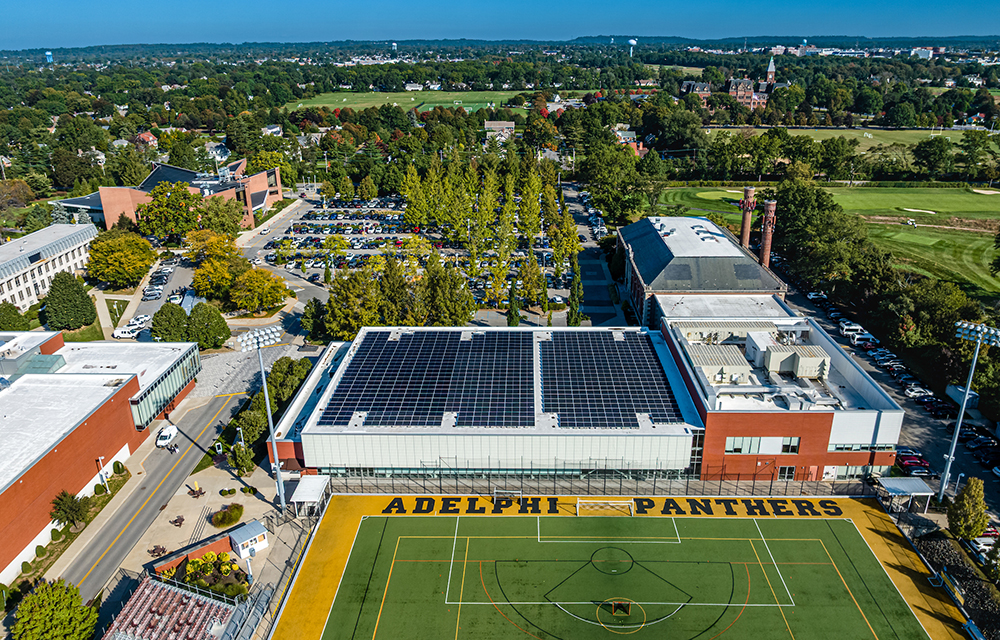
Adelphi University turns roof challenge into solar opportunity with SolarKal and Greenskies
Garden City, NY Adelphi University, Long Island’s top-ranked private university, today announced a major new solar energy initiative on its 75-acre main campus. A new 295 kW solar system on the roof of its Center for Recreation and Sports is now providing renewable solar electricity for the university over the next 20-plus years.




Quick Hits
 (2).gif)

Columns and Thought Leadership

New York City’s historic rent freeze now rests with the courts - by Ron Cohen
New York City’s first-ever two-year rent freeze is now in the hands of a state Supreme Court judge, and the decision could reset income for owners of roughly one million rent-stabilized apartments housing some 2.4 million residents.

Don’t leave severance damages behind - by Sebastian Jablonski
When the government takes a portion of a landowner’s property, most assume just compensation stops at the value of the land taken. However, in partial takings, that is only half of the equation.
NYC's Community Opportunity to Purchase Act is back - and multifamily owners should pay attention - by Ron Cohen
New York City’s Community Opportunity to Purchase Act (COPA) is back, and this latest version could have a much better chance of becoming law. The proposal would give qualified nonprofit organizations

Hunt Commercial Real Estate Q&A: Location, location, location? - by David Hunt
In working with our clients, we break down our search objectives into two categories. The first category involves the specific needs of your business such as warehouse height, amount of office space and number of loading