


 (2).gif)
News:
Spotlight Content
Posted: May 21, 2019
Hempstead LDC gives preliminary authorization for bond sale – $55 million
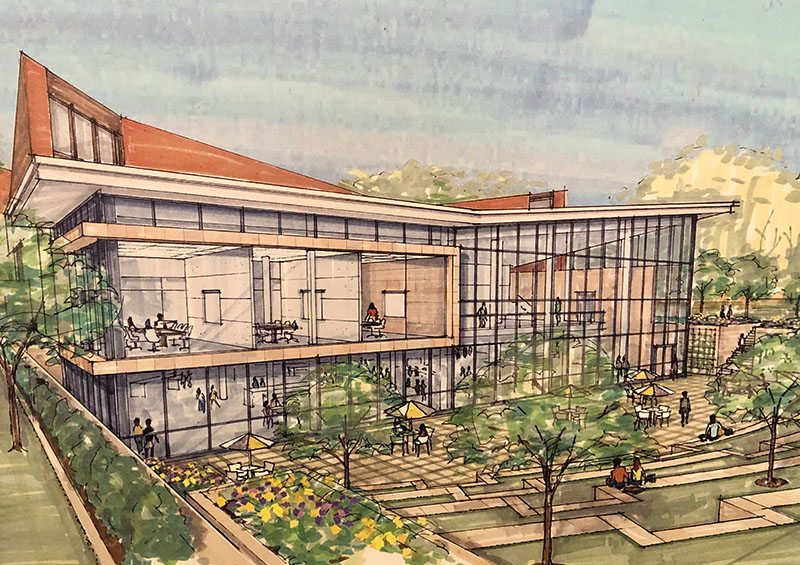
University - Garden City, NY
Garden City, NY The town of Hempstead Local Development Corp. (LDC) has given preliminary authorization for the sale of $55 million in tax-exempt bonds on behalf of Adelphi University.
The LDC gave its preliminary authorization for the bond sale at its March 28 board meeting. A public hearing and final authorization are required as is the approval of the town supervisor.
The bonds, to be underwritten by TD Securities, are to be repaid by Adelphi and are secured by a first-mortgage lien on the land and building. There is no out-of-pocket expense to the towns taxpayers.
Adelphi plans to use $34 million of the bonds to expand its 74,272 s/f University Center by 24,164 s/f. The University also plans to refinance $21million in bonds that were issued through the LDC in 2009 to build dorms and renovate other campus buildings.
The planned University Center expansion will include a student dining center, a new school store and larger meeting spaces for student organizations. Also, there also will be an added enhanced art gallery with state of the art technology. Adelphi serves 8,300 undergraduate and graduate students, most of them commuters
“There is no doubt that the sale of these new bonds, once final, will have a great impact on Adelphi University, its students, as well as on the economics of the surrounding communities,” said Fred Parola, executive director of the LDC.
The Hempstead LDC is dedicated to helping non-profit organizations prosper and grow within the town, and fulfill its mission of serving our residents. The LDC offers incentives to help not-for-profit businesses and agencies — schools, hospitals, and religious organizations — relocate, expand, and build.
Tags:
Spotlight Content
MORE FROM Spotlight Content

The commercial classroom: 1031 tax-deferred exchanges - by Edwad Smith Jr.
The sale of real estate may trigger capital gains taxes on the net profits of that sale. These taxes may be deferred by participating in a 1031 tax exchange, in essence, by purchasing property(s) to replace the



.png)

Quick Hits


Columns and Thought Leadership

2026 Developing Queens: Long Island Board of Realtors advances commercial growth and advocacy in Queens
The Long Island Board of Realtors (LIBOR) Commercial Network continues to play a key role in advancing opportunities and strengthening the commercial real estate landscape across Queens. Through targeted programming and global outreach

CRE Guide Featured Company: Merritt Environmental Consulting Corp.
Merritt Environmental Consulting Corp. (MECC) was established in June of 2009 after being part of a larger engineering firm for almost 20 years. The focus of the company is to assist lending institutions, attorneys, real estate investors, and property owners with environmental concerns. Today, MECC has offices in New York, Florida, and Vermont and has grown into a regional consulting firm serving clients along the East Coast.

From vacancy to vitality: How adaptive reuse is reshaping Long Island’s CRE landscape - by Andrea Tsoukalas Curto
Adaptive reuse has become one of the most important conversations in commercial real estate today. Long Island has a large inventory of aging retail, office and industrial

2026 Developing Long Island: ERG Commercial Real Estate launches its new Retail Leasing division
North Hempstead, NY ERG Retail Leasing is the dedicated leasing division of ERG Commercial Real Estate, an established full-service commercial real estate brokerage for over 35 years.