


News:
Owners Developers & Managers
Posted: February 14, 2023
Google’s Sidewalk Labs hosts BOMA New York - by Lori Raphael

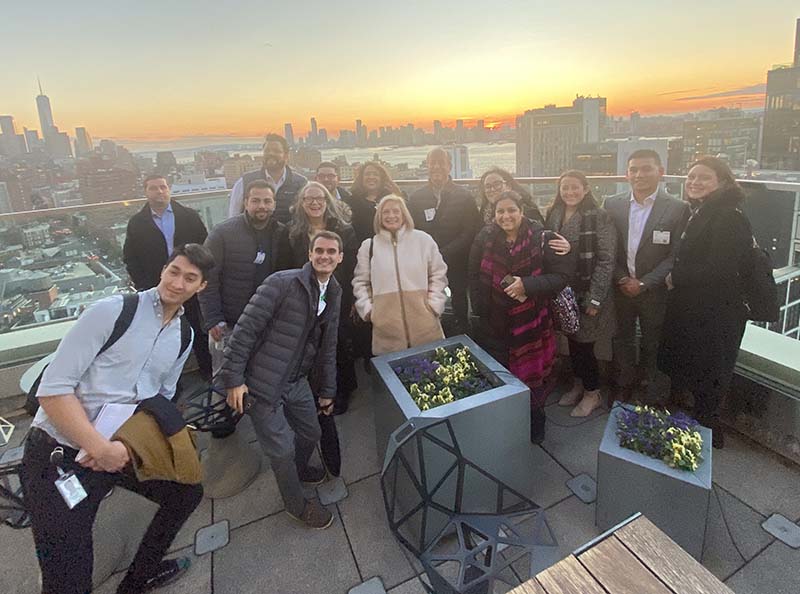
In the middle of December 2022, and only two weeks after BOMA New York announced the formation of its Proptech Committee, Google’s Sidewalk Labs and BOMA New York hosted an engaging, practical conversation on sustainability and decarbonization, followed by a facility tour of the NYC Google campus at Chelsea market.
Building owners and managers from leading commercial real estate firms were invited to this educational session titled “How New York City’s Older Commercial Buildings can Become More Sustainable and Profitable.” The event highlighted the urgent need for decarbonization among older, small and medium commercial buildings in New York City and how Sidewalk Labs, as part of Google, is helping partners and customers make progress in this realm.
Sidewalk Labs, previously an urban innovation company under Alphabet, announced it would join Google earlier last year to contribute to Google’s goal of helping 500 cities reduce one gigaton of carbon emissions annually by 2030. Mesa is one of Sidewalk Labs’ three products and helps commercial buildings reduce emissions with affordable, easy to use energy management. Delve, another Sidewalk Labs product, helps real estate teams and cities create and compare thousands of design options for a city block or neighborhood. Pebble helps cities and developers understand where parking is needed and when to reduce the number of total spaces needed.
Drew Foulkes, who started his career as a coworking manager in Philadelphia and now works at Google, underscored the urgency for carbon reduction in New York City buildings given Local Law 97 will require included buildings in the city to comply with applicable emissions limits starting 2024. He also shared that 94% of commercial buildings in the U.S. are under 50,000 s/f in area but only 13% of those buildings use smart controls to reduce carbon consumption, as was found in a white paper published by the industry-leading newsletter, Nexus Labs.
 “It is critical to equip building owners and managers with technology that is accessible and affordable to reduce carbon emissions.” said Foulkes, given his experience with both the built and the technology environment. Beyond the magnitude of climate change, Foulkes said another reason commercial building owners and managers need to retrofit buildings for the future is because “Tenants are flocking to modern office spaces now more than ever” as was also reported by JLL who found buildings completed after 2015 are commanding a 61% rent premium compared to older-vintage buildings.
Foulkes recommended building owners and managers to conduct an energy audit in order to determine how and where energy is used today, followed by a comparison with a decarbonization scenario. He also recommended owners and managers involve tenants early in the process and run pilots before locking in larger investments.
Foulkes demonstrated the use of Mesa, which automates energy and carbon reduction in commercial spaces based on occupancy, space utilization, weather and tenant feedback.
He showed how IoT (the Internet of Things) and building data can come together to optimize energy use, as well as predict when spaces will be occupied.
In closing, Foulkes reiterated, “A carbon-free future is a shared responsibility” There is no question that more innovation and engagement is required to achieve decarbonization in New York City. To that end, Foulkes concluded with, “I hope people will fast follow us.”
This BOMA New York experience was a collaboration between Google and BOMA’s Proptech and Professional Development Committees.
Lori Raphael is the executive director of BOMA New York chapter, Manhattan, NY.
MORE FROM Owners Developers & Managers

JVP Development names new sales team at 250 West 96th St.
Manhattan, NY JVP Development has appointed Team Arceon, led by Corcoran Top 25 broker Kristen Suh, as the exclusive sales and marketing team for 250 West 96th St., the 131-residence luxury condominium on the Upper West Side designed by renowned Danish designer Thomas Juul-Hansen. The official announcement comes on the heels of 250 West 96th St.




Quick Hits
 (2).gif)

Columns and Thought Leadership

Hunt Commercial Real Estate Q&A: Location, location, location? - by David Hunt
In working with our clients, we break down our search objectives into two categories. The first category involves the specific needs of your business such as warehouse height, amount of office space and number of loading

NYC's Community Opportunity to Purchase Act is back - and multifamily owners should pay attention - by Ron Cohen
New York City’s Community Opportunity to Purchase Act (COPA) is back, and this latest version could have a much better chance of becoming law. The proposal would give qualified nonprofit organizations
New York City’s historic rent freeze now rests with the courts - by Ron Cohen
New York City’s first-ever two-year rent freeze is now in the hands of a state Supreme Court judge, and the decision could reset income for owners of roughly one million rent-stabilized apartments housing some 2.4 million residents.

Don’t leave severance damages behind - by Sebastian Jablonski
When the government takes a portion of a landowner’s property, most assume just compensation stops at the value of the land taken. However, in partial takings, that is only half of the equation.