



News:
Brokerage
Posted: March 14, 2023
Good+Foundation expands offices at 307 West 36th St.
 Manhattan, NY GFP Real Estate, LLC represented the Good+Foundation, a nonprofit founded by Jessica Seinfeld in 2001 that “works to dismantle multi-generational poverty by pairing tangible goods with innovative services for low-income fathers, mothers and caregivers, creating an upward trajectory for the whole family,” in a five-year lease for 10,250 square feet at 307 W. 36th St. in Manhattan’s Garment District.
With warehouses in New York City and Los Angeles, Good+Foundation’s principal goal is to “incentivize parental enrollment and participation in programs like counseling, health services, employment assistance, financial literacy, co-parenting classes and more.” A tenant of 307 W. 36th St. since 2008, the nonprofit extended its existing 6,500 s/f lease on the 8th floor and added an additional 3,750 s/f of space on the 17th floor.
“There has been a growing demand for our work as families living on low incomes were hit hard by both the pandemic and inflation,” said Katherine Snider, CEO of Good+Foundation. “The increased space will allow us to hire additional staff, and welcome more corporate volunteer groups, to help process and sort donations of cribs, clothing, diapers, and more. We are grateful to GFP Real Estate and Barbara Yagoda for working with us to support this much-needed scale up of our work.”
Barbara Yagoda, senior managing director of GFP Real Estate, represented the landlord and the tenant in the transaction.
Built in 1926 and known initially as Garment Wear Arcade, 307 West 36th Street is an 18-story, 220,000 s/f pre-war high-rise building designed by Emery Roth. Renovated in 2012, the building features a white-marble lobby with entrances on both 36th and 37th St. The building has become home to a wide range of tenants, from notable fashion brands Penn & Fletcher and Lingua Franca to civic design firm Urbahn Architects, as well as many non-profits such as Good+Foundation and the Neighborhood Housing Services of New York City.
Tags:
Brokerage
MORE FROM Brokerage
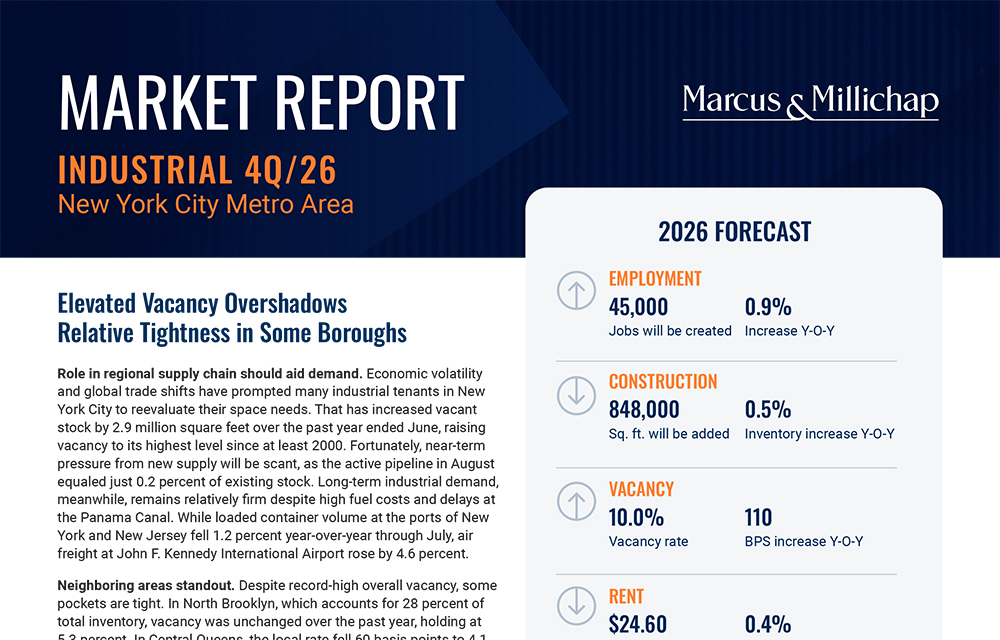
Marcus & Millichap releases fourth-quarter 2026 NYC industrial market report
Manhattan, NY Marcus & Millichap has published its fourth-quarter 2026 New York City Industrial Market Report. “New York City’s industrial market is showing a clear




Quick Hits

Columns and Thought Leadership

The art of investing in real estate - by Thomas Donovan
Real estate investing is as much an art as it is a skill. No one can time the market, or the factors that drive it, perfectly. Location, zoning, size, transportation, and neighborhood density give you a baseline for

Hunt commercial real estate question and answer: Fortune 500 wisdom - by David Hunt
Yes, there are lessons to be learned from the largest companies in America when comes to managing your real estate. But the decision to buy or lease real estate may not be one of

Hunt CRE question and answer: Choosing a real estate agent - by David Hunt
First, we will only work with one agent exclusively. The primary reason is that we want that agent to legally represent our client’s interests. In New York State, a real estate agent has a fiduciary

New York’s streets are full again, and the retail numbers prove it - by Noam Aziz
Walk down any New York block this year and you can feel it. The sidewalks are crowded, the storefronts are lit, and the energy that defines this city is back at full volume.
.gif)