


News:
Owners Developers & Managers
Posted: February 25, 2025
Forever chemical risk in by-product of wastewater treatment - by Jesse Hiney

On January 14, 2025, the U.S. Environmental Protection Agency (EPA) issued a draft risk assessment to evaluate the disposal of sewage sludge containing the forever chemicals PFOA and PFAS. Sewage sludge refers to the nutrient-rich biosolids that remain after wastewater is sent to a wastewater treatment plant.
The two most common disposal/re-use applications of sewage sludge are: (1) reuse as fertilizer; and (2) disposal in a landfill. The EPA identified elevated risks for pasture and crop farms that applied sewage sludge as fertilizer with PFOA and PFAS levels at, or exceeding, one part per billion (ppb). In addition, the EPA risk assessment recognized groundwater sourced near sewage sludge disposal sites where one ppb of PFOA or 4-5 ppb of PFAS were disposed.
The concerns identified in the EPA risk assessment could be troublesome for Long Island. The sewer sludge risk assessment follows voter-approved funding for the Suffolk County Water Quality Restoration Act (the Act). While serving to protect Long Island’s sole-source aquifer, the Act enables the infrastructure for sustainable development initiatives; with a prime focus of modernizing wastewater infrastructure and upgrading the county sewer system. For much of the county, this means new sewers and treatment facilities (and thereby proliferation of sewage sludge).
Together the Act and the EPA risk assessment highlight the importance of sewer infrastructure on Long Island for economic growth and environmental stewardship. The long-term environmental and economic benefits and success of the Act will be dependent on, among other things, the proper care and management of sewage sludge, made even more essential considering Long Island’s sole-source aquifer and prolific farm industry.
Jesse Hiney is a partner and chair of the environmental department at Forchelli Deegan Terrana LLP, Uniondale, NY.
MORE FROM Owners Developers & Managers
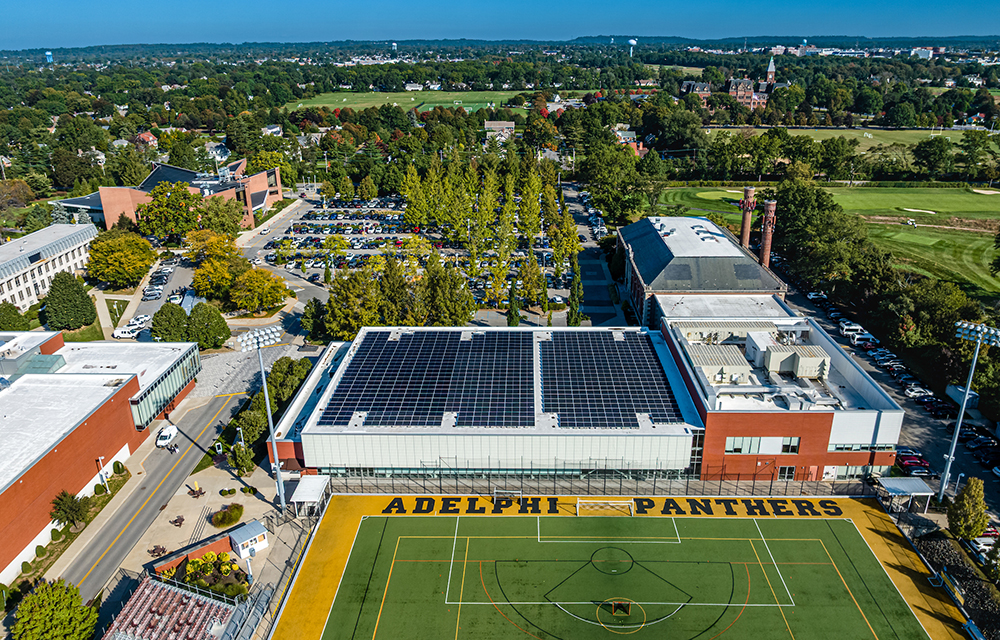
Adelphi University turns roof challenge into solar opportunity with SolarKal and Greenskies
Garden City, NY Adelphi University, Long Island’s top-ranked private university, today announced a major new solar energy initiative on its 75-acre main campus. A new 295 kW solar system on the roof of its Center for Recreation and Sports is now providing renewable solar electricity for the university over the next 20-plus years.





Quick Hits


Columns and Thought Leadership

Don’t leave severance damages behind - by Sebastian Jablonski
When the government takes a portion of a landowner’s property, most assume just compensation stops at the value of the land taken. However, in partial takings, that is only half of the equation.

Hunt Commercial Real Estate Q&A: Location, location, location? - by David Hunt
In working with our clients, we break down our search objectives into two categories. The first category involves the specific needs of your business such as warehouse height, amount of office space and number of loading

NYC's Community Opportunity to Purchase Act is back - and multifamily owners should pay attention - by Ron Cohen
New York City’s Community Opportunity to Purchase Act (COPA) is back, and this latest version could have a much better chance of becoming law. The proposal would give qualified nonprofit organizations
New York City’s historic rent freeze now rests with the courts - by Ron Cohen
New York City’s first-ever two-year rent freeze is now in the hands of a state Supreme Court judge, and the decision could reset income for owners of roughly one million rent-stabilized apartments housing some 2.4 million residents.