


 (2).gif)
News:
Spotlight Content
Posted: November 24, 2026
Fixed and flexible: Frank Gehry’s Peter B. Lewis Library at Princeton University - by William Gati

On a visit today, after an inspiring week at the AIA TriState Conference on Architecture at Princeton, NJ and after an impressive keynote lecture by Joshua Ramus, FAIA: I visited the Peter B. Lewis Library, at the corner of Washington Rd. and Ivy Lane, as a piece of programming as much as a piece of sculpture. Every good building starts with a needs assessment, and here is how Gehry’s 2008 library answers its users.
Students need daylight, quiet, and places to work together. The north-facing reading rooms in the tower get soft, even light. Nine group study rooms and five seminar rooms support teamwork. The glass “tree house” on the second floor, with a ceiling almost 34 ft. high, looks out into the treetops.
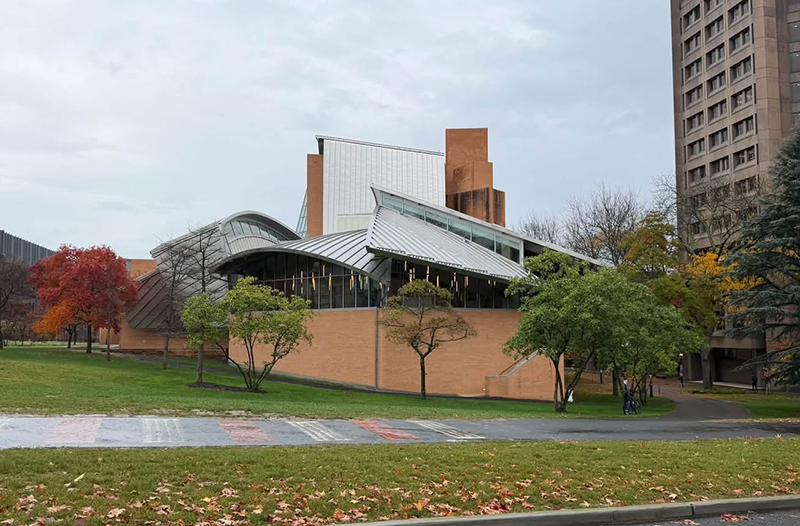 Librarians needed to bring scattered collections together. Astrophysics, biology, chemistry, geosciences, math, physics, statistics and maps all moved under one roof. The staff also tested furniture mockups and revised them on site before the building opened.
The university wanted a science hub. The library holds six classrooms, a geospatial center, media and broadcast studios, and computing support. Underground links connect it to Fine Hall, Jadwin, McDonnell and the chemistry building. It anchors the Ivy Lane science neighborhood in the campus plan.
The community got a landmark. The stainless-steel curves now draw visitors and public tours to a campus known for Collegiate Gothic.
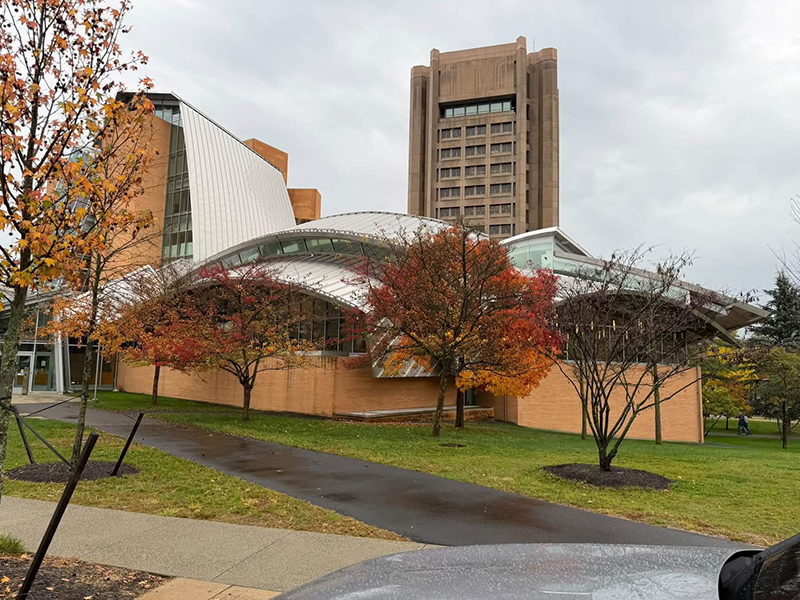 Architectural history: Princeton’s campus plan had long been built in stone, and this was a deliberate break. It was the first building in Princeton’s history modeled in CATIA, the aerospace software behind Bilbao. MIT had sued over leaks at Gehry’s Stata Center, so Princeton tested the Lewis Library with fire hoses. Gehry also tied it to its neighbors, matching Fine Tower’s scale and stepping the masses down along Ivy Lane.
Fixed spaces are the permanent framework: the steel-clad structure, the brick and stucco towers, the stacks and high-density shelving, the server room and broadcast studio, the classrooms, and the canary-yellow welcome desk. These are long-term commitments, sized for functions that won’t change soon.
Flexible spaces are where life adapts: movable chairs, angled tables, open reading areas, computer clusters, and an atrium that can hold anniversary celebrations and tours. Fixed spaces protect the mission. Flexible spaces let the building grow with how people actually learn.
That balance is the lesson for every project, from a Princeton library to a Queens brownstone: decide what must last and what must adapt.
What’s your favorite building that gets this balance right?
#Architecture #FrankGehry #Princeton #LewisLibrary #LibraryDesign #AdaptiveDesign #ArchitectureStudio #AIA
William Gati is principal of Architecture Studios, Kew Gardens, N.Y.
MORE FROM Spotlight Content

Hunt CRE question and answer: Rights of first refusal - by David Hunt
A right of first refusal is a contractual right, giving you the option to purchase the building before it can be sold to a third party. An option is the right to exercise something, but not the obligation




.png)
 (2).gif)

Columns and Thought Leadership

2026 Developing Long Island: ERG Commercial Real Estate launches its new Retail Leasing division
North Hempstead, NY ERG Retail Leasing is the dedicated leasing division of ERG Commercial Real Estate, an established full-service commercial real estate brokerage for over 35 years.

From vacancy to vitality: How adaptive reuse is reshaping Long Island’s CRE landscape - by Andrea Tsoukalas Curto
Adaptive reuse has become one of the most important conversations in commercial real estate today. Long Island has a large inventory of aging retail, office and industrial

CRE Guide Featured Company: Merritt Environmental Consulting Corp.
Merritt Environmental Consulting Corp. (MECC) was established in June of 2009 after being part of a larger engineering firm for almost 20 years. The focus of the company is to assist lending institutions, attorneys, real estate investors, and property owners with environmental concerns. Today, MECC has offices in New York, Florida, and Vermont and has grown into a regional consulting firm serving clients along the East Coast.

2026 Developing Queens: Long Island Board of Realtors advances commercial growth and advocacy in Queens
The Long Island Board of Realtors (LIBOR) Commercial Network continues to play a key role in advancing opportunities and strengthening the commercial real estate landscape across Queens. Through targeted programming and global outreach
