



News:
Brokerage
Posted: February 7, 2017
Exit strategies for multifamily investment property owners by Gullo
 Russell Gullo, R. J. Gullo & Co., Inc.
So, you like the four benefits that a multifamily investment property can provide (cash flow, equity build-up, appreciation and tax shelter). And with the use of leverage (other peoples’ money) you know that you can control more real estate then if you paid cash for a property.
You have learned that because of these benefits the equity (capital) used to acquire your multifamily investment property may have doubled, tripled or even quadrupled over time. This is possible because of the principal pay down of your mortgage and the increase in value through appreciation over your holding period.
You also have experienced the “Three T’s Of Ownership,” tenants, toilets and trash and may be at the point in your life that you are no longer interested in being an “active” investor handling the day-to-day property management.
The problem is you like the financial benefits of a real estate investment, but you don’t want to be involved in the property management aspect of ownership. Because you have such a great gain (profit) in your investment you can’t afford to sell, because of the tax liability. The solution to this common problem can be solved with the use of the “best kept secret in real estate” known as a 1031 Exchange and “passive real estate investing.”
A 1031 Exchange is the opportunity to pay no tax when disposing of income-producing, investment held property or a secondary residence. This concept is nothing new it has been available since the early 1900’s when the first exchange laws were enacted. With this tool, it can provide half the formula as an “exiting strategy” and that is to keep 100% of your equity working for you rather then paying in many cases as much as a third of your selling price in taxes to Uncle Sam.
The second part of the formula requires you to purchase other income-producing, investment held property or a secondary residence to complete a 1031 Exchange. This does not have to be an “active” form of an investment. You have the ability to acquire what’s called a “NNN Leased Investment Property” meaning you purchase a building that is leased long term to a tenant like Walgreens, Dollar General, Mac Donald’s, Family Dollar, or Auto Zone, just to mention a few. The tenant pays the utilities, property taxes, insurance and maintenance. You own the real estate and receive a monthly check for your rent without any property management.
Another “passive” real estate investment would be a “co-ownership investment” As an example you would be a co-owner in a large multifamily investment property that would be acquired and managed by what’s called a “sponsor” and you would receive all the benefits of a real estate investment without being involved in the management. Today, these co-ownership vehicles are called “DSTs” meaning Delaware Statutory Trusts.
So, if you like real estate as an investment but don’t want to be an “active” investor any longer you have either “NNN leased investment property” or “co-ownership in a DST” available to you today to complete a 1031 Exchange. This will allow you to keep 100% of your equity.
One of the other benefits of exiting strategies is, when you bid this world good-bye, your heirs receive a “stepped-up basis” meaning that the income taxes that were deferred through the “1031 Exchange” are forgiven. Doesn’t get any better then that.
Russell Gullo, CCIM, CMIA, CEA, is a certified multifamily investment advisor, a certified exchange advisor and CEO of R. J. Gullo Cos., Buffalo, N.Y.
Tags:
Brokerage
MORE FROM Brokerage
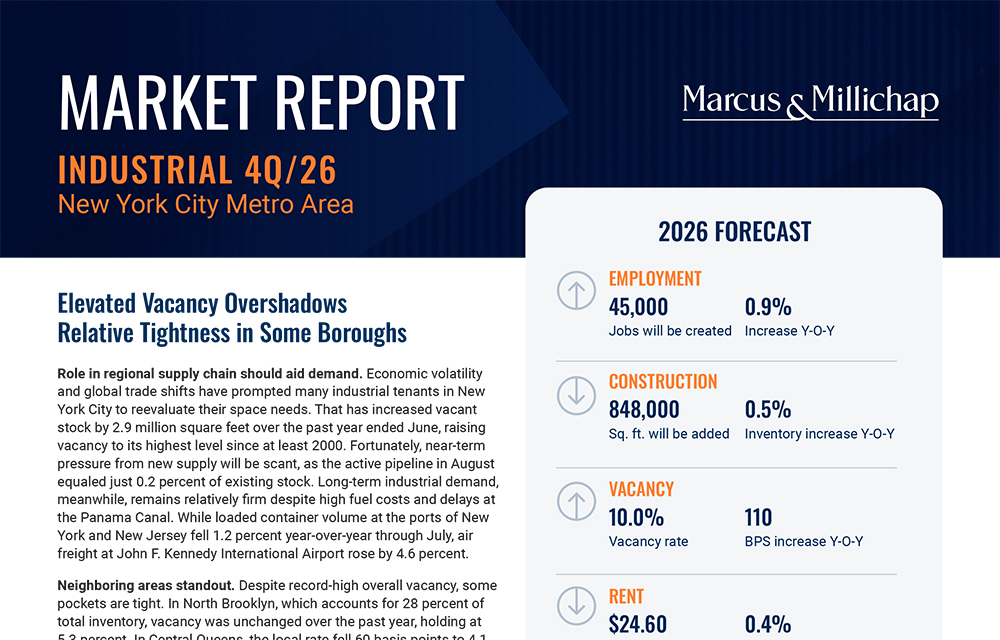
Marcus & Millichap releases fourth-quarter 2026 NYC industrial market report
Manhattan, NY Marcus & Millichap has published its fourth-quarter 2026 New York City Industrial Market Report. “New York City’s industrial market is showing a clear





Quick Hits
 (2).gif)

Columns and Thought Leadership

Hunt CRE question and answer: Choosing a real estate agent - by David Hunt
First, we will only work with one agent exclusively. The primary reason is that we want that agent to legally represent our client’s interests. In New York State, a real estate agent has a fiduciary

Hunt commercial real estate question and answer: Fortune 500 wisdom - by David Hunt
Yes, there are lessons to be learned from the largest companies in America when comes to managing your real estate. But the decision to buy or lease real estate may not be one of

The art of investing in real estate - by Thomas Donovan
Real estate investing is as much an art as it is a skill. No one can time the market, or the factors that drive it, perfectly. Location, zoning, size, transportation, and neighborhood density give you a baseline for

New York’s streets are full again, and the retail numbers prove it - by Noam Aziz
Walk down any New York block this year and you can feel it. The sidewalks are crowded, the storefronts are lit, and the energy that defines this city is back at full volume.
.gif)