



News:
Brokerage
Posted: April 5, 2016
Ellicott Development renovates 56,000 s/f 960 Busti Ave. in Buffalo
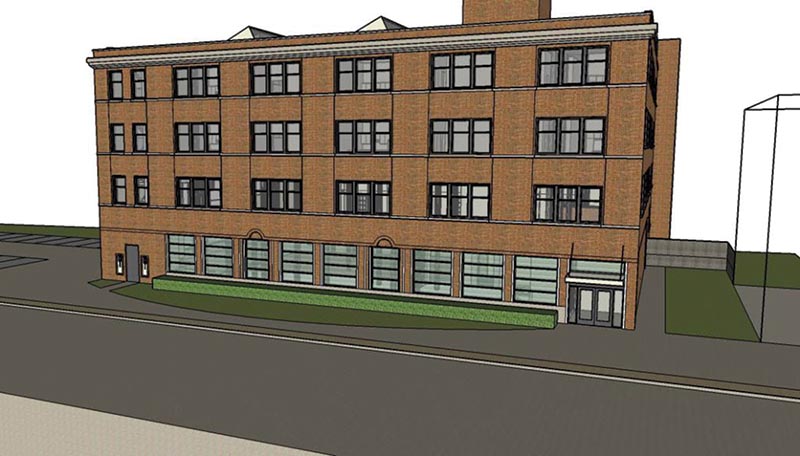 Rendering of 960 Busti Avenue - Buffalo, NY
Buffalo, NY 960 Busti Ave. is located near the Peace Bridge in an area going through long awaited and anticipated changes. This property is a portion of the positive development occurring in the Niagara St. corridor. A variety of private sector interest and investment is going into the area, including the work on 960 Busti by Ellicott Development, a full service real estate management and development company with over 40 years of experience.
In 1922 when 960 Busti was originally constructed, the property was a service building for the Buffalo General Electric Co. until around 1968. After, Multiform Desiccants occupied the building until 1995. Following their vacancy the building remained untouched for 20 years. Ellicott Development purchased the 56,000 s/f building at the intersection of Busti Ave. and Niagara St.
Upon completion, the building will be mixed use divided by residential, commercial, and retail space. The first two floors will include 27,500 s/f of commercial and retail space, while floors three and four will include 23,000 s/f of residential space. The residential space will consist of 18 market-rate apartment units in one, two, and three bedroom configurations.
Ellicott Development is working with the State Historic Preservation Office to complete renovations. The building will be restored and cleaned in a way that enhances the nature of the circa 1930 building. This involves cleaning and restoring the exterior masonry where needed, replacing in-kind the existing windows, cutting in new window openings, restoring the original wood windows, and reopening previously in-filled window openings. The former first floor loading bays will be in-filled with a storefront glass system. In addition, a new handicap ramp and industrial style canopy will be added on to accompany the building’s new main entrance, located within one of the former loading bays.
The adaptive reuse of previously vacant building adds to the recent momentum seen in this section of the city by bringing a mix of new residential and commercial tenants to the neighborhood.
Tags:
Brokerage
MORE FROM Brokerage

Ones To Watch: Innovators In Commercial Real Estate: Lisa Nickerson, Infinityy
What I’m most proud of is the human impact of what we’re building. Technology should do more than improve efficiency — it should make



Columns and Thought Leadership

New York’s streets are full again, and the retail numbers prove it - by Noam Aziz
Walk down any New York block this year and you can feel it. The sidewalks are crowded, the storefronts are lit, and the energy that defines this city is back at full volume.

The art of investing in real estate - by Thomas Donovan
Real estate investing is as much an art as it is a skill. No one can time the market, or the factors that drive it, perfectly. Location, zoning, size, transportation, and neighborhood density give you a baseline for

Hunt CRE question and answer: Choosing a real estate agent - by David Hunt
First, we will only work with one agent exclusively. The primary reason is that we want that agent to legally represent our client’s interests. In New York State, a real estate agent has a fiduciary

Hunt commercial real estate question and answer: Fortune 500 wisdom - by David Hunt
Yes, there are lessons to be learned from the largest companies in America when comes to managing your real estate. But the decision to buy or lease real estate may not be one of
.gif)