



News:
Brokerage
Posted: March 3, 2020
Electric vehicle charging in commercial and residential developments in New York State - by Victoria McGarril

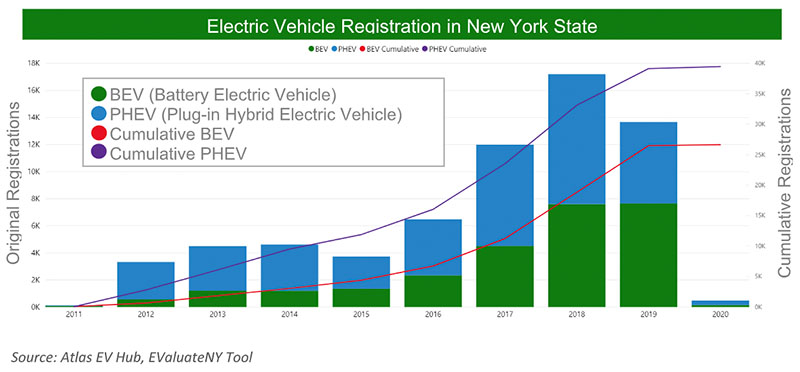
In the last decade electric vehicle (EV) registration in New York State has been increasing, causing a demand for EV charging stations in commercial and residential developments. Equipping developers and property managers with information on this emerging technology, incentives available, and best practices for installation can support the successful implementation of EV charging technology.
EVs offer many benefits: they have better fuel efficiency, no tailpipe emissions, and are less expensive to operate. These benefits positively impact the communities where EVs are driven. The presence of public charging infrastructure further encourages EV purchases and support current EV drivers. Including EV charging in developments can attract EV drivers to local businesses and retail centers and can encourage local spending. EV charging stations can also help attract and retain tenants in both commercial and residential developments, allowing drivers to charge at work, home, or while patronizing local businesses. Investing in EV charging will attract EV drivers and prepare communities for this emerging transportation technology.
 EV charging stations are most heavily used in workplaces, higher education, medical campuses, retail settings, and municipal lots that provide access to various businesses. According to the Atlas EV Hub there are currently over 4,000 charging ports spread across over 2,000 locations in New York State, most located in suburban and metro areas. Depending on the type of development and typical driver behavior, some level of charging is more suitable than others. EV charging stations are classified by the form of electricity (alternating current [AC] or direct current [DC]) and power delivered to the vehicle battery. These determine the approximate time to charge. The most common level of charge is AC Level 2, which uses 240 volt power and provides 10-20 electric miles per hour of charging). The lower level, AC Level 1 chargers uses 120 volt power and provides 2-5 electric miles per hour of charging. DC fast chargers which typically need a 480 volt power supply provide the fastest charge, supplying over 50 electric miles of range in only 20 minutes of charging.
Now is a great time in New York for developments to consider EV charging in their current and future projects. There are several incentives available for the installation of EV charging stations, as well as purchasing electric vehicles. Through the Charge Ready NY Rebate, the New York State Energy Research and Development Authority (NYSERDA) is currently offering up to $8,000 per station installed. There are also tax incentives available to commercial installations and other rebates for municipalities that install EV charging stations. Along with the financial incentives to install EV stations, several sustainability rating systems recognize EV charging stations in their score or rating system.
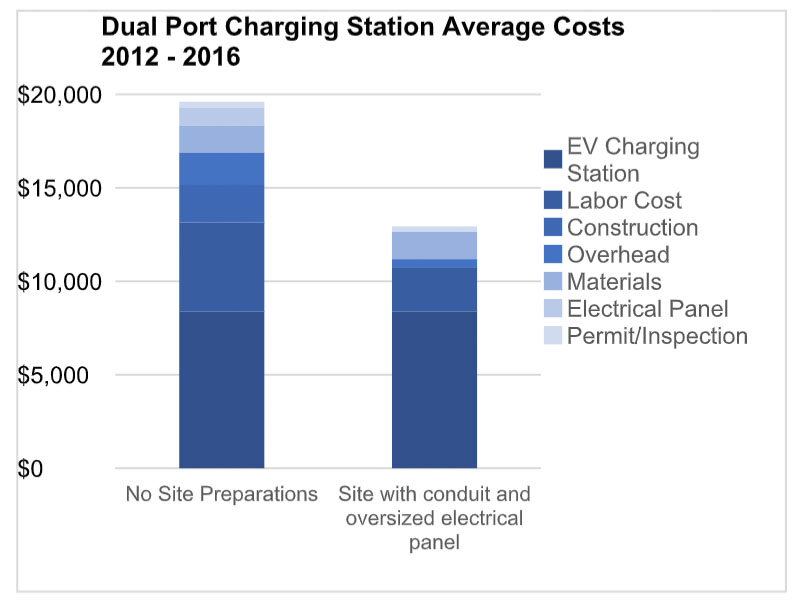
Along with financial incentives for EV charging stations, costs of installation can be significantly reduced by planning for EV charging in the early stages of development. Using data from NYSERDA supported EV charging stations between 2012 and 2016, it was found that costs can be reduced by over 30% at sites that prepare for EV charging. While costs of station hardware are decreasing, preparing sites for EV charging further reduces costs and can future-proof developments.
To learn more about EVs and EV charging, join Energetics on Thursday, March 19th, at 11:30am for a webinar presentation. The presentation will review the basics of EVs and EV charging technology, incentives available, and best practices for installation.
To register for this webinar, please contact me at [email protected] or by following this link: https://global.gotomeeting.com/join/960906317
Victoria McGarril is a consultant at Energetics, a Division of Akimeka, LLC, Clinton, N.Y.
Tags:
Brokerage
MORE FROM Brokerage

Adirondack Capital Partners arranges $45 million sale of West Chelsea development site to Toll Brothers
Manhattan, NY Adirondack Capital Partners (ACP) closed the $45 million sale of 126/128 Tenth Ave. and 456 W. 18th St. to Toll Brothers City Living. The acquisition forms part of a broader






 (2).gif)

Columns and Thought Leadership

A guide to finding the right NYC property management company - by Sanjay Gandhi
Being a small to midsize landlord in NYC is an increasingly demanding endeavor. From navigating complex regulations, increased compliance demands to dealing with tenant issues and remediating violations. It is wise to enlist the assistance of a partner, a professional

Positive forecast for New York’s pro-housing push? - by Philip Butler
New York’s housing crisis remains a hot button topic despite growing consensus that varied and affordable housing is desperately needed statewide. Governor Hochul has recently introduced several initiatives to overcome N.Y.’s anti-housing

New York’s streets are full again, and the retail numbers prove it - by Noam Aziz
Walk down any New York block this year and you can feel it. The sidewalks are crowded, the storefronts are lit, and the energy that defines this city is back at full volume.

Hunt commercial real estate question and answer: Fortune 500 wisdom - by David Hunt
Yes, there are lessons to be learned from the largest companies in America when comes to managing your real estate. But the decision to buy or lease real estate may not be one of
.gif)